- Stay Connected

Socialize

 Abraham Lincoln
If given the truth, the people can be depended upon to meet any national crisis...
Abraham Lincoln
If given the truth, the people can be depended upon to meet any national crisis...

 Guildford news...
for Guildford people, brought to you by Guildford reporters - Guildford's own news service
Guildford news...
for Guildford people, brought to you by Guildford reporters - Guildford's own news service
Honorary Freeman and Aldermen Remain Part Of The Judicial Service Procession
Published on: 13 Oct, 2012
Updated on: 16 Oct, 2012
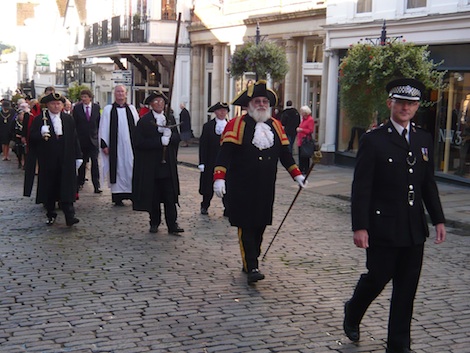
The Procession led by a senior police officer, the Town Crier, and Sword Bearer and Mayor’s Chaplain starts to make its may from the Guildhall to Holy Trinity Church
Judges followed councillors in procession along the High Street yesterday (October 12) making their way to Holy Trinity Church for the Judicial Service. Tradition has it that there is a definite gap between the two groups. It is said that the judges did not wish to associate too closely with the hoi polloi in the council.
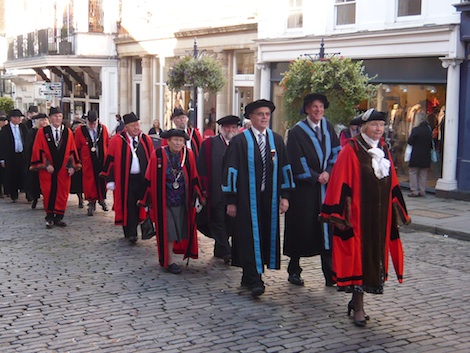
The Deputy Mayor, Cllr Pauline Searle, leads the colourful contingent of two Honorary Freeman, the Honorary Remembrancer and six Honorary Aldermen. Next come the Councillors
Fortunately, the sun shone and shoppers paused to admire the colourful event. Despite the recent misunderstanding leading some to conclude that Honorary Freemen and Honorary Alderman would no longer be invited to these events, two Freemen and six Aldermen were present.
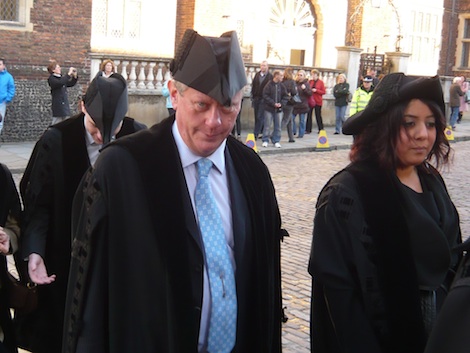
Just hours after his formal election as Council Leader, Cllr Stephen Mansbridge accompanies Cllr Monika Juneja, newly promoted to the Executive towards Holy Trinity steps
Four facts about the Judicial Service
- The Service for the Judiciary is a service held annually in early October to celebrate the start of the new legal term and offer support to those responsible for keeping the law of the land.
- It is organised in collaboration with the High Sheriff of Surrey and Surrey County Council
- During the Service the High Sheriff reads an Affirmation of the Shrieval Promise and the Chief Constable of Surrey reads a Declaration of Commitment to Public Service
- Crown Court, District and Circuit Judges and Magistrates join our Borough Councillors, Honorary Freemen and Honorary Aldermen and take part in a procession to Holy Trinity Church
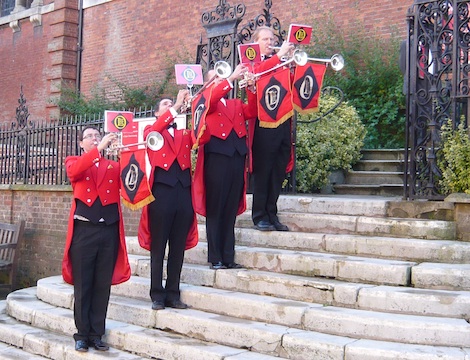
In the deliberate gap between the party of councillors and the judiciary fanfares are played by trumpeters, a tradition thought to go back hundreds of years
Matthew Alexander, Guildford’s Honorary Remembrancer, who took part in the procession, has kindly provided this short account of the ceremonies’ history:
The annual Judiciary Service has its origins in the service held to mark the opening of the Assizes, the medieval criminal courts in which serious offences were tried by the Crown’s itinerant judges. These judges travelled around ‘circuits’ of counties.
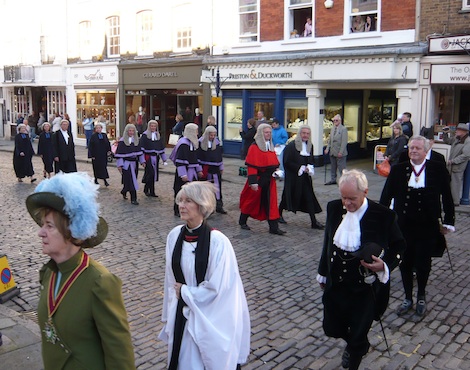
The High Sheriff of Surrey, Karin Sehmer, in her plumed hat, leads the judicial section of the procession
The central courts were based in London, and the counties around London formed the ‘home’ circuit. Surrey thus became one of the ‘home counties’. Guildford was one the towns in Surrey where the Assizes were held. In Georgian times the High Sheriff often entertained the judges at the home of the Town Clerk of Guildford, now known as Guildford House.
The grand first-floor room overlooking the High Street became known as ‘the Sheriff’s Parlour’. At that time, there were relatively few cases to bring to the Assizes and consequently the sessions lasted only a week or two. This meant that Guildford was reluctant to build a dedicated court room for them.
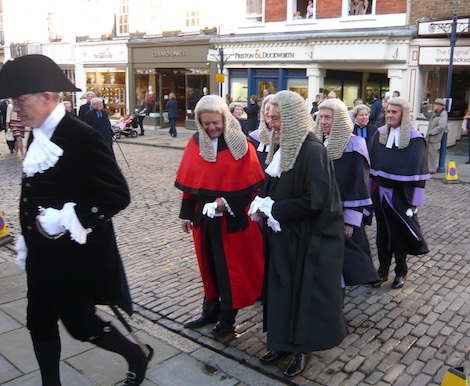
‘ Mind your step m’lord’, two judges share a joke on their way into the church service
The Guildhall was used, then a series of other multi-use halls, none of which were really suitable. Finally, the judges’ patience ran out. In 1930 the Assizes were removed from Guildford and transferred to Kingston, which had a purpose-built court.
At the end of the 18th century, the Sheriff’s court dress, with velvet knee-breeches and a smallsword, became fixed. When the first female Sheriffs were appointed, they were not expected to wear the male court dress or sword, but could have a sword carried before them by a sword-bearer.
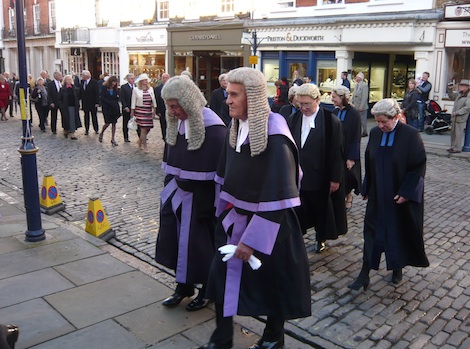
The end of the procession
The Courts Act of 1971 abolished the Assizes and replaced them with Crown Courts, and the opening of Guildford’s Crown Court restored the town’s status as a major centre of justice in the county. In 2005 the introduction of Her Majesty’s Courts Service saw the magistrates being amalgamated with the judges for the first time.
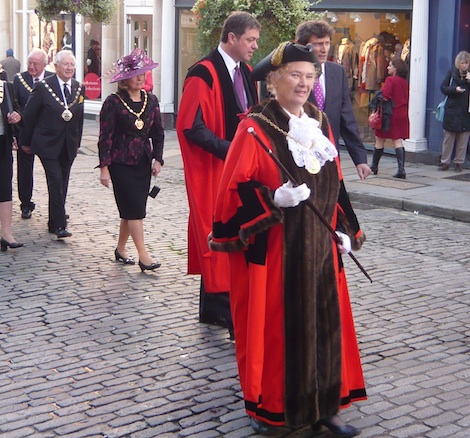
The Town Mayor, Cllr Jenny Jordan, just behind, in a red robe, GBC Chief Executive, David Hill and behind him a group of invited mayors from neighbouring boroughs
What do you think? Is it important to retain these traditions or is the money spent on them wasteful in these modern times? Please use the ‘Leave a Reply’ box below to have your say.
Share This Post


Responses to Honorary Freeman and Aldermen Remain Part Of The Judicial Service Procession


I'm living well for nothing at all! (See: No Trifling Matter: Magpie Trapped in Godalming Sainsbury’s)




Next stop, Debt Chasm! (See: We Should All Be Outraged About the Failure to Deal with Legacy Debt)





Mary Alexander
October 16, 2012 at 11:42 am
Yes, it is important to keep these traditions. The robes and swords may look old-fashioned but they remind us that these people are doing a special job on behalf of us all. It is good to see them in person, reminding us of the link between church and state, and between borough and county government, the judges and the magistrates. The sermon this year was based on the Good Samaritan and the theme of helping others, and of accepting help ourselves. It was pointed out that the injured man might have felt awkward about being helped by an outsider, the Samaritan, reminding us to be gracious about accepting help. The story of the Good Samaritan resonates with everyone, including non-believers, and it’s good to be reminded of how much our society owes to Christian beliefs about justice and the importance of individuals. Children from Holy Trinity School watched the service, and led the prayers. This will impress the service on their minds in a way that no video or television programme could. It is so important to see and take part in something symbolic.