- Stay Connected

Socialize


 Abraham Lincoln
If given the truth, the people can be depended upon to meet any national crisis...
Abraham Lincoln
If given the truth, the people can be depended upon to meet any national crisis...

 Guildford news...
for Guildford people, brought to you by Guildford reporters - Guildford's own news service
Guildford news...
for Guildford people, brought to you by Guildford reporters - Guildford's own news service
Brookwood Station Shortlisted for Railways and Communities Award – Some History Too
Published on: 13 Oct, 2026
Updated on: 13 Oct, 2026
Brookwood railway station, with its delightful garden for reflection, has been shortlisted for the title of World Cup of Stations 2026.
The competition is being run by the Rail Delivery Group, and this year it is celebrating stations creating connections that matter.
With the public deciding the winner from the 20 stations nominated, voting is online from Monday to Sunday, October 12 to 18.
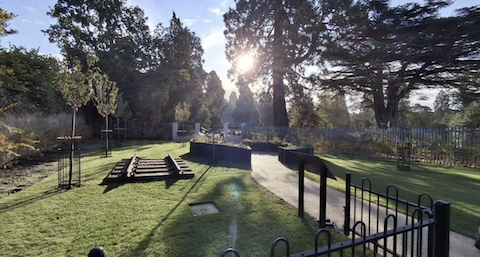
The garden of reflection at Brookwood railway station that is adjacent to Brookwood Cemetery.
Brookwood has been shortlisted because a piece of unused railway land at the station has been transformed into a garden “where railway families and the wider community can remember loved ones, discover shared heritage and connect with nature”.
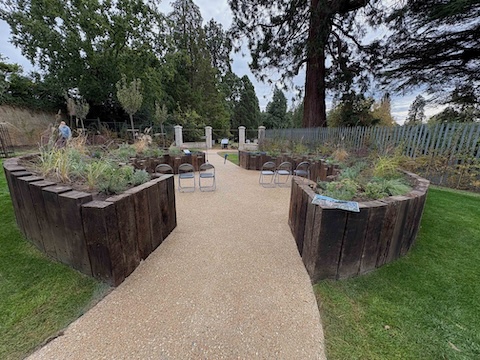
The garden photographed on its official opening day in 2025. Picture by Geoff Burch.
Created with the help of more than 30 volunteers, the Rail Delivery Group says the garden turns the station’s link to the adjacent Brookwood Cemetery into a “lasting place of reflection, belonging and community care”.
The co-chief officer of the Rail Delivery Group, Dan Mann, said: “This competition is an opportunity to celebrate the wider impact of our railways and the stories behind this year’s shortlisted stations show how rail helps people and communities thrive.
“Whether opening up opportunities, supporting local projects or bringing people together, railway stations like Brookwood, are making a real difference.
“As we move towards a simpler, more joined-up railway through Great British Railways, these stations highlight the important role our railway plays in connecting people, places and communities.”
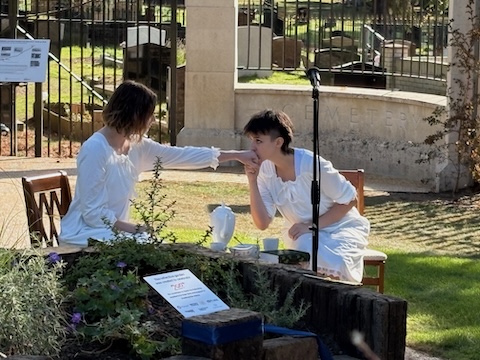
A scene from the official opening of the garden. Picture by Geoff Burch,
The community rail manager at South Western Railway, Paula Aldridge, said: “Our Brookwood reflective garden is a beautiful and peaceful space.
“Seeing people come together and install plaques for those who are no longer with us has been incredibly moving.
“The garden is open to all and renews the connection between the railway and Brookwood Cemetery, once linked by the London Necropolis Railway.
“That link made Brookwood the perfect place for volunteers to transform disused railway land, using railway sleepers and sections of track, to create a special legacy for years to come.”
Voting on line is open now, but closes at the end of this week, Sunday, October 18.
To vote, go to this link on the Rail Delivery Group’s website.
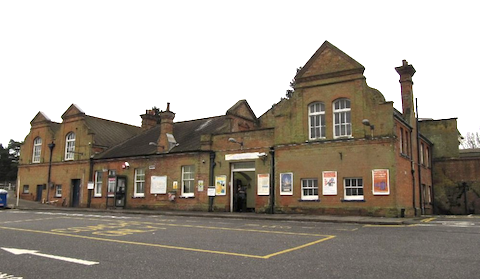
Brookwood railway station. Photo by Bill Nicholls, courtesy of Wikimedia Commons.
As we do at The Dragon…. here’s some history, this time about the railway at Brookwood…
By David Rose
The London & Southampton Railway (later the London & South Western Railway) built a line from its station at Nine Elms in London to Southampton. It reached the then named Woking Common in 1838 and Southampton in 1840.
However, the station at Brookwood was not opened until 1864.
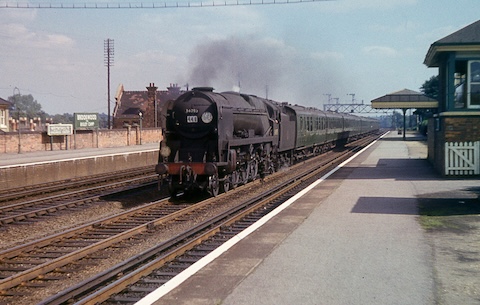
Rebuilt Bulleid pacific West Country Class locomotive, 34095, Brentor, speeds through Brookwood station on a down Bournemouth-express on September 9, 1961. Of the two green and white signs on the left, one gives the station name as BROOKWOOD FOR BISLEY CAMP, and the other refers to the Necropolis Railway. Picture: Geoff Burch collection.
From 1854 until 1941, the London Necropolis Railway Company – ran an almost daily service from London Waterloo Station to Brookwood Cemetery, carrying anything up to 2,000 bodies a year.
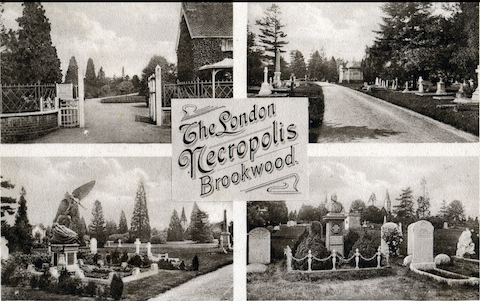
Wish you were here? A early 20th century picture postcard of Brookwood Cemetery.
In the 19th century and due to a rise in population (and then the dead) London’s cemeteries were filling up.
Following an Act of Parliament, the London Necropolis Railway bought 2,268 acres of land from Lord Onslow for £33,944 (just about all of today’s Woking) and 400 acres was set aside for the cemetery.
A branch line from the main line at Brookwood ran about three quarters of a mile through the cemetery. There were two sections of the cemetery divided by the road known as Cemetery Pales.
The southern section being for Anglican burials, the northern section for non-conformist burials. There were two stations, one in each section.
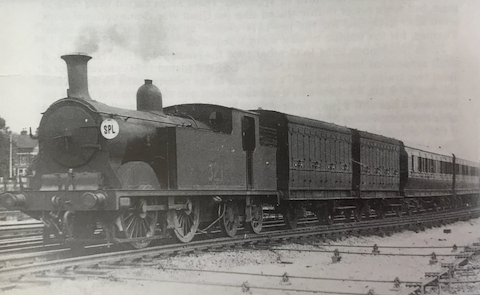
The London Necropolis Company’s funeral train on its way from London to Brookwood.
In the photo above, the dead are in the two wagons behind the locomotive and the mourners in the carriages behind. Steam locomotives for the trains, this one an M7 tank engine, were supplied by the London & South Western Railway and later the Southern Railway.
This class of locomotive was designed by Dugald Drummond – and he’s buried at Brookwood Cemetery.
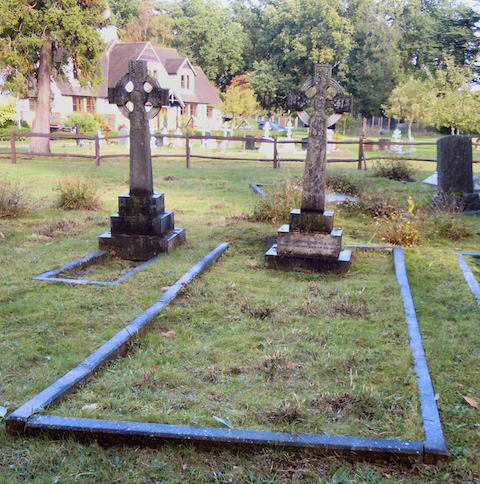
The grave of locomotive designed Dugald Drummond (1840-1912) in Brookwood Cemetery.
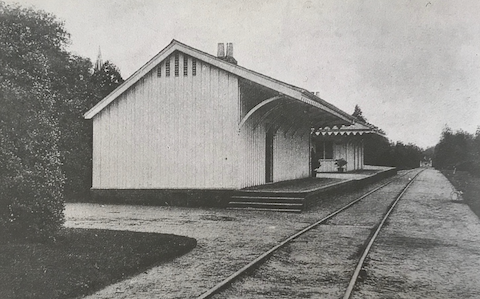
The station in the south section of Brookwood Cemetery.
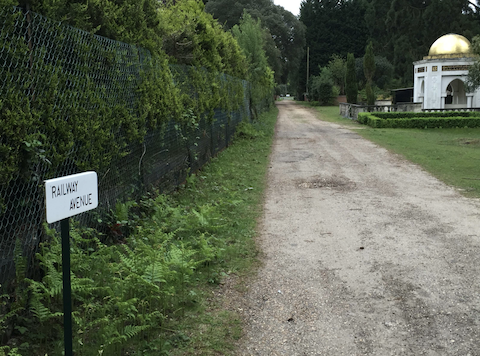
The same location today and path in Brookwood Cemetery is on the alignment of the former trackbed. The platform of the south station is just visible within the hedge.
Inside the stations were mourners’ waiting rooms, lavatories, chaplains’ rooms and refreshment rooms with a bar, plus living accommodation for each station’s caretaker.
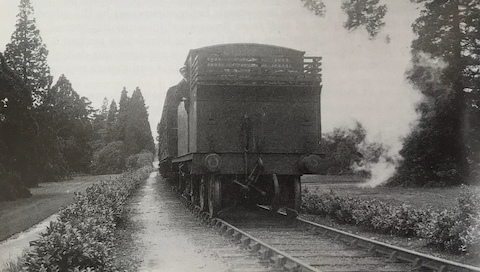
A train makes its way through Brookwood Cemetery.
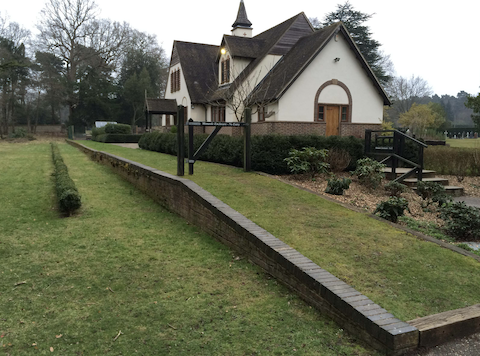
The north station today is home to the Saint Edward Brotherhood. It is a Greek Orthodox monastery. The brothers are members of the Church of the Genuine Orthodox Christians.
During the Second World War, a German bombing raid on London on the night of the April 16 and 17, 1941 destroyed the London Necropolis Railway Company’s rolling stock, along with much of its building.
And that was the death nail of the railway for the dead and their mourners.
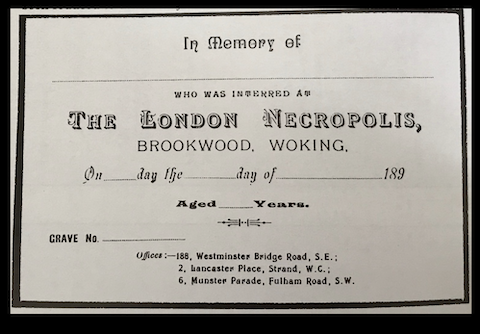
An unused “in memory” card issued by the London & Necropolis Railway Company.
Dragon editor Martin Giles comments…
I have a particular connection with Brookwood railweay station and am very pleased to hear it is being well maintained and up for an award.
In 1955 I was born, at home, in Green Shutters, Connaught Road, Brookwood. The garden backed on to the railway line and my mother told me later that, as a baby, I would get excited with the sight and sounds of any goods shunting activity. In those days this happened on sidings of even minor stations, throughout the country.
My father when he returned from the Second World War, worked at the station as a booking clerk. He was following a family tradition. His father was a porter at the station and his grandfather a “ganger” in charge of a group of men carrying out track maintenance.
I believe, from some research, that the first Giles to work on the railway did so in the first half of the 19th century when the lines were still being constructed. He hailed from East Horsley but moved to Worplesdon.
My grandfather Giles died before I was born, in 1938, only three years before the demise of the Necropolis railway. His work colleagues clubbed together to buy a granite gravestone.
As young children, my sister and I would normally stay a few days of the summer holidays with my widowed grandmother in Brookwood and we would often accompany her on her frequent visits to tend grandfather’s grave, in Brookwood Cemetery, only a couple of hundred yards from the station. She used to say that she was pleased that grandad would still be able to hear the trains.
In those 1960s days the old Necropolis stations in the cemetery were still standing, deserted and looking rather forlorn.
Share This Post












Recent Comments