- Stay Connected

Socialize


 Abraham Lincoln
If given the truth, the people can be depended upon to meet any national crisis...

 Guildford news...
for Guildford people, brought to you by Guildford reporters - Guildford's own news service
Insight: Impending Changes to the Planning Application Process Are Draconian
Published on: 28 Oct, 2026
Updated on: 30 Oct, 2026
 By Bernard Quoroll
former local authority CEO
Cllr Jane Austin’s powerful commentary (see: Changes to Planning Law Remove Local Democracy) on the changes just introduced to require almost all planning applications to be determined by officers, is accurate and well argued. They are Draconian.
For the sake of balance, I need to say that the Conservatives have form too. It was Margaret Thatcher who implemented the idea that costs should be awarded against unreasonable refusals of planning permission, or the imposition of unreasonable conditions way back in 1987, and that is now writ in stone. But the issues go deeper.
Governments of all political persuasions have shown impatience with local councils for not doing what they are told…”
The starting point is that town planning is on every councillor’s agenda. It generates most business and causes most controversy in local democratic life.
Governments of all political persuasions have shown impatience with local councils for not doing what they are told, particularly in relation to permissions for commercial development (the economy) and housing (roofs over heads). The most recent incarnation of that impatience is data centres and before that, major infrastructure projects.

A GBC Planning Committee Meeting (July 2023)
It is fair to say that some councils did behave unreasonably when determining planning applications. But when I started work as a planning lawyer in the 1970’s that was still the exception rather than the rule, and Governments are good at arguing from the particular to the general.
As always though, some people can point to a few horror stories. At that time most decisions were still taken in committee, and it was a fight to persuade councillors that straightforward applications which were within policy could be delegated.
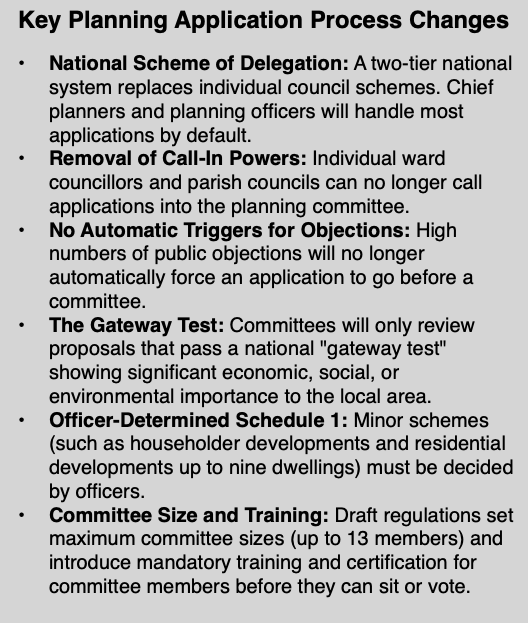
But delegations were usually accompanied by rights of call-in which enabled councillors to use their judgement as to when to require an application to go to committee. The new Gateway Test effectively removes that right, which most elected people would regard as fundamental to their role.
See also: Head of Planning Explains Planning Process Changes
Already, the great majority of applications are delegated. Planners write reports to themselves (evaluations), as if they were going to committee and then decide them themselves, invariably with internal checks and balances. It is not an exaggeration to say that they work for the government now, leaving local planning authorities in the firing line. Devolution it is not.
 A lot of things have also happened since. A vast range of requirements have been added to the process of determining planning applications – environmental, conservationist, tree surveys, flood related and many more.
Planners do a good job of grinding through these and they are necessary. They can be costly and they take time, but they were all a requirement of central government and apart perhaps from a few bat tunnels, justifiable.
There are many other reasons why development gets delayed, which have nothing to do with local planning, not least, land assembly, land hoarding by developers, and the financial markets, which determine when funds become available. Local Planning Authorities are a convenient scapegoat for these delays but as always, the devil is in the detail.
More fundamentally, there is a national debate to be had about what we mean by local empowerment and devolution. Giving a little and taking back a lot while pretending to devolve, which all parties have done over the last fifty years, infantilises and disempowers councils and damages local democracy.
Councillors are better trained now and more accountable to their electorate via social media. With near universal delegation, that is going to change, and councillors will not get enough exposure to planning technicality to fulfil any kind of meaningful function.
With greater empowerment and more local discretion, most would make the right decisions, and the outliers would have to live with the consequences, both practically and in the ballot box.
Our new Prime Minister is making much of the claim that power and resources should go back to councils as a means of regenerating the economy. But that is not what is happening.
More fundamentally, there is a national debate to be had about what we mean by local empowerment and devolution. “
The resources and modest powers are going to piecemeal regional mayors who act more like extensions of central government, whilst trying to claim local credit. If he really wants to turbo charge the economy, he needs to trust and empower local people where they live.
One other consequence of this, and the cumulative changes that I have mentioned, barely gets a footnote. Planners are trained to apply rules and circulars handed down to them by the Government. They take few lessons from what local people know.
But one of the most important aspects of planning regulation is at the most detailed level – the effect of a proposal on neighbours. Neighbours are supposed to be given notice of applications which might affect them. One way to reduce correspondence is to construe the definition of “neighbours’ tightly.
When neighbours are offered the chance to make comments or objections, some spend hours doing their best to explain a need for changes. Some objections will be justified in planning terms and some not.
But one of the most important aspects of planning regulation is at the most detailed level – the effect of a proposal on neighbours.”
Councillors may be approached to help present a case for a constituent, but it can work both ways as they do not always agree but at least it is personal.
It is common practice already to reduce such laboured-over comments to a word, or a line of text, in an appendix to a report. What is going to happen now when everything is delegated and no elected person gets to see them? Transparency will certainly be the first casualty.
Over the decades, the art of planners mediating informally between neighbours to improve proposals and reduce friction has been lost. The only meaningful test is whether an application can be refused. It is town planning but not as I know it.
Share This Post


Responses to Insight: Impending Changes to the Planning Application Process Are Draconian
Leave a Comment Please see our comments policy. All comments are moderated and may take time to appear. Full names, or at least initial and surname, must be given.


"But I was sure that at least Guildford, in Surreyland, would make me an Alderman. Such a nice robe." (Click here to see: Proposed List of Honorary Aldermen Rejected - Cartoon AI assisted.)











Ellen Portess
October 28, 2026 at 9:17 pm
This new Council plan shows a scandalous lack of concern for the inhabitants it purports to serve. Self-serving, perhaps?
Just hope it will be more transparent and caring for its County’s needs and wants than we see currently.