- Stay Connected

Socialize


 Abraham Lincoln
If given the truth, the people can be depended upon to meet any national crisis...
Abraham Lincoln
If given the truth, the people can be depended upon to meet any national crisis...

 Guildford news...
for Guildford people, brought to you by Guildford reporters - Guildford's own news service
Guildford news...
for Guildford people, brought to you by Guildford reporters - Guildford's own news service
New Ash Housing Can Go Ahead After Inspector Says the Site is ‘Grey Belt’ Land
Published on: 16 Oct, 2026
Updated on: 16 Oct, 2026
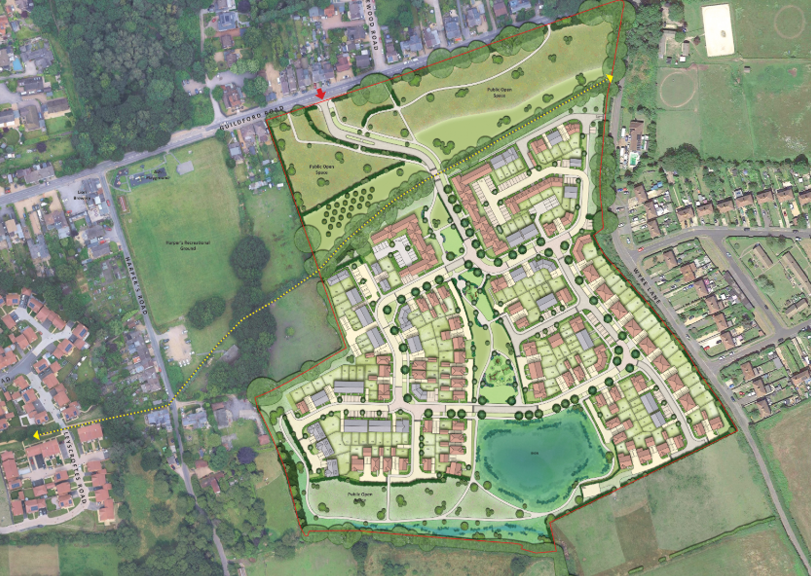
The Shortlands Farm site: A planning inspector says it can be designated as “grey belt”
By David Reading
A developer has won its appeal for outline planning permission to build up to 200 homes at Shortlands Farm, Guildford Road, Ash.
The planning inspector agreed the land can be designated as “grey belt”. The concept of grey belt was introduced in national planning guidelines in 2024, relaxing development restrictions on green belt land that is not deemed to contribute adequately to green belt purposes.
People in opposition to the Shortlands Farm plans had argued that the concept of grey belt referred originally to low quality scrubland and sites such “derelict garages”. One opponent commented: “It’s not low quality scrubland at all, it’s a farm.”
But following a public inquiry, a planning inspector has allowed the appeal by Gleeson Land Ltd. The scheme includes the demolition of existing buildings on the site, which is between Ash and Normandy. Access will be from Guildford Road and Wyke Lane.
The inspector’s decision has drawn a strong reaction from Normandy Parish Council and the Normandy Action Group.
Action group chairman Mike Aaronson said the designation of the land as grey belt was deeply concerning and could mean other green belt sites in the area might be at risk from development.
Significantly, the planning inspector, Mr Graham Chamberlain, noted that Guildford Borough Council (GBC) had failed to determine the planning application within the prescribed period and this was why the appellant had exercised their right to appeal.
The council has explained that an agreement to extend planning discussions with Gleeson was attempted but not reached, and the company opted instead to launch an appeal.
Members of GBC have voiced opposition to the plans, citing concerns about the impact on the green belt, biodiversity, infrastructure and the character and appearance of the area.
In explaining his decision to allow the appeal, the inspector said the condition of the area was relatively degraded because the hedgerows were of variable quality, with some being “gappy”. Ad hoc equestrian activity, including the subdivision of historic fields into smaller paddocks with fencing, had resulted in a localised reduction in the scenic quality of the site immediately south of Footpath 356.
He considered that the former farm buildings on the site, as well as extensive fencing and lighting were “visual detractors”. There were some distinctive features in the locality, such as the Special Protection Area to the north or Week Wood to the south, but the appeal site and its immediate context was generally “unremarkable.”
He said the appeal site was not especially tranquil or deeply rural given the presence of the A323 and development on three sides. Although the site was used for equestrian activities, it was not open access land. The site played a functional role in separating the Wyke estate and the village of Normandy from Ash, but this was not a defined green wedge or gap, and the Wyke estate was not a historic settlement.
The inspector agreed the proposal would erode the gap between Ash and Normandy but not significantly given the enclosing presence of the Wyke estate, a belt of trees beyond this and housing along Guildford Road.
The inspector said the drawings submitted with the appeal demonstrated that the scheme could be delivered with nearly all the existing mature trees and hedges retained and the hedgerows strengthened and improved. Importantly, the housing could be set amongst generous areas of open space to the north and south linked by a central “green corridor”. This would improve recreational access and retain a spatial and visual connection between Guildford Road and the open landscape to the south, including views towards the Hog’s Back. The northern open space could be a very pleasant feature on the approach into Ash, having the character of a green or common.
The inspector said landscaping, including street trees, and careful treatment of building heights and materials (such as muted colours) would soften the impact in views from the wider landscape. The proposed open spaces could be designed to be visually positive landscape features as they mature, especially if coupled with attractive buildings of an appropriate scale orientated to overlook them.
The inspector said: “In conclusion, the proposal would harm the landscape character and visual amenity of the area. However, the impact can be mitigated to an extent and would be localised.”
Local reaction
Mike Aaronson, Chair of the Normandy Action Group, said: “While this outcome was not unexpected, it does raise serious concerns.
“The decision reveals just how much Government changes to national planning rules have weakened protections for the green belt. Whereas hitherto the site was considered an important buffer preventing the further eastward sprawl of the Ash-Tongham Urban Area, its new designation as grey belt has made that position harder to defend.
“How far will this go? With two further applications pending for major housing development in this area – for up to 420 dwellings in Tongham and up to 950 in Normandy – the green belt in this area is under serious threat.”
Simon Schofield, chair of Normandy Parish Council, said: “We are disappointed that this development in the green belt has been given permission and its role in checking the unrestricted sprawl of the Ash-Tongham urban area was not recognised.”
He raised a specific concern that Guildford Borough Council failed to secure a planning contribution of £435,200 from the developer for accessibility improvements for Ash Station, adding: “It seems odd that some reliance is placed on Ash being a well-connected station but that contributions towards making the station more accessible were not forthcoming.”
As the inspector’s report confirmed: “The council had originally also sought £435,200 for upgrades to Ash Rail Station. However, when the appellant sought further justification, including evidence regarding any issues with capacity and how the sum had been calculated, the council no longer sought the contribution.”
Guildford Borough Council has been invited to comment on the inspector’s decision and the matters it raises.
Share This Post




PM You say you're worried about the reaction in Surrey to council reorganisation. How many Labour MPs does Surrey elect? Angela Rayner: None, ever. PM Next item!












Recent Comments