- Stay Connected

Socialize

 Abraham Lincoln
If given the truth, the people can be depended upon to meet any national crisis...
Abraham Lincoln
If given the truth, the people can be depended upon to meet any national crisis...

 Guildford news...
for Guildford people, brought to you by Guildford reporters - Guildford's own news service
Guildford news...
for Guildford people, brought to you by Guildford reporters - Guildford's own news service
Story of ‘Jessie’s Seat’ Topiary Railway Memorial to a Guard Killed at this Spot near Chilworth
Published on: 17 Nov, 2025
Updated on: 21 Nov, 2025
Historian Frank Phillipson tells the story of the fatal goods train accident between Gomshall and Chilworth just before midnight on February 29, 1892, and the topiary later planted there in memory of railwayman Henry Wicks
With the recent unfortunate felling of the memorial topiary called “Jessie’s Seat” east of Chilworth station, it seems appropriate to tell the story of the fatal accident that led to its being planted.
On Monday, February 29, 1892, an evening goods train running from Redhill to Reading on the South Eastern Railway was involved in a crash which killed a guard and saw a large number of wagons thrown off the line down an embankment.
The train was made up of 49 goods wagons, mostly loaded, with a brake van at the front and rear, and hauled by two engines. It was to run non-stop between Redhill and Shalford. The guard in the front brake van was in charge of the train with a brakesman in the rear brake van.
With no continuous brakes, the guard and the brakesman were to assist in the braking of the train. The brakesman in the rear brake van, as the train descended a gradient, was to apply his brakes to keep all the couplings in the train taught. Other braking was carried out by the two locomotives.

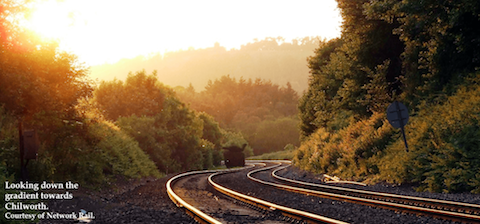
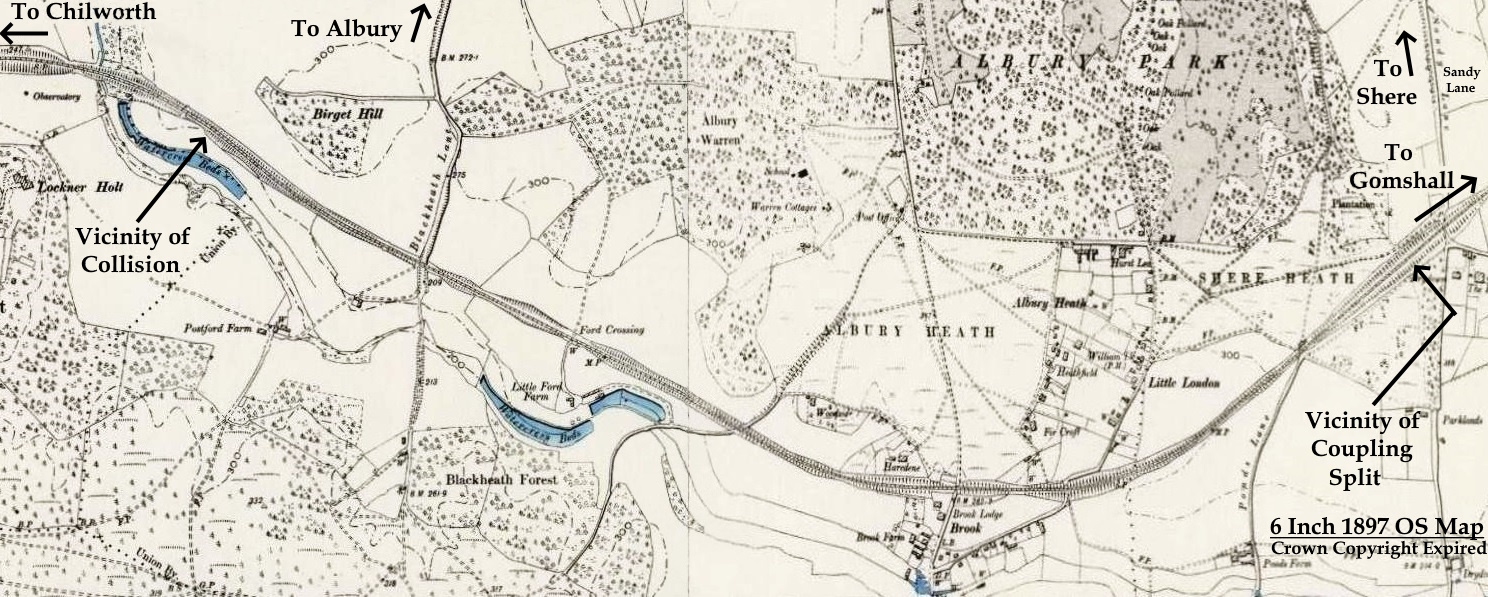
The train left Redhill at 10.40pm and everything was normal as the train passed Gomshall station and started to climb Shere Heath bank. Around midnight it reached the summit at Shere Heath and then ran for a quarter of a mile on level track. As it began to descend toward Chilworth, the coupling between two wagons in the mid-teens broke (at about two miles from the collision site) and the front portion of the train continued away from the rear 30 or more wagons and brake van.

Click on image to enlarge in a new window.
The driver and firemen of both engines did not realise that the train had parted and they braked to slow the train down as it descended the gradient. The rear portion of the train maintained some forward momentum and, on reaching the descending gradient, its speed rapidly increased. It then caught up and collided with great force with the front section of the train made up of the remaining wagons, brake van and the rearmost of the two locomotives.
The tender of this locomotive was derailed and the adjacent brake van became detached and was smashed to pieces. It and a large number of wagons were sent down the south side of the embankment in the vicinity of Messrs. Coe’s watercress beds, with a large number of wagons totally wrecked.
Click on image to enlarge in a new window.
The guard, 52-year-old Henry Wicks, a long serving and very well-respected railway man of Reading, was instantly killed when his brake van was smashed. Some accounts state that his body was flung clear and found on the embankment. Another report states that, when it was found that the guard was missing, after some time searching, his lifeless body was found by the rear brakesman George White “lying on the embankment quite clear of the wreckage”.
Other accounts however say that the shockingly mutilated parts of Wicks’ body were recovered by the Reading, Redhill or Bricklayer’s Arms (Southwark) breakdown crews in various parts of the wreckage during the following day.
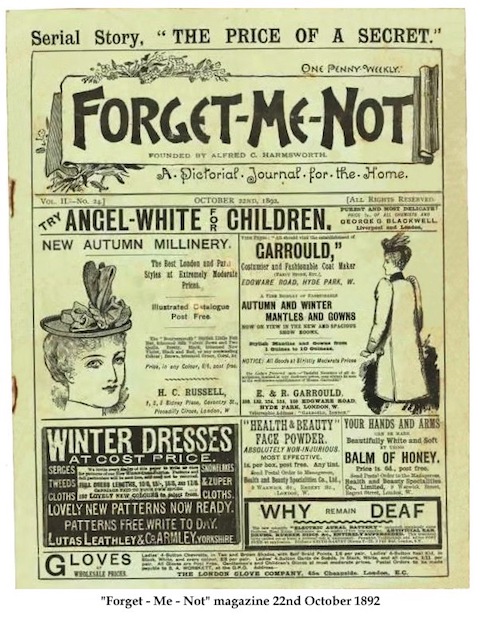
Found in the wreckage of the brake van was a copy of the Forget Me Not magazine which Wicks seems to have had with him at the moment of impact. Henry Wicks’ body was taken to Chilworth station to await a coroner’s inquest.
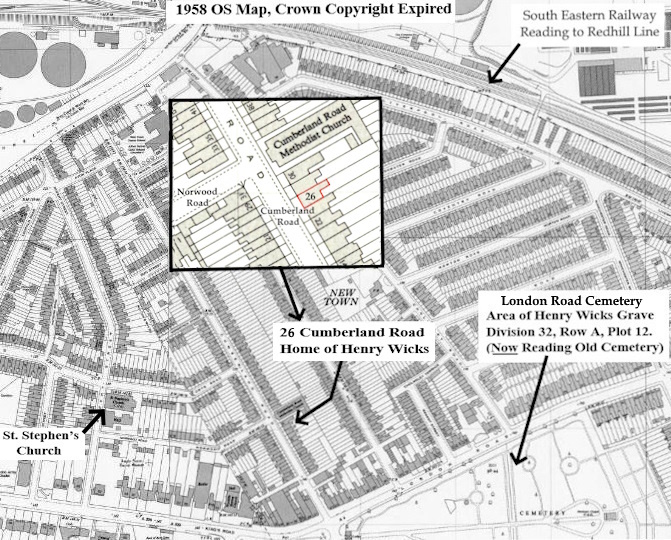
Henry Wicks was not scheduled to be on this train only volunteering to being there to fill in for a colleague, a guard named Wilkins, who was visiting his parents. He left a widow Emma Elizabeth Wicks, two grown-up sons and a grown-up daughter. The daughter Martha and son Joseph were living at the Wicks’ home at 26 Cumberland Road, Reading in the 1891 census.
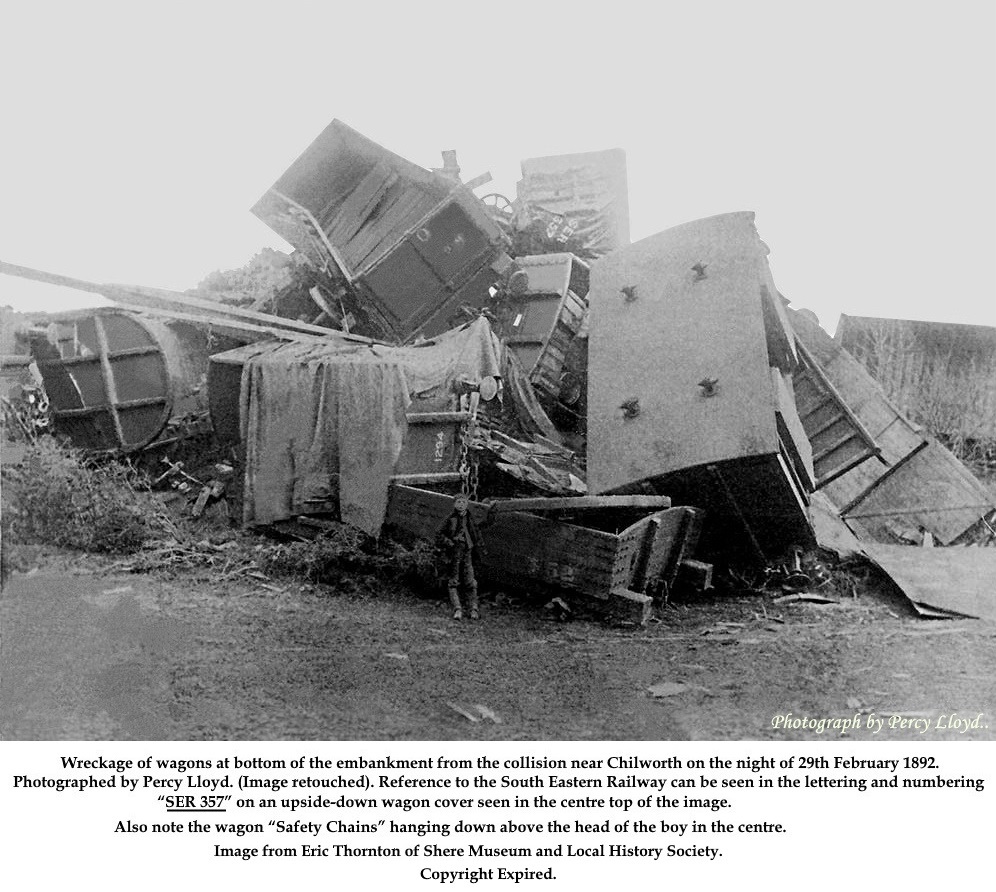
The wreckage from the crash was piled up higher than the railway line, with two, almost intact wagons, standing on end leaning against each other on top.
Click on image to enlarge in a new window.
Amongst the match wood and wheels of the wagons on the ground below the embankment were spread the loads from the wagons. These consisted of amongst others; bricks, coke, lime, drain pipes, biscuits, corn, and brewer’s grain. Loose barrels had rolled away into the meadow below and a pair of wheels had run some 100 yards away towards the Lawbrook stream.
The railway track of the ‘Down’ line towards Guildford was also considerably damaged with rails torn up and bent for 150 yards. In addition to this there was wreckage blocking the ‘Up’ line towards Redhill and two telegraph poles were broken off severing Post Office and railway communication along the line.
The line was blocked for “some hours” before the breakdown crews, with jacks and cranes, managed to get the ‘Up’ line towards Gomshall reopened by 10am, with traffic passing alternately in both direction under single line working.
Out of the wreckage only between 16 and 20 wagons were recovered intact. The ‘Down’ line was finally reopened in the evening of Thursday but with wreckage clear of the line still to be removed. The Post Office and railway phone lines were reconnected by about 12 o’clock on Tuesday.
A coroner’s inquest was held by Mr G.F Roumieu at the Percy Arms, Chilworth, (opposite Chilworth station) on Thursday, March 3. The foreman of the jury was Mr Joseph Cooke and the railway company was represented by Mr Smith, the Chilworth stationmaster.

Joseph Wicks, son of the deceased, told the inquest that his father was 52 years of age and had worked for the South Eastern Railway for about 30 years.
Henry Forbes, the driver of the second engine (the ‘train’ engine and therefore the senior driver), said the train had left Redhill at 10.40pm and usually ran non-stop to Shalford.
When the rear portion of the train collided with the front portion, driver Forbes, was thrown to the floor of the cab, struck his head and was momentarily rendered unconscious. He stopped the train and sent the front engine off to Chilworth to raise the alarm and to prevent any train going towards Gomshall owing to the wreckage thrown onto that line.
The Chilworth station master Mr Smith arrived at the scene of the collision shortly after it had occurred, but until it was daylight little could be done.

The weight of the train was not unusually heavy with a limit of 45 wagons for haulage by two locomotives. In the train there were 49 wagons but, of those 14 were empty wagons. With three empty wagons equalling one loaded wagon, it meant the train load was therefore theoretically made up of around 40/41 wagons.
George White of Reading, the brakesman in the rear brake van, was cautioned by the coroner as it could be construed that failure to hook up all the wagons ‘safety chains’ might have led to the train parting after the main coupling broke.
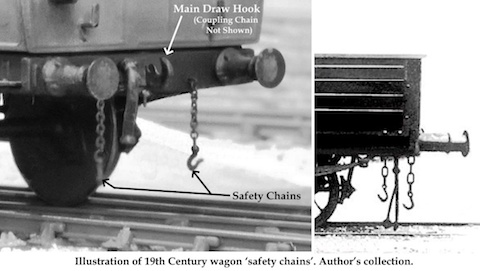
‘Safety chains’ were mounted either side of the main central coupling hook. They were intended to keep the train together should the main coupling fail. At this time, the quality of the metal of the main coupling was not always of a high quality. Therefore, the use of ‘safety chains’ were used as a possible back-up to keep the train together. Early in the 20th century the quality of the metal used in main couplings had improved and the use of ‘safety chains’ was gradually dispensed with.
White said that he had inspected the train before it left Redhill and ensured that all the couplings were hooked up. He also checked that the ‘safety chains’ were hooked up “where there were corresponding chains on the adjoining trucks to hook them to”.
He stated that he noticed nothing wrong until the collision occurred. He said that the train had climbed the Shere Heath Bank at 20 to 25 mph and as it started to descend the Chilworth bank he applied his brake to help take the strain of the train.
At this point the brakesman and guard of a train travelling in the opposite direction shouted to White but he could not understand what they meant. He said the collision occurred three or fur minutes after this. White went on to state that he found Henry Wicks’ body “on the embankment almost covered in earth”. This does not fully tally with other evidence as to when and where Henry Wicks’ body (or parts of it) was/were found.
White did not know if the ‘safety chains’ would have been strong enough to hold the train together if the main coupling failed. He had never known a main coupling to have failed before.
After the coroner’s inquest on March 3 was adjourned, Henry Wicks’ body was released for burial.
The inquest was reopened at 11am on Friday, March 11, again at the Percy Arms, Chilworth. Evidence was heard from the night inspector and examiner of carriages at Redhill. It was stated that all reasonable care had been taken and that the train was not overloaded.
Technical evidence showed that the broken coupling was of the best quality material and the wagon to which it was attached had been overhauled at Ashford works in September 1891.
The coroner, Mr Roumieu, stated that the only verdict possible was “accidental death” which the jury agreed with. They made a recommendation that some form of communication should be devised between the guards and the engine drivers of goods trains.
The jury donated their fees to Henry Wicks’ widow and it was noted that the South Eastern Railway had granted her a weekly pension of 10s a week for life.
Once prepared by an undertaker, Henry Wicks’ body was taken to his home in Reading. On Friday, March 11, his funeral took place with a large number of people attending.
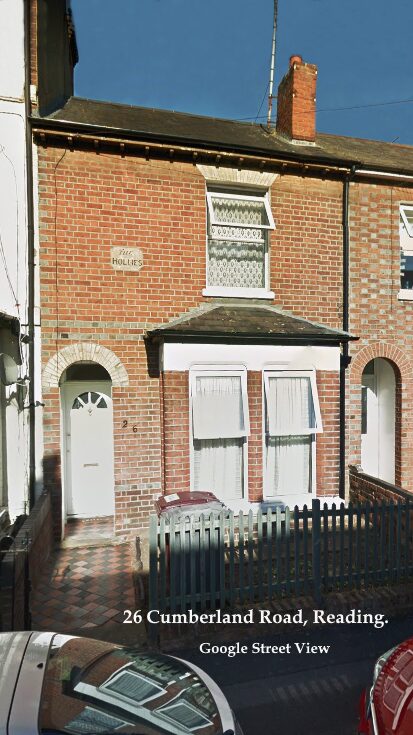
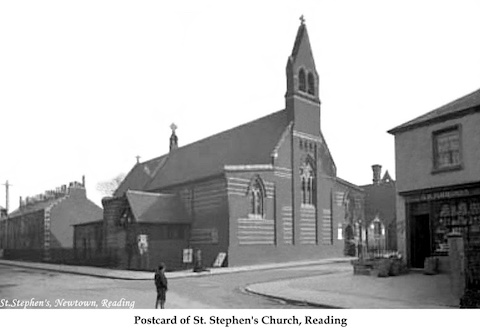
His coffin was taken from his home on an open hearse carriage to the nearby church of St Stephens with a procession of 80 South Eastern Railway. colleagues, many in uniform, marching ahead of the hearse. Four carriages followed with the first three carrying the widow, her sons and daughter and other relatives. The fourth carriage carried Mr J, Genders (South Eastern Railway stationmaster, Reading), Mr F. Burton and Mr T. Norris (South Eastern Railway Goods Department, Reading).
Click on image to enlarge in a new window.
At the church it was met by the Revd J.L Hughes, and the coffin carried down the central aisle, by six of the deceased’s fellow guards, and placed against the chancel steps. The service was partly choral with the reverend mentioning the circumstances of the tragedy and the dangerous work that Wicks’ fellow guards carried out.
https://www.reading.ac.uk/adlib/Details/archive/110149927
At the conclusion of the church service the coffin was borne out and placed on the hearse carriage. The procession then reformed and proceeded to the London Road cemetery where it was noted that there were Mr Smith (stationmaster at Chilworth), Mr Trewren (Wokingham), Mr Jury (Earley) and Inspectors Oxley and Wigzell.
With many people in attendance, the service at the graveside was conducted by the Revd Hughes and it concluded with the singing of hymn 428 by the Albert Road Bible Class.
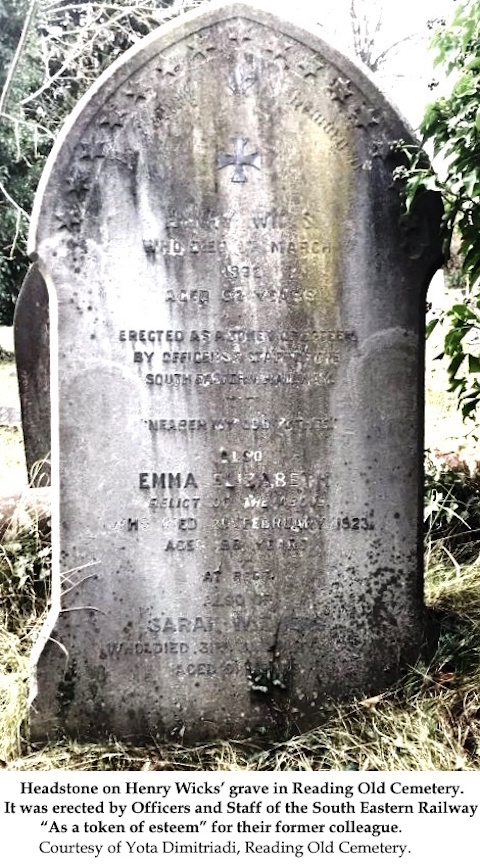
In due course the station master and staff at Reading provided a large headstone for the grave “as a permanent mark of high esteem in which the deceased was held”.
At the site of the crash, a box plant was placed on the southern side of the line and was formed into a memorial topiary of a guard’s seat with a pheasant.
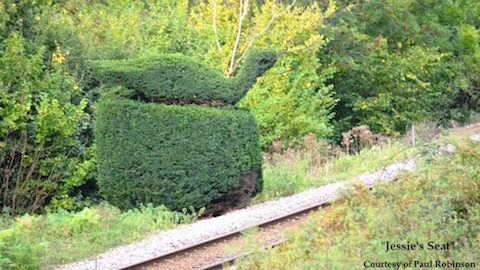 The chair was said to represent a seat which Guard Wicks’ spirit could sit upon with a pheasant perched on the arm of the seat.
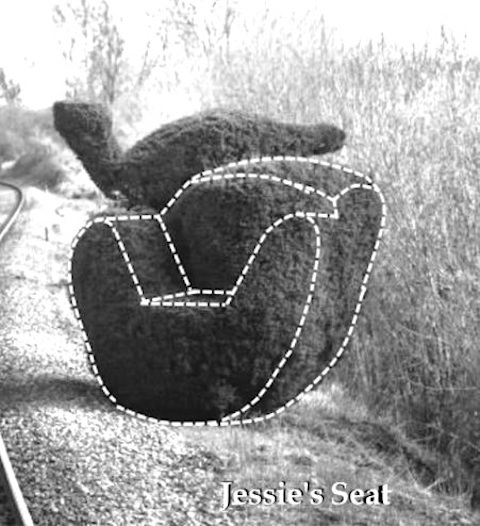
The topiary with the seat part outlined to highlight it.
It became known as ‘Jessie’s Seat’ after Jessie Wicks, who it was stated was Henry Wicks’ daughter-in-law, and whom it was said, was the driving force to have it planted.
Most accounts state that Jessie Wicks was Henry Wicks’ daughter-in-law. However, his son, Joseph Wicks, didn’t marry Jessie Williams until May 15, 1895 at Feltham Parish church and so at the time of the crash she was not his daughter-in-law.

The topiary as it looked in about 1968.
The topiary was planted and maintained by railway staff and latterly by volunteers up until recent years. It is understood that Network Rail has stopped access to it on safety grounds due to its closeness to the railway line.
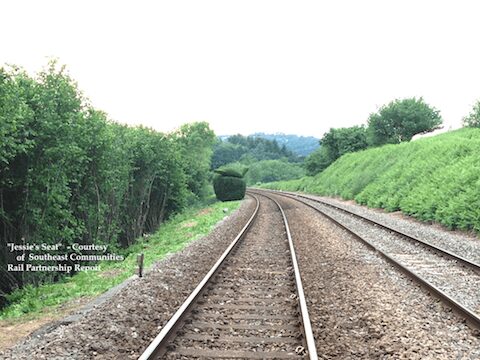 With the ‘accidental’ cutting down of ‘Jessie’s Seat’ during upgrading of the line in September 2025, Network Rail says it is working on plans with local community groups, the parish council, etc., to replant the memorial in a “safer, more visible” location and will also look to install a plaque. If this is the case it will then not be at the site the memorial is supposed to be marking.
With regard to the cutting down of the topiary, a Network Rail spokesperson stated that it “was removed “for safety reasons, as it was blocking signs that remind train drivers to sound their horn near crossings”.
However, there is no crossing (or a need for a sign) on the ‘Down’ line to the west of the site of ‘Jessie’s Seat’ the next feature being Chilworth station! So, perhaps a not so accidental cutting down or perhaps a “genuine mistake”?
Share This Post



I'm living well for nothing at all! (See: No Trifling Matter: Magpie Trapped in Godalming Sainsbury’s)



Next stop, Debt Chasm! (See: We Should All Be Outraged About the Failure to Deal with Legacy Debt)





Recent Comments