- Stay Connected

Socialize

 Abraham Lincoln
If given the truth, the people can be depended upon to meet any national crisis...
Abraham Lincoln
If given the truth, the people can be depended upon to meet any national crisis...

 Guildford news...
for Guildford people, brought to you by Guildford reporters - Guildford's own news service
Guildford news...
for Guildford people, brought to you by Guildford reporters - Guildford's own news service
The Night David Bowie Brought Ziggy Stardust To Guildford
Published on: 18 Jan, 2026
Updated on: 18 Jan, 2026
David Bowie died ten years ago this month and his legacy is very much in the news. Here, Dragon reporter David Reading recalls one of the most memorable events in Guildford’s rock ‘n’ roll history.
The audience was waiting for Bowie but what they heard before the curtain went up was Beethoven.
The opening music for David Bowie’s Ziggy Stardust Tour, which reached Guildford Civic Hall on May 27, 1973, was a majestic electronic recording of Beethoven’s Ode to Joy. Both grand and futuristic, the piece was a perfect scene-setter for the show we were about to see.
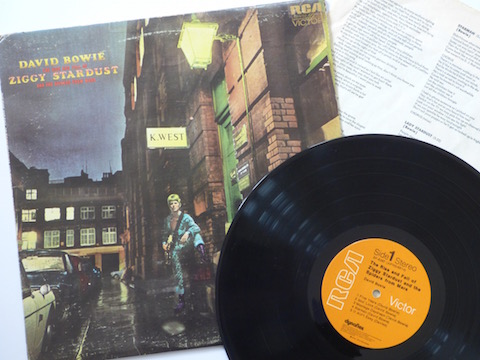
The classic album, The Rise and Fall of Ziggy Stardust and the Spiders From Mars, that David Bowie performed at Guildford Civic Hall on May 27, 1973.
In this ground-breaking tour, Bowie acted the role that made him a star – Ziggy Stardust, the mythical rock ‘n’ roll starman with the “screwed up eyes and screwed down hairdo;” the “leper messiah” who “played it left hand, but made it too far”.
That Beethoven intro – recorded by the experimental musician Walter Carlos using a new device called a spectrum follower – is said to be the first electronic vocal piece. The audience clapped along waiting for the band to appear and suddenly there was Bowie, lit up by a strobe, standing seductively in a blue-grey check jumpsuit. The band launched into Hang Onto Yourself from the Ziggy album and the fans went crazy.
Everything was different about this gig, even the clothes Bowie wore. In itself, the idea of wearing outlandish stage gear wasn’t new but Bowie – sexually ambiguous, prancing about on stage like a mischievous pixie – had taken the concept further than ever before. Bowie was bringing a new face to rock ‘n’ roll and that was clear to that Guildford audience back in 1973.
The notion that Ziggy is a concept album with a story to tell is fully ingrained in the minds of many fans. It’s not a happy story. The year 1972 – when the album was released – came during a time of frightening international tension: five years after the Six Day War, four years after the Soviet invasion of Czechoslovakia and the year before the Yom Kippur War which began with an Arab attack on Israel. Vietnam was aflame and Nixon was President.
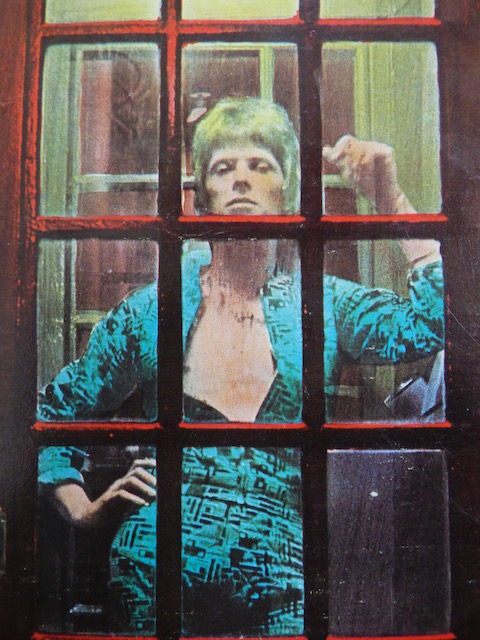
David Bowie pictured on the back cover of the Ziggy Stardust album.
The album’s opening track Five Years sets a disturbing scene with the lyrics: “Pushing thru the market square, So many mothers sighing, News had just come over, We had five years left to cry in. ”
So the beginning of the story is clear: the world is in a mess and something has got to happen fast. Some writers have suggested the Ziggy character was devised as an alien who became a rock star here on earth. He carried a message of peace, but was destroyed by his own ego, his excesses of drugs and sex, and the fans he inspired.
The desolation pictured in some of Bowie’s early songs led people to think that maybe they were a reflection of the guy who wrote them and acted the role. Was Ziggy one of Bowie’s alter egos – one of his multiple personalities who emerged over the years – with the implication that there was something not quite right about him? Did he need to construct his various doppelgangers and wear outrageous disguises in order to escape the madness within? Or was he just a great showman?
Paul Trynka, ex Mojo magazine editor, makes some interesting points about the development of the Ziggy album in his biography Starman. People tend to think the story was mapped out in advance as a concept album. In reality, says Trynka, this wasn’t the case. At the beginning they were simply recording a bunch of songs, some of which fitted together, others that didn’t work. Early on, the album was starting to sound like ‘50s rock ‘n’ roll. A cover of Chuck Berry’s Around and Around (which the Stones had recorded for an EP in 1964) featured in the early track listing and there were also touches of Gene Vincent.
Trynka writes: “The straight ahead rockers – Hang On To Yourself and Suffragette City – took Eddie Cochran’s teenage rebellion as a model, with the same mix of acoustic and electric guitars, as well as liberal musical quotes from Something Else.” But where Cochran spoke to kids about breaking parental bonds, Ziggy’s message was about sexual liberation.
According to Trynka, the central concept – Ziggy’s rise and fall – arrived late in the day. This was Bowie’s “homage to the outsider”, partly inspired by the singer Iggy Pop, partly by another strange character: an obscure rock ‘n’ roll singer named Vince Taylor. Although living in the US, Taylor was actually born Brian Maurice Holden in London in 1939. He claimed to be a composite of the Son of God and an alien. He carried a crumpled map showing the places where spaceships were going to land. This was the kind of character who caught the imagination of the young Bowie.
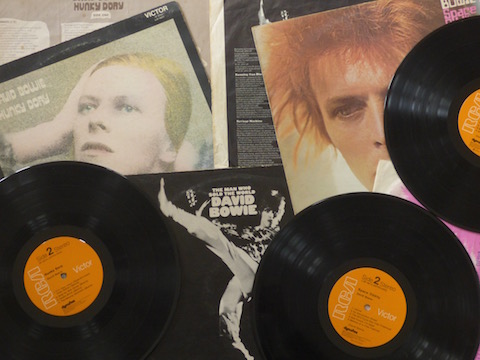
Other David Bowie albums released prior to Ziggy Stardust and now classics in their own right.
But there was another figure who had an even more profound impact on Bowie. The story goes that the young David Jones, as he was then, was sitting in his little terraced house in the suburb of Bromley sometime in the 1950s, when his dad walked in with a bag full of rock ‘n’ roll records. That night David played them all: starting with Fats Domino, Chuck Berry, the Platters and Frankie Lymon and the Teenagers. Then he hit gold. The song that marked his eureka moment was Little Richard’s Tutti Frutti. He was eight or nine at the time.
“My heart nearly burst with excitement,” he was quoted as saying. “I’d never heard anything even resembling this. It filled the room with energy and colour and outrageous defiance. I had heard God.” More than anyone else, Little Richard would be the guiding light of Bowie’s stagecraft – the irresistible combination of sex, glamour and thrilling rock ‘n’ roll music.
Bowie’s two Guildford performances were part of a world tour that took in just over 100 performances from January to early July. Although this was many years ago, there are still highlights I remember well: the manic energy in the rockier numbers such as Suffragette City; Mick Ronson’s howling, Jeff Beck-inspired guitar; above all, Bowie’s dazzling showmanship. Long before the band reached the final number, Rock ‘n’ Roll Suicide, the place was in uproar.
The above article is an edited version of one we published when Bowie died.
Share This Post




I'm living well for nothing at all! (See: No Trifling Matter: Magpie Trapped in Godalming Sainsbury’s)



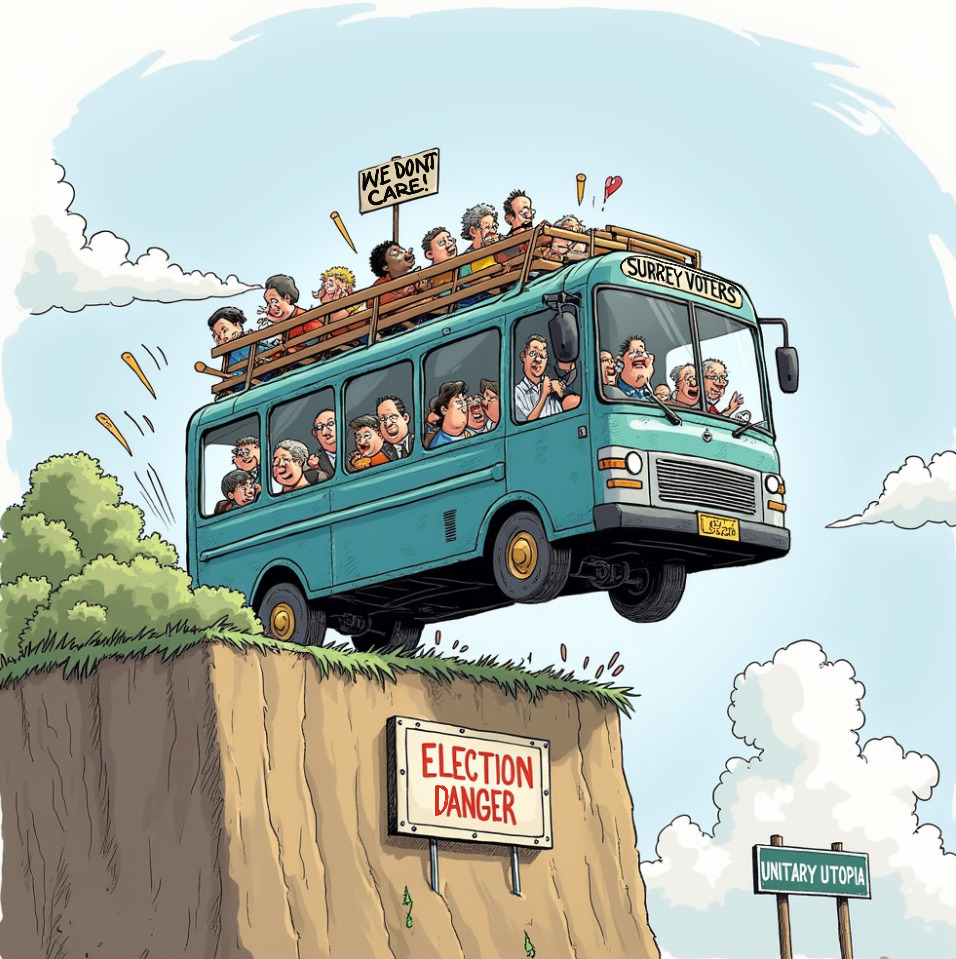
Next stop, Debt Chasm! (See: We Should All Be Outraged About the Failure to Deal with Legacy Debt)





Recent Comments