- Stay Connected

Socialize


 Abraham Lincoln
If given the truth, the people can be depended upon to meet any national crisis...
Abraham Lincoln
If given the truth, the people can be depended upon to meet any national crisis...

 Guildford news...
for Guildford people, brought to you by Guildford reporters - Guildford's own news service
Guildford news...
for Guildford people, brought to you by Guildford reporters - Guildford's own news service
Councils Lack Confidence That Gatwick Expansion Will Be Controlled
Published on: 20 Sep, 2024
Updated on: 21 Sep, 2024
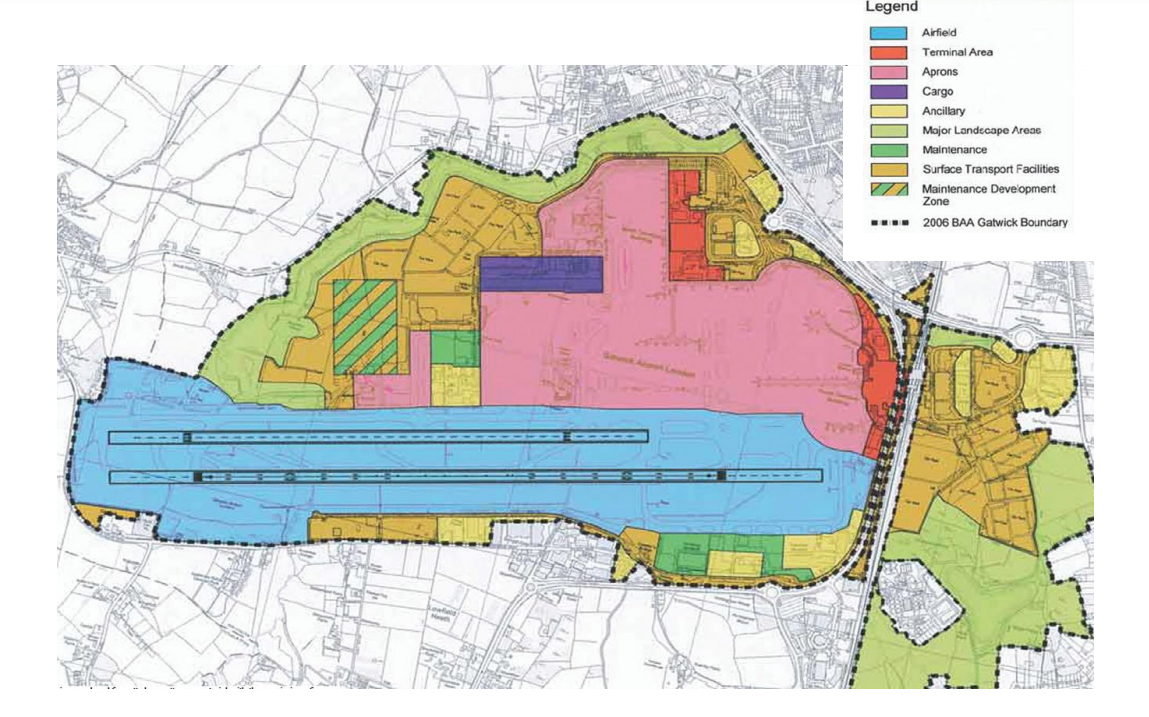
Gatwick Plan. Image PINS/Gatwick
By Emily Dalton
local democracy reporter
Local authorities have said they will not support Gatwick Airport’s plans to expand unless its growth is dependent on meeting environmental and noise targets.
According to legal documents, the impacted councils are concerned that there is currently a “lack of sanction” against Gatwick if the growth of the airport exceeds expected environmental guidelines without clear accountability.
Airport chiefs at Gatwick, the country’s second busiest airport, want to modify its northern runway so that it can increase passenger numbers to about 75 million a year on 386,000 flights. It says this will help minimise delays, bring in about £1 billion into the region’s economy every year, and create 14,000 jobs – all while staying within agreed noise levels. It also has a carbon action plan for how the airport will be net zero for its own emissions by 2030, with aviation emissions excluded.
Gatwick Airport has applied for a Development Consent Order (DCO), a legal document that allows the construction of major infrastructure projects. Part of the process requires the applicant to show the planning inspector how it will mitigate the impact of the development.
The airport’s current position is that the impact from the growth of the runways will be controlled by an air noise envelope (a way to limit sound) an annual cap of 386,000 commercial air transport movements, surface access commitments/SACs (55 per cent people accessing the airport by public transport by 2040) and a carbon action plan (to reduce carbon footprint).
Councils such as Crawley Borough, West Sussex County, Surrey County, Reigate and Banstead Borough, Mole Valley District and Tandridge (together the JLA) have been consulted on the proposals and have written to both Gatwick Airport and the planning inspector with recommendations.
The JLA say they are “concerned” that the current project “will impose unjustified adverse impacts on local communities, local businesses, and the receiving environment”. The group disagrees with the Planning Inspectorate’s recommendations for the major development and believes it does not go far enough to address their concerns.
Instead, the JLA has put forward an approach where any increase in passenger numbers would be dependent on Gatwick Airport’s achievement of specific targets which would avoid, limit and reduce impacts of the project. The group said that if all its recommended measures were adopted, including the Environmentally Managed Growth framework (EMG), they would “not object”.
Under the JLAs’ proposed approach, Gatwick Airport would be required to continually monitor and regularly report on the extent of the environmental effects associated with the airport in the four areas: noise, air quality, greenhouse gases and surface access. In each of the cases, the JLAs say they want to ensure Gatwick meet their specific targets and are held accountable, to prevent the airport expanding at any cost.
The group has proposed a tier system in which to monitor potential breaches in environmental commitments. For instance, if air quality or green gas emissions go above a certain point (level 1), Gatwick will review the current measures and work on mitigation. Then, if air quality gets increasingly poorer (level 2), Gatwick will review its pollutant contributions and introduce mitigation measures, perhaps preventing further capacity.
If the limit for air pollution is breached, further mitigation would be required to solve the problem and no more aeroplane flight slots will be allocated.
The JLAs also want further clarity on the impacted areas exposed to higher levels of aircraft noise, especially areas where noise could wake people up. Measures should also be applied to give Gatwick Airport an incentive to transition to quieter aircraft and noise insulation as soon as possible, according to the JLA’s statement. The JLAs also want to secure night time controls for flying.
The examination of the proposed DCO closed on August 27. The Planning Inspectorate will make a recommendation to the Secretary of State for Transport, who will then make a final decision on or before February 27.
A London Gatwick spokesperson said: “We are fully committed to making sure the airport’s growth is sustainable. London Gatwick has thoroughly assessed the environmental impacts of its growth plans, which include environmental mitigations related to noise, carbon emissions and surface access improvements.
“As part of our sustainability policy we are committed to reaching net zero for our own scope one and two admissions by 2030, as well as continuing to reduce overall energy use, invest in on-site renewable energy, and continuing to source 100% renewable electricity.
“London Gatwick is delighted with the strong support shown by many local people and businesses during the recent hearings, who all voiced their desire to see the airport grow for the economic benefit of the area. We thank them for their ongoing support.”
Share This Post




PM You say you're worried about the reaction in Surrey to council reorganisation. How many Labour MPs does Surrey elect? Angela Rayner: None, ever. PM Next item!












Recent Comments