- Stay Connected

Socialize

 Abraham Lincoln
If given the truth, the people can be depended upon to meet any national crisis...
Abraham Lincoln
If given the truth, the people can be depended upon to meet any national crisis...

 Guildford news...
for Guildford people, brought to you by Guildford reporters - Guildford's own news service
Guildford news...
for Guildford people, brought to you by Guildford reporters - Guildford's own news service
Residents Tell Councillors and Planner What It Is like to Live With Multiple Occupant Houses
Published on: 5 Jun, 2026
Updated on: 5 Jun, 2026
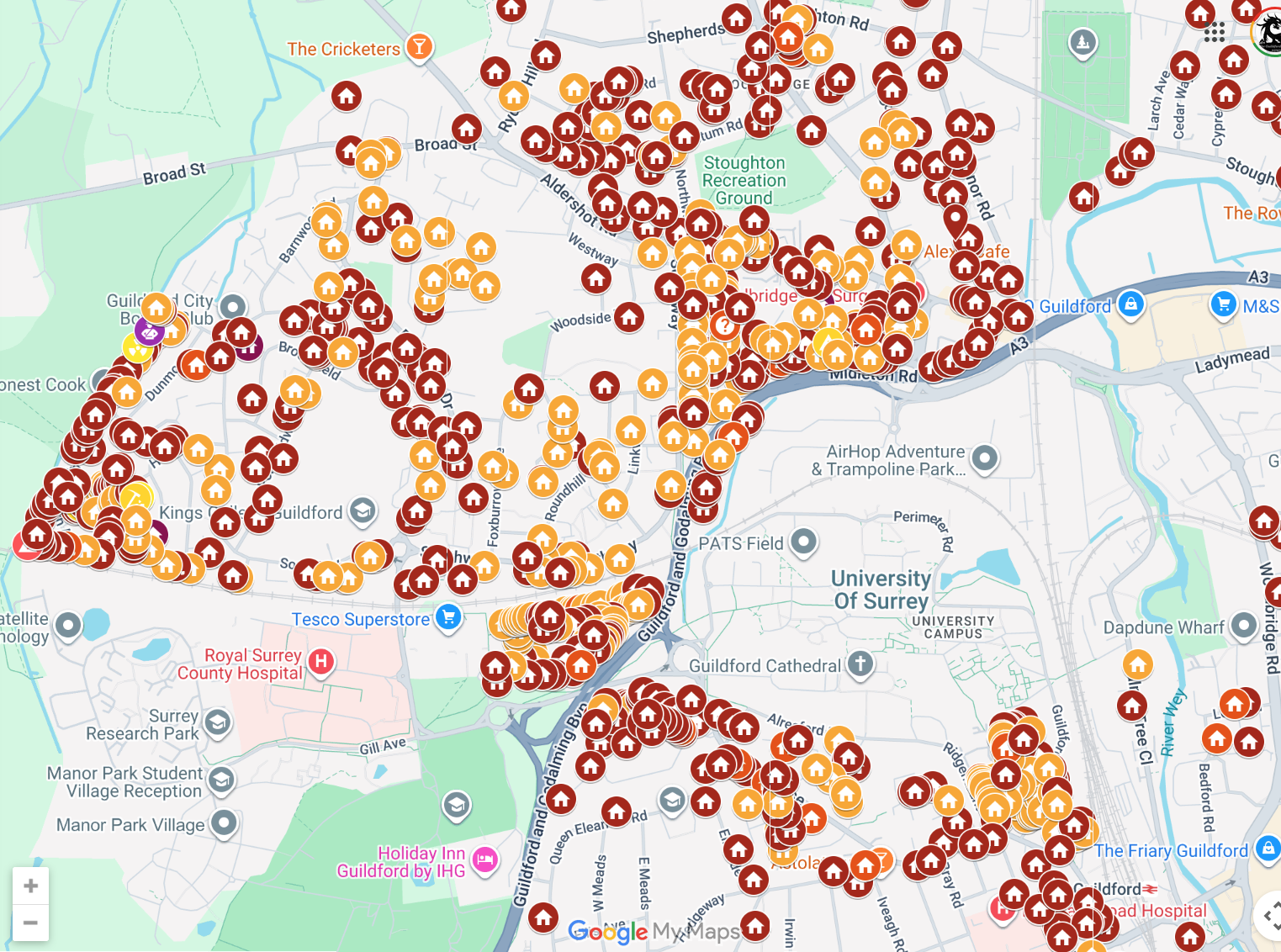
This Google map was compiled by Guildford Residents for Responsible HMOs and shows, they say, the proliferation of, in red, large HMOs with five or more occupants and, in orange, small HMOs generally with four occupants.
By Martin Giles
Residents’ concerns about the increased number of houses of multiple occupancy, or HMOs, came face-to-face with the reality of current planning regulations on Wednesday evening (June 3) in Westborough.
Council leader Julia McShane (Lib Dem, Westborough) warned of the appearance of hostility among sections of the community, while GBC’s Head of Planning said counter-measures were not straightforward. But another Westborough councillor, Howard Smith (Lab), concluded that it was “absolutely possible to find a way through” to address the problem.
The public meeting at Westborough Church, Southway, heard how an apparently inexorable increase in HMOs is said to be affecting the quality of life and the character of roads in Westborough, Stoughton and Park Barn.
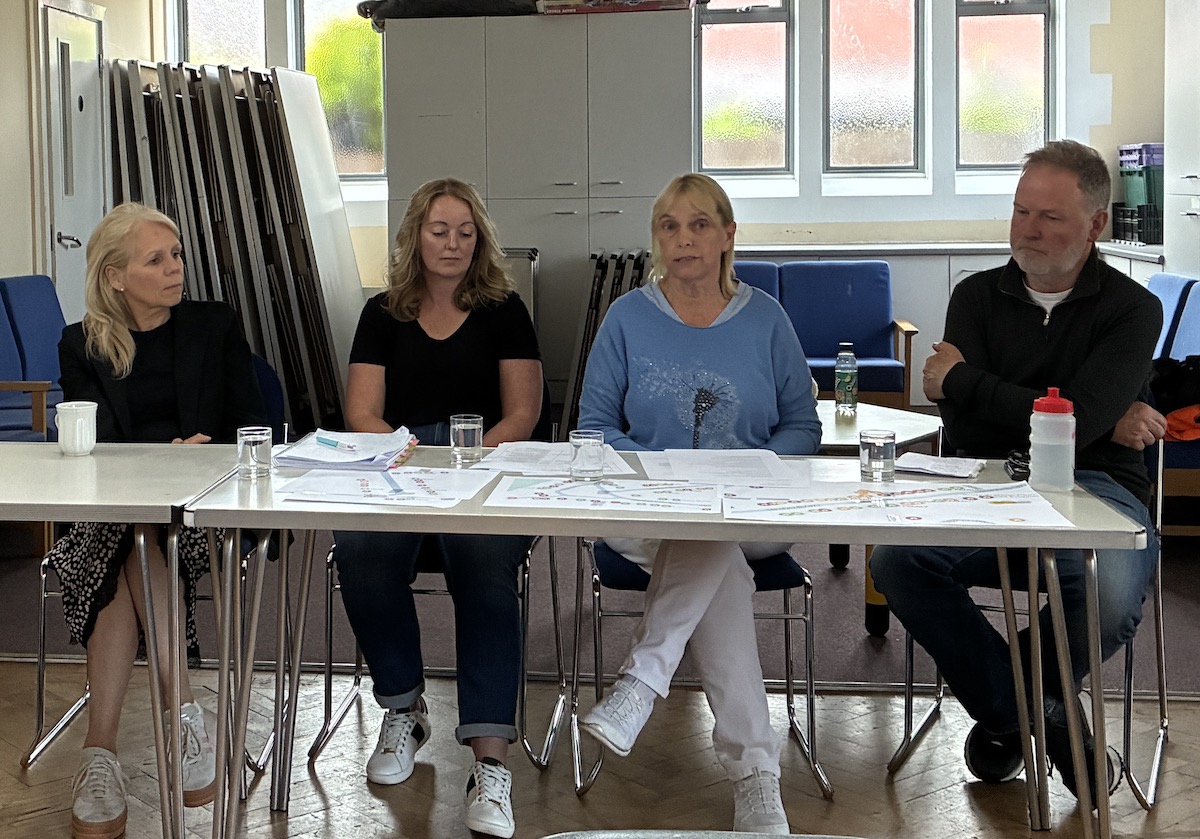
The “panel” at the meeting comprised (left to right): GBC’s Head of Planning, Claire Upton-Brown, Guildford Residents for Responsible HMOs organisers Lara Stock and Tamsin Mayhead, and Westborough borough councillor Howard Smith (Labour). On the table are charts that have been drawn up plotting HMOs in certain roads.
Organiser Tamsin Mayhead, of the Guildford Residents for Responsible HMOs, opened the meeting by summarising people’s concerns.
She said some streets were being rapidly transformed by the increasing number of HMOs, giving examples based on her research of Blackwell Avenue, Park Barn, and Queen’s Drive in Stoughton, both with 70 per cent of dwellings being HMO, and the Ashenden Estate next to Tesco at 50 per cent.
Official figures, she claimed, missed many HMOs because they were unregistered or because they were too small, ie for six people or less, to be be categorised as HMOs.
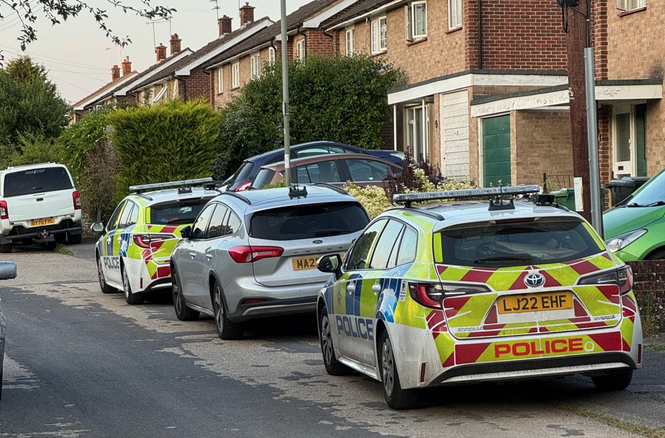
Police vehicles are often seen Applegarth Avenue and Blackwell Avenue, returning or collecting people from a care facility.
She said residents reported a loss of community, feelings of isolation, an increase in anti-social behaviour and difficulties in reporting problems. Gardens were lost and, because HMOs had multiple occupants, there was a proliferation of cars, which sometimes blocked pavements.
The desirability of issuing an “Article 4 direction” was discussed. Such a direction, it was explained, would not ban HMOs but remove automatic “permitted development rights”, meaning proposals to convert family homes into HMOs would have to go through the planning process.
The Head of Planning at GBC, Claire Upton-Brown, said that issuing an Article 4 direction, which had been considered and rejected in 2020, might not be straightforward and that strong planning reasons would need to be identified.
She said the policy with which planners would assess an HMO wasn’t about, will the residents like it? It was about, will the number of HMOs change the character of the area?
She said decisions had to be evidence based. Removal of hedges and the introduction of more cars were unlikely to be factors that would be considered. But the number of HMOs in a road or area could be.
Upton-Brown said all the needs in the community had to be assessed, including those of the University and its students.
One resident said: “Something’s gone wrong somewhere”, adding that [surely] “common sense” would dictate that the character had, and was continuing to, change. The mention of “common sense” met with a suppressed ironic titter from the audience.
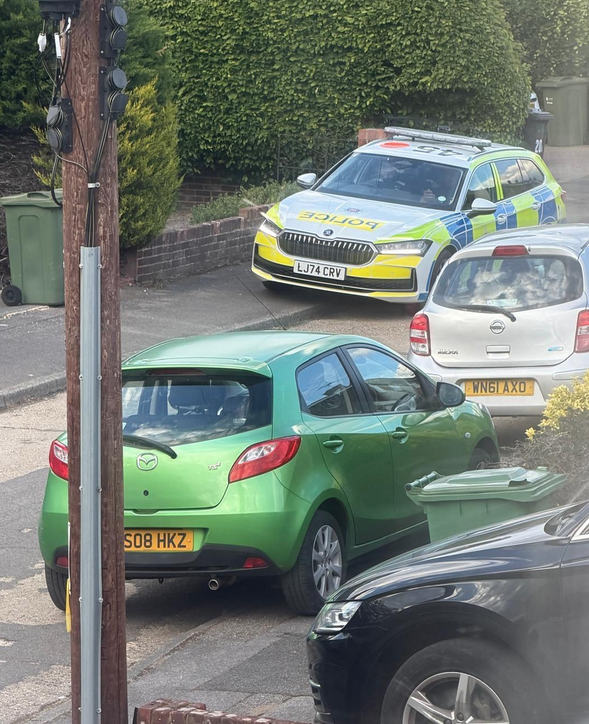
The increased number of cars on affected roads can cause pavement parking, even from the police.
In the audience was Cllr Julia McShane, the leader of Guildford Borough Council, lead councillor for housing and also a ward councillor for Westborough. She has also just been announced as the Executive Member for Housing and Communities on the new West Surrey Shadow Council.

Cllr Julia McShane
She said: “This is a really emotive subject.” Having described the ways that anti-social behaviour could be reported to the council, she explained how she had lived all her life, 58 years, in Park Barn. It had been “stable for decades” as a community and “back then every house was a family house”.
But she said: “Things don’t stay like that forever. Things change. I think this is what we’re seeing now, that there is a change.
“There is a range of needs from people who need homes. I absolutely acknowledge everything that you’re saying about the impact that some HMOs are having on you and on your quality of life. But I just want to also say that we are talking about people as well, who live in these places, and I think that, you know, I’m sorry to say it, some of the narrative around this issue can come across a bit hostile, and I know that you know I’m a councillor for the community, and I represent everyone in that community, whether they’re in a family house or whether they’re in an HMO.
“I absolutely acknowledge and hear what you’re saying about where there’s a high density of them, and the fact that Surrey County Council also use some of them for probation hostels and things like that. But there are other HMOs where there are perhaps young people sharing, where they’re just living their lives, they just… they work, they’re not causing a problem to anybody in the community.
“So I think we need to focus on actually narrowing down rather than saying all HMOs are awful, we shouldn’t have any.”
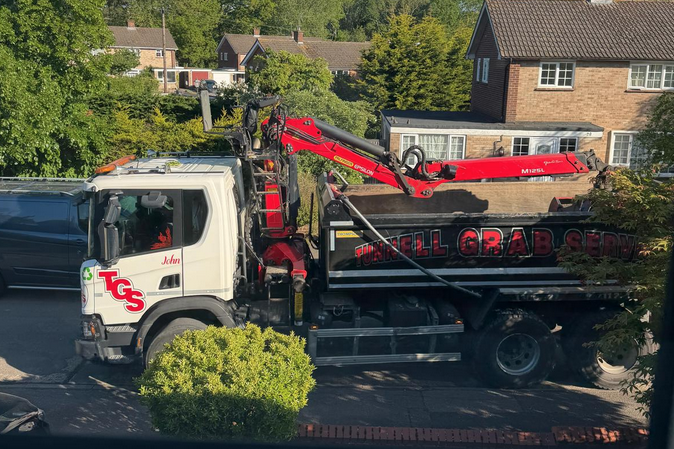
Construction vehicles add to noise and pollution levels as they busily transport building materials, usually for more house conversions.
After the meeting, Cllr Howard Smith, who in January helped persuade GBC to refuse two applications for HMOs in Park Barn, said: “Since I was elected in Westborough in 2023 the most comments and complaints I’ve had from residents is about the increasing number of houses of multiple occupation.
Cllr Howard Smith
“I want to make it clear. I and the residents of Westborough are not against students or other people in need of this type of accommodation, indeed we welcome it. But unfortunately the density in some areas of the ward have now become overwhelming, particularly on Ashenden Estate and the Applegarth Avenue and the Beckingham Road/Weston Road areas.
“The meeting on Wednesday, which I organised with residents, was to meet with the Director of Planning at GBC, Claire Upton-Brown, to work out how we can resolve the issue. Not to put too fine a point on it, it’s actually about saving our community.
“In just over two hours we discussed how we could compile a much more full and accurate register of existing HMOs in Guildford. How we could develop stronger policy to reduce further ‘densification’. It was a lively but friendly exchange of ideas.
“The feeling I had at the end of the meeting is that it is absolutely possible to find a way through, but it will require more support from the council leadership and their willingness to support residents who currently feel under siege.”
Share This Post


Responses to Residents Tell Councillors and Planner What It Is like to Live With Multiple Occupant Houses
Leave a Comment Please see our comments policy. All comments are moderated and may take time to appear. Full names, or at least initial and surname, must be given.









John Redpath
June 5, 2026 at 8:01 pm
It’s such a shame that Cllr Smith was not elected at the West Surrey Unitary elections. He clearly cares for this community, and his opinion is positive on what might be achieved in order to stabilise the well established community in the area.
What a shame his fellow councillor for this ward yet again showed a lack of determination and drive to support residents, many of which she has lived among for her entire life.
John Redpath is a former R4GV borough councillor.
Jeremy Holt
June 23, 2026 at 3:16 pm
I have never understood why the new unitary council has two councillorsfor each ward.
I feel sure that the majority of voters used bothe their votes for the same party in the recent election.
Ideally we could have half size wards each with one councillor representing a more local area.
An even better option might be for each voter to have a single vote. It might well result in two ward councillors from different parties who would have (heaven forbid) to work together like grown ups.
Elected councillors would then more closely reflect the vote.
At the moment we seem to have the worst of all worlds.
Perhaps also, in order to give the electorate a semblance of control over their lives, we should introduce propositions which can be voted on (at very little extra cost) at council elections.
The elections are supposed to be about local democracy.
Dee Bruce
June 6, 2026 at 12:09 pm
I attended this meeting, and I wish to take issue with Cllr Julia McShane’s completely unfounded comment regarding residents’ feelings about HMOs, that “all HMOs are awful, we shouldn’t have any”.
What nonsense.
Not one resident that I spoke to (and I chatted to many) felt this way. The frustration is with the over-proliferation of HMOs, not HMOs themselves. The council must address this issue with some urgency and focus their attention on the wellbeing of their tax-paying residents, prioritising the preservation of their communities.
Jeremy HOLT
June 10, 2026 at 11:03 am
According to the government website an HMO licence is required for a property with 5 or more people:
“Licensing: If a property qualifies as a “large HMO” (housing five or more people from multiple households), landlords are legally required to obtain a specific House in Multiple Occupation Licence from their local council.”
https://www.gov.uk/find-licences/house-in-multiple-occupation-licence.
This is different from the comment above:
“Official figures, she claimed, missed many HMOs because they were unregistered or because they were too small, ie for six people or less, to be be categorised as HMOs.”
The government website states five or more for a licence which is the same as four people or fewer not needing a licence.
M Durant
June 18, 2026 at 12:53 am
Guildford’s HMO market isn’t serving local workers. Single rooms are now £750–£850, which pushes working‑class people out to Hampshire and Berkshire while most local housing is geared toward the growing student population.
There’s also a rise in ads with gender and age restrictions, “female only”, “male only”, “under 30″,”no one over 40”. It’s hard to see how this is acceptable when so many people urgently need rooms under £600 and wages haven’t kept up.
Guildford needs genuinely affordable accommodation for the people who actually work here, not just more student‑focused HMOs.