- Stay Connected

Socialize

 Abraham Lincoln
If given the truth, the people can be depended upon to meet any national crisis...
Abraham Lincoln
If given the truth, the people can be depended upon to meet any national crisis...

 Guildford news...
for Guildford people, brought to you by Guildford reporters - Guildford's own news service
Guildford news...
for Guildford people, brought to you by Guildford reporters - Guildford's own news service
Insights: The Gathering Storm – Part 2
Published on: 23 May, 2026
Updated on: 28 May, 2026
 By Bernard Quoroll
In Part 1 (click here to view), I tried to paint the bigger picture of a system of government which is losing its connection with people at every level, irrespective of individual party politics.
In Part 2 I explore what this might mean in a more local context. That involves some repetition.
Politicians and civil servants in the centre cannot possibly hope to understand the diverse aspirations and needs of such a geographically and ethnically diverse population as in the UK.
There is a misguided belief that an elite based in one part of the country knows best. But it is worse than that. Successive governments have found themselves incapable of finding enough time and organisational energy to address problems which do need to be addressed at national level.
Local government has already been reinvented as a pale copy of the centre.”
Much of the North has been left to its fate. National politicians could achieve more if they did not try to fix everything themselves. But the solution is not to create local authorities which are themselves too large and too distant from the communities they serve, and which will in turn become “co-conspirators” with government in a rush to centralise even more.
Local government has already been reinvented as a pale copy of the centre. It is beyond the scope of this Insight piece to explain how that has been happening in detail, but the progression has been relentless and been continued by different administrations, driven by the one thing they all have in common – a desire to accumulate power, no doubt in the belief that only big government can change the world.
All this matters because tribalism and centralism trumps cooperation. Voters are being trained to see the world through political competition, so many of the traits of national politics filter down to local level and local politics loses its flavour. If you doubt me, you only have to look back at the most recent set of elections where very little about local needs and aspiration has surfaced. The distinction between national and local politics has all but disappeared.
A measure of local government autonomy would be a significant step in reintroducing a system of checks and balances. It would free up central government to focus on national issues. It would release local knowledge and aspiration to address local problems and give meaning to a more mutually respectful and cooperative form of local politics.
It would also reemphasise the importance of checks and balances in a messy system which we call democracy but which is infinitely better than rule or misrule from the centre.
Councils need to be large enough to be efficient but small enough to be aware of local problems and priorities…”
At the macro level, local people, governing themselves, closest to their own problems and aspirations provide a foundational antidote to centralism, not just in UK government but in a wider authoritarian context. If that sounds too apocalyptic, I would invite the reader to note what I have said about LLMs (Large Language Models or AI) in Part 1 and tell me why I am wrong.
Meanwhile, West Surrey can be seen as just another step along the road to centralisation. Councils need to be large enough to be efficient but small enough to be aware of local problems and priorities and motivated and resourced to fix them.
The truth is that it will save a bit of money here but cost a bit of money there…”
The Government’s proposals lack rigour even by comparison with proposals for restructuring in the past. They are ignorant, unsophisticated and very unlikely to deliver better and more responsive government anywhere in Surrey.
I hope to be proved wrong. There are many successful unitary councils with populations much smaller than the government model. In Surrey there is scope for more than two councils – perhaps as many as four.
My sense however is that this whole exercise has been prejudged from the beginning. It has been very obvious that any pretence of community has been abandoned in favour of the misguided belief that two councils will provide financial resilience. That could not in my view be further from the truth.
Some services will benefit from scaling up but big is not beautiful in local government and local politicians have been thinned out to the point where representation becomes meaningless.
The truth is that it will save a bit of money here but cost a bit of money there but we will never see the financial balance sheet, so will never be able to make a proper judgement about what it costs. This reorganisation is a dog’s dinner.
My sense however is that this whole exercise has been prejudged from the beginning.”
Elected people, chief executives and directors (the leaders and decision makers) will no longer have enough time to walk the floor and smell the air in their communities, be “got at” by local people or understand currents of feeling from which in Surrey they are already too well insulated.
The risk is also that transparency will be further replaced by faux efficiency mechanisms which further insulate elected people and officers from the people they serve.
I also expect that AI will need to be used much more extensively in communications between the council and residents as a cost saving measure. LLM’s are designed to sound sympathetic in conversations with people but below the surface, they are just a machine.
For me, local government has always been a “body contact sport’. It is hard enough to get an answer from the council now, on things other than basic services. Expect the new council to be even more remote and AI responses to be even more frustrating.
The public hardly bother to attend council meetings nowadays and I suspect, do not watch them much online. (If you do attend to observe, you need to bring a lap top to read the agenda and reports there are no paper copies) or struggle with a smart phone).
…all this assumes that West Surrey Council is not bankrupt on the first day…”
If local government meant more to local people, perhaps we would engage more in person. If councils in Surrey had the self confidence to assert themselves properly on our behalf we would not be in the current state.
Of course, all this assumes that West Surrey Council is not bankrupt on the first day.
Why are our newly elected representatives not already shouting about that from the rooftops? Why is no all-party deputation queueing up outside the door of number 10? It is that big an issue and a critical test for a new administration and the opposition to show some unity of purpose.
This is not meant to be a criticism of all or even most politicians at local level. Most people stand for the worthiest of reasons, work hard for constituents and are trapped within their own cultures like the rest of us. It is important to remember though, that their thinking is sometimes pre-informed by a number of political imperatives which is part of the DNA of the most political of them.
Some believe that only their way of seeing the world is the right one and that the pursuit of their political ‘religion’ excuses behaviours they would not countenance among their own family and friends. Others have a feeling that it is somehow disloyal not to follow a tribal party line which offends their own sense of what is right but is thought somehow to be necessary to obtain or retain power.
These are legitimate feelings but not ones that should trump engagement with the facts. It is naive however to suggest that politics can somehow be removed from local debate. We need good politics and good politicians.
Some believe that only their way of seeing the world is the right one…”
Most local decisions however require rationality, cooperation and compromise, coming from local knowledge of people and places, not political posturing It should be based on the respectful comparison of arguments, not belittling people with whom you disagree. The routine business of governing is also best done in public and not by individuals acting alone.
I attended the first meeting of the shadow West Surrey Council on May 21, sitting at the back in the public gallery some 60 feet from the computer screen so it was hard to follow the debate. I counted 15 people in the public gallery but very few of them seemed to be citizens.
It is a sad reflection on public life that so few ordinary members of the public attended to see the historic launch of their new council but perhaps a sign of the times.
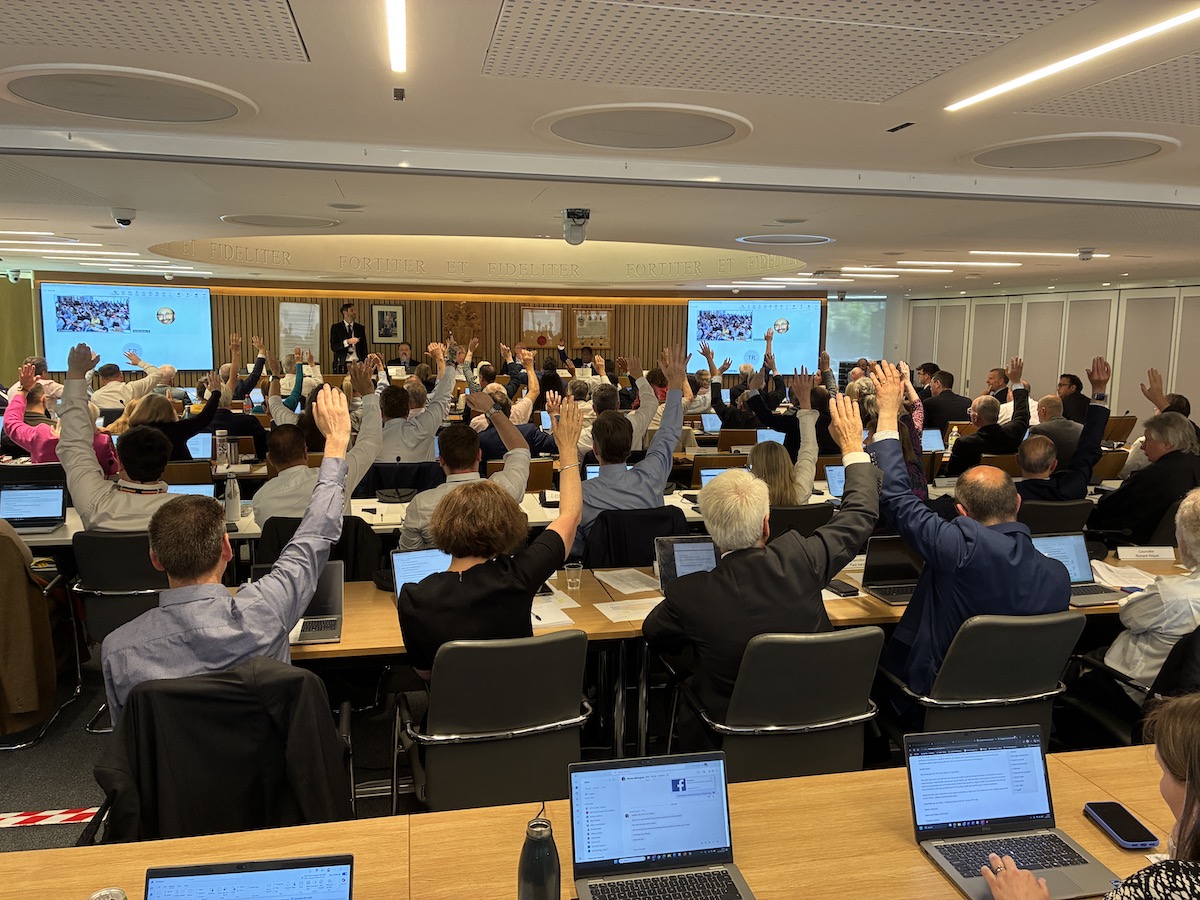
The inaugural meeting of West Surrey Shadow Council. A view from the public gallery, so far back it was hard to make out information displayed on the screens.
A GBC officer was kind enough to lend me a paper copy of the agenda and reports, all 500 pages of it, which I doubt whether all councillors had read but they might be excused this time, as timescales are very compressed.
But I have to say that I was encouraged to see, that while political differences were being aired, and members expressed strong convictions, the debate was for the most part orderly and mutually respectful in civilised Surrey.
This is unlike some councils I know where almost every Full Council meeting falls quickly into bitter recrimination. All the signs here were of elected people trying to get to grips with the magnitude of the task.
They have less than a year to do something which is unlikely to be done well in less than three years. Very few new councils have been tasked with amalgamating six districts and boroughs and half a county into one. But goodwill will not be enough.
There were already indications during the meeting of fault lines in the process and between the parties which are a long way from resolution. In particular the new leader of the administration’s claim that he is about to roll out “the most comprehensive localism agenda ever seen in the United Kingdom” is in principle a very worthy one – but the devil will be in the detail.
Implementing culture change on that scale within the time available is challenging in every way, as I will try to explain in my final commentary.
Share This Post




I'm living well for nothing at all! (See: No Trifling Matter: Magpie Trapped in Godalming Sainsbury’s)



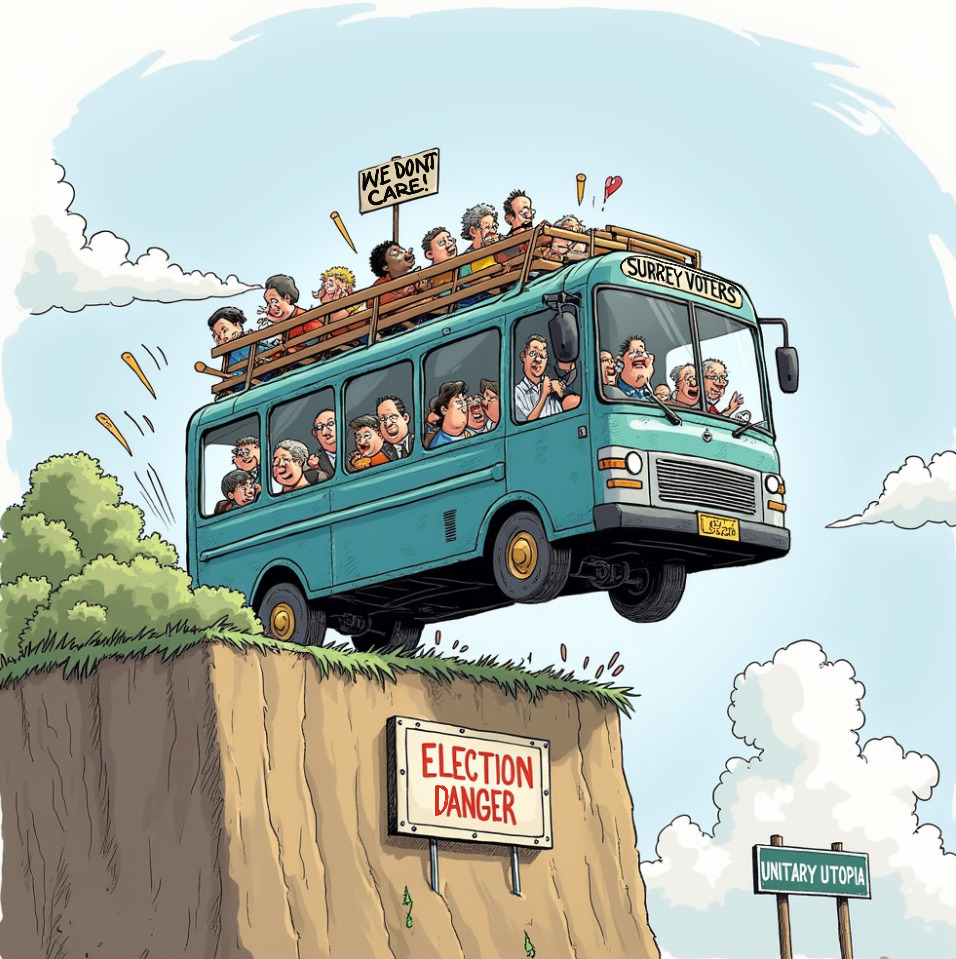
Next stop, Debt Chasm! (See: We Should All Be Outraged About the Failure to Deal with Legacy Debt)



Recent Comments