- Stay Connected

Socialize

 Abraham Lincoln
If given the truth, the people can be depended upon to meet any national crisis...
Abraham Lincoln
If given the truth, the people can be depended upon to meet any national crisis...

 Guildford news...
for Guildford people, brought to you by Guildford reporters - Guildford's own news service
Guildford news...
for Guildford people, brought to you by Guildford reporters - Guildford's own news service
Letter: Proportional Representation Is Essential To Restore Democratic Legitimacy
Published on: 18 May, 2026
Updated on: 18 May, 2026
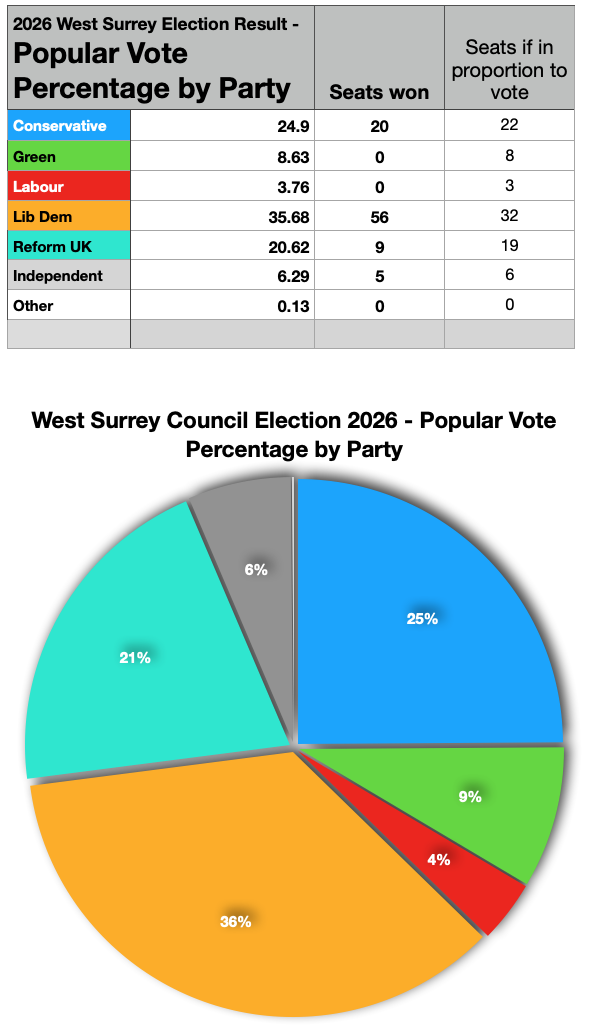
WSC Election 2026 Per cent Vote
From Andy Berriman
In response to: First Past the Post Still Has Its Merits
Patrick Bray writes that we live in a “time where a huge swath of votes are cast not as a choice for an option but as a protest”.
I would ask: where does this discontent come from? This trend is a logical response to a rigid First-Past-the-Post (FPTP) electoral structure.
Under this system, people have been unable to support a preferred party due to the risk of splitting the vote or wasting their ballot.
Forced to vote defensively against a least-favoured candidate, genuine political expression has been suppressed, breeding deep frustration. The Electoral Reform Society rightly called the 2024 general election “the most disproportional election in British electoral history”.
The UK is now, undeniably, a multi-party political landscape; our archaic two-party voting system was not built for this. The result is highly distorted outcomes, both nationally and within local communities.
While defenders argue FPTP is a “very important safeguard… from extreme or popularist movements,” it actually increases the risk of a polarizing movement gaining unchecked power on a minority mandate. When 100 per cent of power is awarded to whichever party edges ahead in fragmented contests, a fringe platform can secure total control with limited public support.
As the grassroots campaign group Make Votes Matter noted in their recent election analysis: “These should not be regarded as edge cases; they are the predictable consequences of applying a two-party voting system to a five-party political landscape.”
Their data confirms that: “Five parties polling in double digits is incompatible with a voting system that gives one party sweeping power at the expense of others.”
Updating our elections to Proportional Representation is essential to restore democratic legitimacy, consensus-building, and stability to our governance.
Share This Post


Responses to Letter: Proportional Representation Is Essential To Restore Democratic Legitimacy
Leave a Comment Please see our comments policy. All comments are moderated and may take time to appear. Full names, or at least initial and surname, must be given.


I'm living well for nothing at all! (See: No Trifling Matter: Magpie Trapped in Godalming Sainsbury’s)




Next stop, Debt Chasm! (See: We Should All Be Outraged About the Failure to Deal with Legacy Debt)





Michael Bursill
May 19, 2026 at 7:56 pm
Our Government needs to take heed of Mr Berriman before they lose their chance to act. Until now Labour’s leaders have refused to change the voting system. But last night, over 60 of their own MPs have tabled an amendment to the forthcoming Representation of the People bill calling for a national commission on electoral reform, to consider more modern voting arrangements.
I’m sure lots of other parties will have joined the call too by tomorrow.