- Stay Connected

Socialize


 Abraham Lincoln
If given the truth, the people can be depended upon to meet any national crisis...
Abraham Lincoln
If given the truth, the people can be depended upon to meet any national crisis...

 Guildford news...
for Guildford people, brought to you by Guildford reporters - Guildford's own news service
Guildford news...
for Guildford people, brought to you by Guildford reporters - Guildford's own news service
Letter: We Propose Reinstatement of Former Railway Lines
Published on: 25 Sep, 2026
Updated on: 25 Sep, 2026
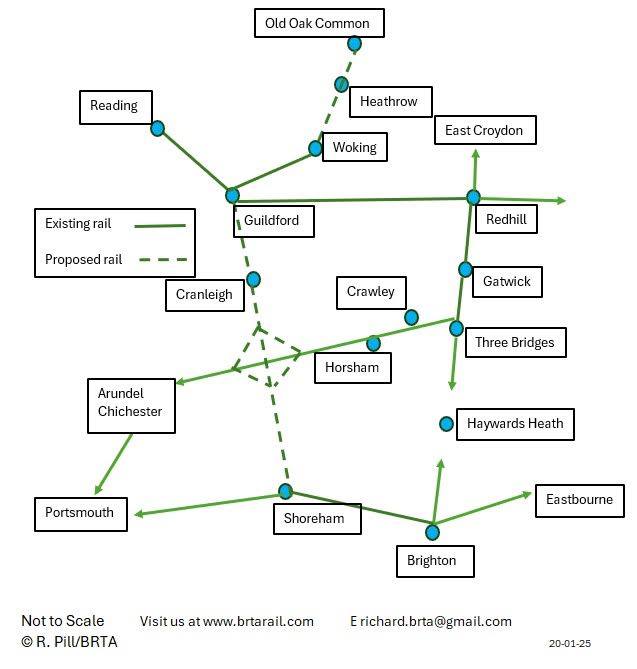 From Richard Pill
CEO, British Regional Transport Association
The British Regional Transport Association (BRTA) sees the following in favour of reopening this rail link with deviations where blockages now exist:
- Direct South Coast to Horsham, Gatwick and Guildford rail access for further afield
- Save changing at Brighton to get to London
- Increased footfall, visitor levels, spend and regenerative flows minus the traffic
- More freight off the roads and on the rails with portal connectivity, employment and supply chain stimulus.
We appreciate over the years, like so many places, councils have been tasked with meeting housing targets, but without the former railway infrastructure. Thus all the traffic from residential and industrial expansion goes onto local roads, which then at cost and land-take, are upgraded and so the pattern spirals.
That impacts urban and rural air quality, noise levels and environmental blight.
If we don’t want the pattern, we need to recover select pieces of railway to give modal choices, create modal balance and enable lifestyle choices to 99 per cent car-road dependency cultures.
BRTA calls for a study into reopening Shoreham to Horsham rail link and how problems structural and engineering can be overcome and cycleways re-routed either alongside a railway or diverted to give routeing options.
The amenity can be retained, but rail handles bulk people and goods, is faster end-to-end and opens up areas to inward investment whilst retaining their land mass and natural beauty.
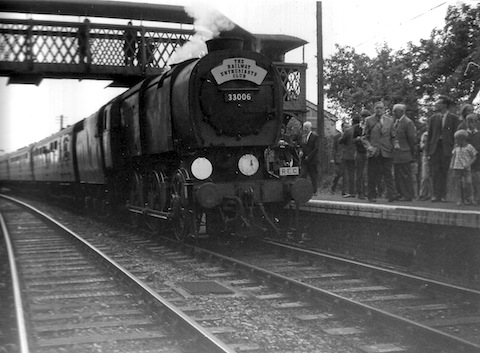
Locomotive at Cranleigh in June 1965.
This may be the last chance, but growing places need more and better rail-based access to and from. We can’t put our heads in the sand and pretend the glaring gap and associated deficits do not exist.
Indeed, were this railway restored to modern standards, it could be part of a regional through route between Brighton and Chichester and Reading/Heahtrow respectively for further afield travel.
At this stage we ask:
- the remaining corridor is protected adequate width for a twin-track railway corridor
- a policy of relocation where possible to restore the route (Not all houses need demolition, but enough to enable railway recovery or lands adjacent even bypassing growth areas, to enable a railway end-to-end to be functional.)
- a study to look at business cases, engineering, environmental impact and feasibility to base policy on and advocate with neighbouring councils and agencies to fund the reopening with full government support and that of leveraging in other investors.
We hope this proposition is considered and that the visionary diagram helps put it in a regional and strategic context.
Share This Post


Responses to Letter: We Propose Reinstatement of Former Railway Lines
Leave a Comment Please see our comments policy. All comments are moderated and may take time to appear. Full names, or at least initial and surname, must be given.

PM You say you're worried about the reaction in Surrey to council reorganisation. How many Labour MPs does Surrey elect? Angela Rayner: None, ever. PM Next item!












Adrian Chandler
September 25, 2026 at 11:10 pm
This makes sense. It may help relieve a congested Cranleigh and may encourage modal shift in journeying to Brighton and beyond.
Tony Harrison
September 27, 2026 at 12:10 pm
Oh yes, get rid of the Down’s Link. Heaven forfend there’s a last place to walk, run (learn to) cycle, free of danger and traffic pollution.
Warren Gill
September 29, 2026 at 4:52 pm
The needs of the many outweigh the needs of a few.
The line should never have been closed in the first place, it was closed by stealth and poor timetabling, so the trains on the Cranleigh line never met with trains on the Arun Valley line at Christ’s Hospital and were deliberately timed so that passengers would have a long wait at either end and the frequency poor.
With the potentially large development of 3,000 houses at Dunsfold, there’s going to be a substantial increase in traffic, which the residents of Bramley & Shalford will undoubtedly moan about.
Restoring the line will help reduce that, it would enable easier journeys to Gatwick, Brighton & Thameslink destinations too.
Fast quiet electric trains (dual or tri-mode) would allow for many destinations to be served more easily and efficiently, it would also benefit St Catherine’s & Gosden House schools as well, the former being within two minutes walk from the station.
It has been proven that where lines and services have been reinstated and introduced that the passenger numbers have been extremely favourable (eg Galashiels and Ashington (T&W)) to the point where extensions are already being planned.