- Stay Connected

Socialize

 Abraham Lincoln
If given the truth, the people can be depended upon to meet any national crisis...
Abraham Lincoln
If given the truth, the people can be depended upon to meet any national crisis...

 Guildford news...
for Guildford people, brought to you by Guildford reporters - Guildford's own news service
Guildford news...
for Guildford people, brought to you by Guildford reporters - Guildford's own news service
Opinion: Locally and Nationally We Are Politically Divided But Some Remedies Are Possible
Published on: 2 Aug, 2017
Updated on: 3 Aug, 2017
 By Martin Giles
Nearly two months since the general election and the political scene remains confused. There will be consequences for Guildford but these are also unclear.
Nationally we are as divided as ever over the EU and Brexit. Remainers might be hoping that with the passage of time Brexit might become softer and softer, they might even continue to hope for a second referendum, while leavers could be more and more frustrated over the time the divorce is expected to take and the predictions that little will change for some years.

The general election did nothing to increase national unity. Even if the opinion polls were correct, and most think that now the referendum result is known the politicians should just get on with it, the Conservatives did not win their expected victory.
And even though Labour claim to have accepted the referendum result their MPs give mixed messages. Some, with an apparently futile hope that we can remain in the Single Market, are simply unable to countenance an outcome that would significantly constrain immigration levels, even though it was the issue that decided the votes of many of their supporters, in the North, in the 2016 referendum.
Some Tories, including some at cabinet level, seem to share the concern that limiting immigration will have an intolerable economic cost.
Locally, the main impact of all this is that the extra demand for housing caused by high immigration levels is unlikely to decrease anytime soon. Indeed, Guildford’s position just 30 miles from London, means the demand is practically limitless.

Even less than the 48% support given to the Conservatives can give complete domination under FPTP.
But our first past the post system and perhaps the seemingly hollow promises to protect the green belt, given during the election campaign in 2015, has ensured that the borough council remains dominated by the Conservatives. Their leaders at Guildford Borough Council remain determined to proceed with a Local Plan that still, despite an unusually high level of objection in the public consultations, includes proposals for significant developments on the green belt.
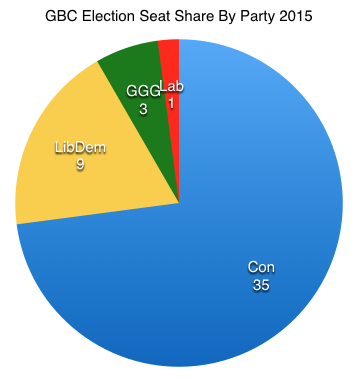
Note one seat has been lost by the Conservatives in a by-election since 2015 and won by Labour.
The opposition and its largest party the Lib Dems are split on the issue, reducing its effectiveness. While the Guildford Greenbelt Group’s three councillors, despite representing 14% of those who voted in 2015, are too often treated contemptuously with shameful arrogance by a small number of leading councillors.
Although the argument is generally accepted that more affordable housing should be provided, most, including council leader Paul Spooner, agree that the planned developments will not significantly reduce house prices. Certainly, it is unlikely that the planned new private houses will help the several thousand on the council’s housing list. Surely what is needed for them is more social housing.
But the council seems, like the government, besotted with economic growth, at all costs apparently. Of course, it would be strange if the economy did not grow roughly in line with the increasing population but to assume that all is okay as long as our GDP increases, the normal measurement of growth, is unwise.
In any case, whether recent growth is being properly shared out seems doubtful, especially with the increased competition faced by native unskilled workers and population growth cannot continue inexorably on a relatively small island without damaging our environment irreparably. Some might say it already is.
Nonetheless, GBC is willing to accept the constraints placed on them by central government planning policy, policed by the planning inspectorate, and the preservation of all of our existing green belt is looking unlikely.
It is said that only a few per cent of green belt land will be given up but the areas around the new developments will inevitably be affected, made less attractive and devalued. Who is to say that with continuing demand in years to come a little more of the marginal green belt will be given up?
Anyway, giving up green belt land is not the only answer to the housing shortage. Amongst other possible measures the government could take is first, to stop or limit foreign investment in UK housing and, second, to prohibitively tax empty housing and undeveloped brown field sites.
Most essentially, the government must understand that the South East is already suffering badly from its density of population while other areas of the UK are in far greater need of economic investment and development.
Share This Post


Responses to Opinion: Locally and Nationally We Are Politically Divided But Some Remedies Are Possible
Leave a Comment Please see our comments policy. All comments are moderated and may take time to appear. Full names, or at least initial and surname, must be given.

I'm living well for nothing at all! (See: No Trifling Matter: Magpie Trapped in Godalming Sainsbury’s)



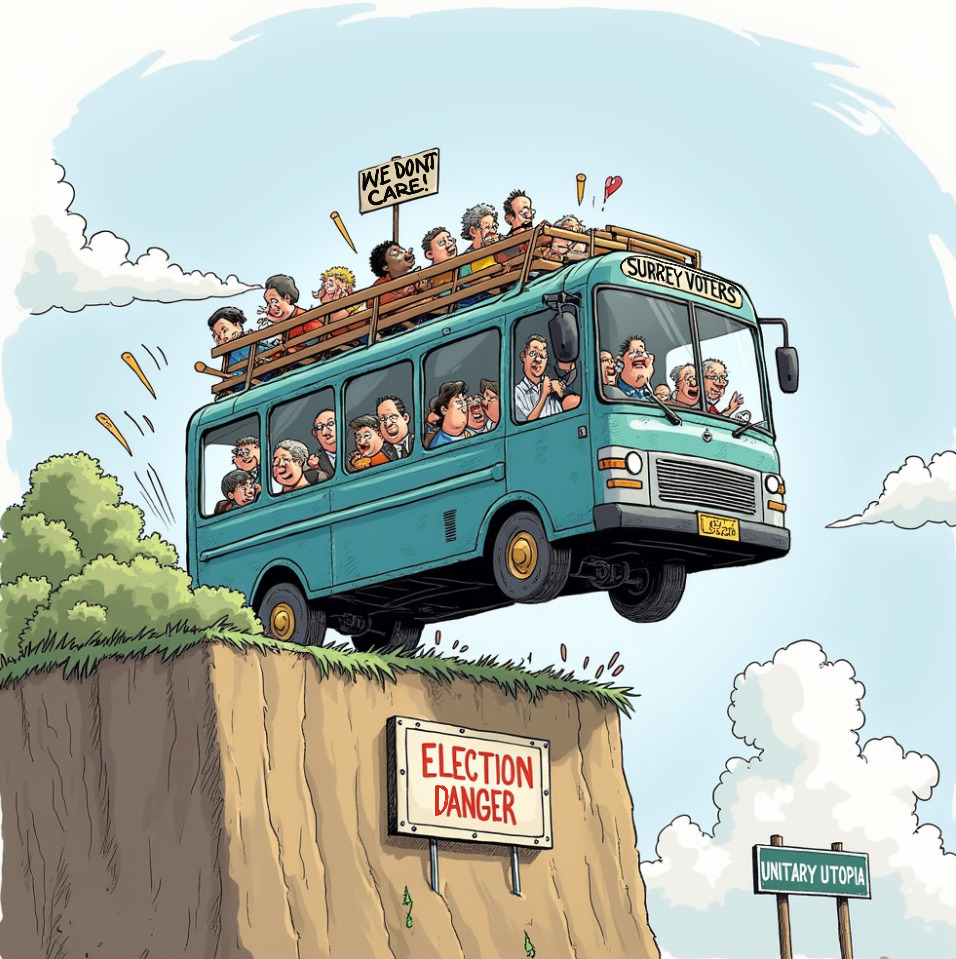
Next stop, Debt Chasm! (See: We Should All Be Outraged About the Failure to Deal with Legacy Debt)




John Perkins
August 2, 2017 at 10:29 am
I doubt that the promises regarding the green belt made by the Conservatives before the election in 2015 can be described as “seemingly hollow”. The fact that, after the election, they have been qualified by the weasel words “wherever possible” shows them for what they really were: actually hollow, at best.
Some claim that only a small percentage of the green belt will be given up, but a further percentage will have green belt protection removed in future by the “insetting” in the Local Plan. It’s worth reminding people that, whilst removing many villages from the green belt, the plan proposes to add that part of the borough where the Conservative leader has his patch.
Also worthy of note is the fact that, although almost every building in one village, plus the two new sites where development is proposed, are shown within the boundary for “insetting”, the small area where a Conservative Minister resides is outside.
Jules Cranwell
August 3, 2017 at 4:11 pm
This is an insightful piece of journalism, worthy of the nationals.
It spells out the hypocricy prevailing within our council leadership.
The game is truly up for the myth of ‘affordable housing’. This will do nothing to help those most in need, including key workers, and the council has shirked its responsibility in providing real social housing, on the back of this myth.
This local plan is nothing but a money tree for the development industry.
Jim Allen
August 4, 2017 at 10:59 am
In the book, “Enquire within for every thing,” circa 1910, it stated “a man should not borrow more than three and a half times salary else he will be in debt for the remainder of his life” (or words to that effect).
As the average “alleged” salary is somewhere around £30,000 I don’t think the purveyors of the “affordable” homes policy have read the ancient text. They certainly don’t seem to understand such a principle.
John Perkins
August 5, 2017 at 11:38 pm
I suspect they don’t care about principles; only money.
Bernard Parke
August 5, 2017 at 11:34 pm
Jim Allen raises an interesting point. In the sixties, when I bought my first house, priority was give to young married couples.
Anyone who was not married found it very difficult to get a mortgage at all. The rule used by building societies was then three times the husband’s salary. Wives earnings were not taken into consideration at all, in case they gave up work to start a family.
Things have changed but that was a time when houses were truly “affordable”.