- Stay Connected

Socialize


 Abraham Lincoln
If given the truth, the people can be depended upon to meet any national crisis...
Abraham Lincoln
If given the truth, the people can be depended upon to meet any national crisis...

 Guildford news...
for Guildford people, brought to you by Guildford reporters - Guildford's own news service
Guildford news...
for Guildford people, brought to you by Guildford reporters - Guildford's own news service
Comment: How An Elderly Man’s Accident Shone a Light on 21st Century Healthcare
Published on: 6 Mar, 2026
Updated on: 10 Mar, 2026

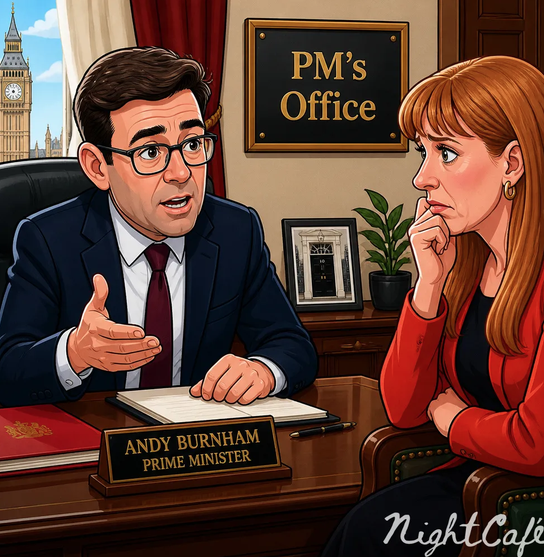
AI illustrative image
By David Reading
A young man I’d known for years knocked on the door and pleaded for help. His 83-year-old Dad had fallen over in the street outside our house and couldn’t get up.
When I went outside, the elderly man, Michael, was lying on his front. His face had hit the road and there was blood everywhere. His walking stick was lying nearby.
Michael is quite a large man but we managed to get him to his feet, helped by a neighbour, and drove him to his home.
Inside the house, we did our best to clean him up with antiseptic wipes. His forehead and nose were bleeding and there was a lump on the front of his head. It was obvious he needed proper medical aid and an assessment.
 I phoned Michael’s local surgery a little after 5pm and asked if I could drive him down. That’s where we hit a problem.
Some of us are old enough to remember how, not too long ago, you could phone your local surgery with a relatively urgent medical problem asking to be seen, and they would tell you to come down immediately.
This happened on numerous occasions with my daughters during the 80s and 90s. One of them suffered frequent asthma attacks and another became ill a couple of times with worrying headaches.
Sometimes this happened on a Sunday. The surgery staff would always say, “Come on down immediately.” In the case of my daughter with asthma, there were times when a doctor would come out in the middle of the night. A home visit was normal in years gone by.
Returning to Michael and his injury, we saw a different state of affairs. After dialling the surgery’s number there was a wait of several minutes while we listened to recorded messages (The best way to get an appointment is to go online, Follow us on Facebook, that kind of thing). This is something one has to accept as a part of 21st century life and there is no point complaining about it.
 But getting immediate help for Michael was the real problem. When a receptionist answered, she was friendly and courteous but adamant that Michael could not be seen. There was no one available. I argued politely: “Michael simply needs a few minutes of someone’s time to assess whether he could have suffered serious damage.” She remained polite but resolute. We would have to take him to an Urgent Care Centre or A&E.
Am I wrong, or are we frequently told to consider all other options before putting pressure on the emergency system? In any case, Michael was suffering from shock and so the prospect of him sitting in a waiting room full of people was not ideal. He needed help soon. Was there no way someone at the surgery, just a few minutes’ drive away, could check him over? “There is no one here,” was the reply. I know for a fact that the surgery opens until early evening.
 Finally, in a state of some anxiety, we decided to dial 999. The thinking – rightly or wrongly – was that a paramedic would be able to assess Michael efficiently and decide whether it was safe for him to remain home (which he wanted) or should be taken by ambulance to hospital.
The emergency operator was efficient, thorough and faultless. After asking a series of questions and taking notes, she arranged for an ambulance. A first responder arrived, followed by a paramedic, and Michael was given a comprehensive assessment. It was decided he was not suffering from concussion or broken bones and could remain home. Next day he was beginning to recover from his ordeal.
So what has changed in 25-30 years? I’m sure there is no decrease in commitment from the local health professionals during that time, and this article is certainly not a criticism of Michael’s local surgery.
No, the key factor is the large increase in new housing and the subsequent rise in the local population. Guildford Borough Council’s own records show that around 4,400 homes were built in the borough between 2015/16 and 2024/25. Based on the 2021 census information 4,400 new homes amounts to about 11,000 new residents. The problem is that the necessary improvements in infrastructure – in this case primary healthcare – do not always keep pace with this population growth.
We are not alone, I’m sure. All over Surrey, and all across the country, new housing developments are going up putting pressure on healthcare, roads and schools. When granted planning permission, developers make legally binding commitments – called Section 106 agreements – pledging to provide benefits to the local community where they are building. But as the Guildford Dragon has reported this week, those benefits do not always come to pass.
https://guildford-dragon.com/questions-raised-over-community-benefits-promised-by-house-builders/
It’s clear that council planners need to be far-sighted when allowing housing developments to go ahead and as local resident John Ferns points out in our article, when s.106 agreements are discussed any uncertainties should be addressed at the outset.
We have asked the Royal Surrey NHS Foundation Trust if they would like to comment on how they view local health services – and whether they are under pressure from the growing population – but so far have not received a reply.
Share This Post



PM You say you're worried about the reaction in Surrey to council reorganisation. How many Labour MPs does Surrey elect? Angela Rayner: None, ever. PM Next item!











Recent Comments