- Stay Connected

Socialize


 Abraham Lincoln
If given the truth, the people can be depended upon to meet any national crisis...
Abraham Lincoln
If given the truth, the people can be depended upon to meet any national crisis...

 Guildford news...
for Guildford people, brought to you by Guildford reporters - Guildford's own news service
Guildford news...
for Guildford people, brought to you by Guildford reporters - Guildford's own news service
Dragon Interview: Local Author David Stokes on His New Book – Sermon of the Wolf
Published on: 12 Oct, 2026
Updated on: 13 Oct, 2026
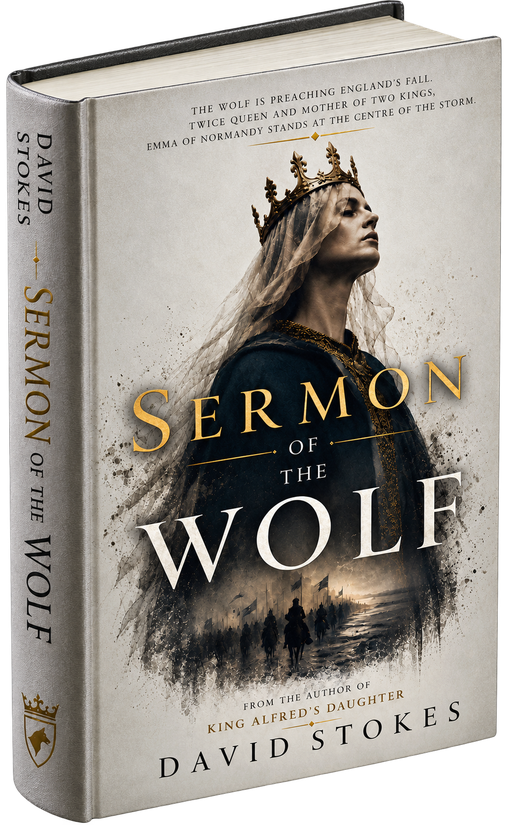 Local author David Stokes launches his third historical novel, Sermon of the Wolf, at Paper Moon bookshop this Thursday (October 15). He tells Alice Fowler how a bloody incident in Anglo-Saxon Guildford helped inspire his latest novel.
Congratulations on your new novel, Sermon of the Wolf. Can you tell us a little about it and its link to Guildford?
The story is set in the fifty or so years before the Battle of Hastings and tells how the Anglo-Saxons lost control of their country through the feuds and divisions amongst the ruling elite. Central to the plot is Emma of Normandy, who was twice queen and mother of two kings during this period.
The local connection is through one of her sons, Alfred the Ætheling, who was apprehended in Guildford and his followers murdered. Their remains were discovered when a gardener in Guildown Road unearthed their bones in 1929.
Many Dragon readers will know you as the chair of Holy Trinity Amenity Group, HTAG. What was your path to becoming a writer?
I have been writing for much of my life, particularly during my time as an academic at Kingston University, where I wrote journal articles and several non-fiction textbooks including one now in its 8th edition. When I retired, I wanted to write more creatively so I turned my hand to fiction. It was a difficult transition! What helped me was that as an academic I specialised in case studies of successful people in my field. This made me realise the importance of characters which to me are still the one overriding thing to focus on in fiction.

David Stokes
What draws you to historical fiction, and to Anglo-Saxon times in particular?
The Anglo-Saxons have fascinated me ever since I studied history at Oxford. They were one of the most successful people to emerge from the ruins of the Roman Empire and built a unified kingdom ahead of other European states yet managed to throw it all away to a minor dukedom! The more I researched the period, the more I found that the women of the period were particularly influential and tended to be more interesting than their warrior menfolk.
This is your third Anglo-Saxon novel – how is it connected to the first two, and are more novels on the way?
The three novels are chronological, but are stand-alone stories. The first, Angles or Angels is set around 600AD when the first Anglo-Saxon kingdoms had emerged in northern Britain and Christianity was spreading.
The second, King Alfred’s Daughter, is the story of Æthelflæd, Lady of the Mercians who ruled a large territory in her own right, helped defeat the Danes, yet was written out of history by her own contemporaries (probably prompted by a jealous brother).
The third, Sermon of the Wolf, is about Emma of Normandy who arrived as a girl of 16 to marry a failing English king and managed to remain at the centre of power for fifty years until she died in 1052 with her son Edward the Confessor on the throne.
I am now working on a fourth Anglo-Saxon novel, this time about a man, the enigmatic foster son of Æthelflæd, King Alfred’s daughter, who united all the Anglo-Saxon states to become the first King of all England, yet who is largely forgotten. (I wonder how many of your readers know his name?)
What was your path to publication?
I have tried most of the paths to publication! We live in a fortunate, yet sometimes bewildering time, of multiple publication routes. My first novels used ‘hybrid’ publishers who do some of the work for you in return for your own investment in your book. If you can afford it, this is a possibly a good way to start.
Self-publishing, that is doing the entire publishing process on your own, can be daunting and difficult to get right. I tried it once with a young adult novel, which was not very successful, primarily because I was not completely clear about my target audience.
For Sermon of the Wolf, I got a traditional contract with an indie publisher Foreshore Books, primarily because of the success of my previous novel. Smaller imprints are returning once again and worth seeking out if you are a relatively unknown author; some do not require you to have an agent but will take direct submissions.
Any tips for aspiring writers?
The best tip I ever had about being a writer was simply ‘keep writing.’ And finish what you have started!
For more information on David and his writing, see www.davidstokesauthor.com
Share This Post


Responses to Dragon Interview: Local Author David Stokes on His New Book – Sermon of the Wolf
Leave a Comment Please see our comments policy. All comments are moderated and may take time to appear. Full names, or at least initial and surname, must be given.










David Roberts
October 13, 2026 at 6:07 pm
David Stokes’ books have shown that, when it comes to the Middle Ages, good historical fiction is often more enlightening than academic history, especially when approached through its neglected female characters.
As a history student, the Wars of the Roses made no sense to me until I read The White Queen by Philippa Gregory. Queen Emma was supremely important in the tangled dynastic politics that set the scene for the Norman conquest, with its multiple Æthelreds, Edmunds, Edwards and Harolds. Her true story is a useful antidote to the Norman propaganda of the famous Canterbury embroidery (alias Bayeux tapestry).
I hope David will tackle the Empress Matilda next.