- Stay Connected

Socialize

 Abraham Lincoln
If given the truth, the people can be depended upon to meet any national crisis...
Abraham Lincoln
If given the truth, the people can be depended upon to meet any national crisis...

 Guildford news...
for Guildford people, brought to you by Guildford reporters - Guildford's own news service
Guildford news...
for Guildford people, brought to you by Guildford reporters - Guildford's own news service
History of Woking’s Fire Service and Some Dramatic Blazes in its Early Years
Published on: 5 Nov, 2025
Updated on: 5 Nov, 2025
By Mark Coxhead with David Rose
Plans to establish a fire brigade in Woking was somewhat later in time compared to other towns.
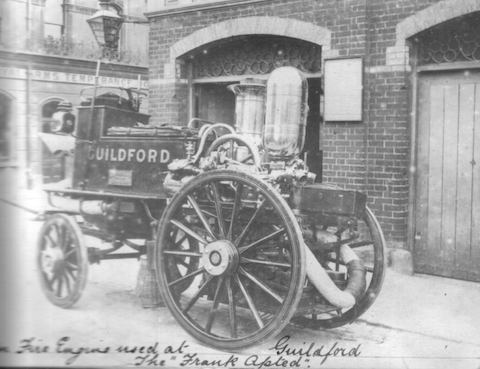
Guildford Corporation’s steamer firefighting appliance pictured in North Street.
Guildford Corporation, for example, purchased a horse-drawn manually-pumped fire engine in 1863, while in Woking the idea of forming a brigade didn’t materialise until 1892.
It was a group known as the Woking Torchlight Society, famed around West Surrey for its November 5th celebrations, that got things moving.
Its committee proposed to reserve its remaining funds to purchase hose and hydrant equipment, laying the foundation for a fire brigade. Members of the society also pledged to serve as volunteer firemen if needed, and a Mr H. W. Gloster offered to store the equipment.
A supplement titled Twenty Years in Woking published in the Woking News & Mail in 1914, gave details of how the brigade was slowly established.
Here are some extracts from it…
The history of the Woking Fire Brigade is perhaps unmatched anywhere in the country. In its formative years, the brigade faced fierce opposition from critics driven by blatant ward rivalries. Council debates over fire-fighting equipment were more heated than any other issue, drainage included.
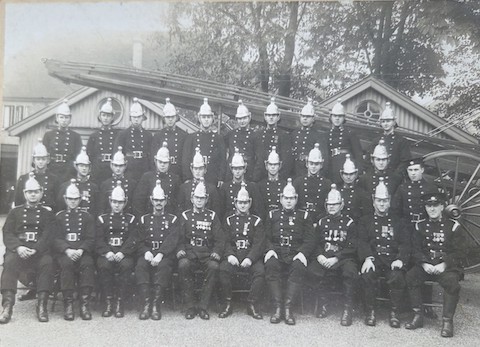
Woking’s firemen when they still wore brass helmets. Photo courtesy of Glenn Howard. His grandfather is pictured in the front row, first left.
Yet the brigade endured. It overcame ill-natured attacks and proved its worth through perseverance and dedication. Mr. C. Sherlock, the original captain, remained steadfast throughout those turbulent times, loyally supported by his fellow officers and men. By 1914, he commanded one of the most well-equipped and efficient fire brigades in all of Surrey.”
In 1894, [Woking’s] Local Board resolved to formally establish a fire brigade and purchase a steam [fire] engine. However, their plans were disrupted by the dissolution of the board and the formation of the Urban District Council. The new council, lacking resources, relied solely on water pressure from the mains and postponed acquiring an engine.
Instead, they purchased 17 lengths of 40ft leather hose and a telescopic escape ladder.
The brigade was officially formed with a central section led by Captain C. Sherlock, Superintendent H. Quartermaine, and six men. Additional sections were established in St Johns with Foreman G. A. Jackson and three men, Knaphill with foreman A. Gunner and three men, and Woking Village with foreman J. W. Grantham and three men.
The brigade made its first public appearance with their equipment at the Torchlight Carnival on November 5, 1895. Just a month later, they faced their first real emergency, a fire in a stable behind a Mr Shepard’s shop on Goldsworth Road.
Had it not been for a relatively minor fire, the brigade’s limitations might have gone unnoticed. But even that small outbreak exposed serious shortcomings. The immediate result was the purchase of additional hose and the replacement of leather with canvas, an improvement, but still far from sufficient.
At the time, the fire station [a basic hut] stood in the centre of Chertsey Road. Despite the upgrades, Captain Sherlock warned the council that the equipment would only prove adequate under ideal conditions, a prediction that was soon dramatically confirmed.
He urged the council to construct a central fire station, acquire a steam fire engine, and invest in a sufficient length of hose to handle serious emergencies. His advice, however, fell on deaf ears.
In October 1897, three fires broke out within a single week. At each incident, the brigade was virtually powerless due to its inadequate equipment. Frustrated by the council’s refusal to purchase a steamer, the entire brigade resigned in protest two months later.
Just a week after their resignation, on December 23, a public meeting was held where ratepayers voiced their outrage. They unanimously demanded the immediate purchase of a steam fire engine. Ironically, the council had recently proposed spending £6,000 to £7,000 on municipal buildings, yet had dismissed the need for proper fire-fighting equipment.
The brigade eventually returned to duty, but the council’s decision to divide it into four separate sections was met with strong opposition from Captain Sherlock.
The scheme proved unworkable, sparking heated debates in the council chamber and a flurry of letters in the Woking News & Mail, reflecting widespread public concern.
The 1898 elections marked a turning point: candidates who had opposed the fire engine were defeated, including the late Mr. H. W. Gloster.
At its first meeting, the newly elected council voted to purchase a steamer. Following a Local Government Board inquiry, the order was placed in February 1899.
Before the engine could arrive, fate intervened. On June 6, the Urban Council Offices, located above the Old Bank [on the corner of Chersey Road and The Broadway], were completely destroyed in one of the most devastating fires Woking had ever seen.
Strangely, the blaze occurred in broad daylight, in offices without any active fires. The caretaker’s apartment on the same floor and the bank below were untouched, yet the offices were utterly consumed.
To many, it felt like poetic justice – Nemesis catching up with a council that had long neglected its fire brigade.
In this and other recent outbreaks, fire had proven itself not just a threat, but a test of preparedness.
The steamer finally arrived on August 2 and was first deployed a month later at a fire in Saunders Lane. From that moment, the brigade’s efficiency soared under the capable leadership of Captain Sherlock, who continued to serve with distinction through 1914, fully earning the trust placed in him.
Further fires during the brigade’s early days as reported by the Woking News & Mail
Fires were reported in incredible detail in Victorian newspapers and on into the early 2oth century. The one below we have reproduced just the first six paragraphs of the story plus a few paragraphs further on.
Serious Explosion at Electrical Works, July 24, 1897
Factory Destroyed, Workman Narrowly Escapes — Estimated Damage £20,000
The old adage that fire is a poor master was tragically affirmed in Woking on Saturday morning, when the factory of the International Electric Supply Company on North Road was engulfed in flames and ultimately reduced to ruins. The estimated damage is reported to be £20,000.
The blaze, which broke out around 5 am, was accompanied by a violent explosion. Due to the highly flammable nature of the building and its contents, the fire consumed the structure in under two hours. Its intensity was staggering – virtually nothing within reach survived. Heavy machinery was warped and twisted by the heat, and a large steel plate, known for its immense resistance, buckled as if it were made of tin. The battle was swift and brutal, with the flames emerging as the undeniable victors.
The cause of the fire remains uncertain. One initial theory suggests it may have resulted from the interaction of chemical gases stored on-site.
However, Mr S. New, the factory manager, believes the fire preceded the explosion and was likely triggered by an overheated flue. Notably, the boiler and steam engine, both operational at the time, remained intact, indicating they were not the source of the blast.
At the time of the incident, four workmen were present, having worked through the night on a special assignment. The eight-horsepower steam engine was running, and one of the men, a young attendant named Ward, was in the boiler house when the explosion occurred.
The force of the blast threw him into the yard, yet remarkably, he escaped with only shock and a severe shaking. The other three workers, stationed at the far end of the building near the road, were unharmed.
The brigade’s Captain Sherlock said: “The issue stemmed from the hydrant at the junction of North and Walton Roads. It was a ‘ball hydrant’ – a type of which there are only two or three in the entire district. Our standpipes aren’t compatible with that design, so we had to look elsewhere.
“The workmen told us there was a hydrant directly opposite the factory, but despite digging at the indicated spot, we couldn’t locate it. We then moved to the hydrant on Maybury Road, where we successfully set up our standpipe. That process took no more than four or five minutes, and within ten minutes of our arrival, water was being directed onto the building.”
Captain Sherlock also pointed out a critical oversight: “The brigade has no comprehensive list of hydrants in the district. That’s a serious omission and needs to be corrected immediately.”
When asked about the delay between deploying the first and second lengths of hose, he responded: “That was simply due to a lack of equipment. Until the Woking Village contingent arrived, we didn’t have enough hose to connect to a second hydrant. Our appliances are distributed across Village, St Johns, and Knaphill stations. In many areas, we’re unable to act until all units arrive with their gear. And in some cases, even combined, our equipment is inadequate. We don’t have a fire engine. That means we can’t pump water ourselves – we’re entirely dependent on the pressure from hydrants, whether it’s sufficient or not.”
Here is a report of a blaze at Wareham Farm, Sutton – presumably Sutton Green – in October 1897. The details are once again extremely comprehensive, especially of note are the problems that arose. One being a lad who couldn’t go and alert the fire brigade because he was without his own bicycle and was unable to borrow one!
Fire at Wareham Farm – Equipment Shortfalls and Communication Breakdown
A fire broke out last Friday at Wareham Farm in Sutton, a property owned by Captain Salvin and rented by Captain D. Bayly.
The farmhouse itself was unoccupied at the time, and Mr G. Faggetter, the bailiff responsible for the premises, resides some distance away.
The blaze was first spotted by a man named Barrett, employed by Mr S. Bircham. A rider was dispatched from the farm to alert the Woking Fire Brigade at 4.50 am. Captain Sherlock responded promptly, sending the same rider on to Woking Village to rouse the firemen there. Simultaneously, arrangements were made with Mr Trist for his son to cycle to St Johns and Knaphill to summon those sections.
Unfortunately, Mr Trist was without a bicycle at that early hour and was unable to borrow one, resulting in the St Johns and Knaphill teams not being called at all.
Fortunately, this did not prove as critical as it might have, since upon arrival it was discovered that the nearest hydrant was over a mile away. The only feasible action was to assist the assembled men in battling the flames with buckets of water.
The Station section – comprising Captain Sherlock, Superintendent Quartermaine, and Firemen S. Wright, E. Abrey, W. Abrey, and J. Harding – arrived at the farm, located between Woking and Guildford, at 5.20 am, roughly thirty minutes after receiving the call.
They were later joined by Foreman J. W. Grantham and Firemen F. Cole, H. Bedford, and C. E. Ham from Woking Village.
However, even if all sections had arrived with their hoses, the lack of a nearby water source and the absence of a fire engine rendered the brigade effectively powerless. The Urban Council had yet to provide the brigade with an engine, leaving them unable to pump water or respond effectively to large-scale fires.
As one fireman aptly remarked, it was “like trying to do a job without any tools.”
There was, however, a second report of Guildford Fire Brigade attending the same blaze…
Guildford Fire Brigade Responds Swiftly to Sutton Blaze
Effective Action Despite Limited Resources – Estimated Damage £600
According to Mr G. J. Wooldridge, surveyor to the Urban District Council, a Guildford correspondent reported the following account:

Guildford Fire Brigade and their horse-drawn appliances by its fire station in North Street, opened in 1872.
The Guildford Fire Brigade received an emergency call at approximately 6.05 am. yesterday morning. The alert was delivered by a mounted messenger employed by Captain Bayly.
The brigade responded promptly, departing at 6.15 am, with both the steamer and county manual engine, under the command of Superintendent Hooks and Deputy Superintendent Hall.
Upon arrival, they found the Woking Fire Brigade already on the scene, having received their call at 5 am. Unfortunately, the Woking team was unable to take effective action due to the absence of pumping equipment.
A large barn was fully engulfed in flames and deemed beyond saving. Additionally, two hayricks were ablaze.
The Guildford steamer was quickly put to work, drawing a strong supply of water from a nearby pond. The engine performed admirably, providing great satisfaction, this being its first operational deployment, and it proved highly effective.
Within roughly an hour, the fire was largely under control. In addition to extinguishing the flames, the brigade focused efforts on protecting a long row of farm buildings and several other hayricks situated dangerously close to the fire. These efforts were successful.
However, the barn, containing 50 sacks of wheat and some machinery, was completely destroyed along with its contents. The two hayricks were almost entirely lost, with only partial salvage achieved by dismantling them manually.
The exact cause of the fire remains unknown. The estimated damage is approximately £600.
And here is the long and fascinating report on the fire in 1906 at Ashby’s Bank and Woking Council’s offices…
Great Fire in Woking – Council Offices Destroyed – Ashby’s Bank Threatened – Dramatic Scenes Unfold
On Tuesday, the town of Woking was struck by a devastating fire that tore through the prominent red-brick and tile building on Chertsey Road.
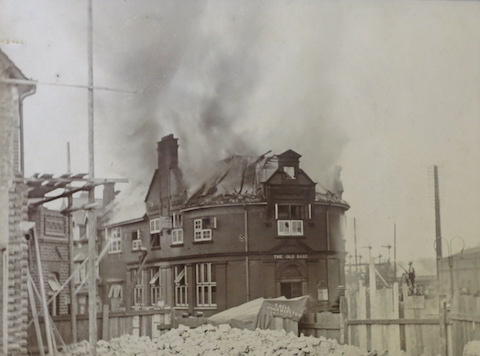
The fire at Ashby’s Bank and Woking’s council offices pictured by Claude de Neuville. Courtesy of Trevor Howard.
This structure housed both Ashby’s Old Bank and the offices of the Urban District Council. The blaze left the building nearly gutted, marking one of the most severe incidents since the fire at the International Electrical Storage Company.
The cause of the fire remains unknown. No one has yet been able to determine how or where it began. The first signs of the outbreak were discovered by Mr G. J. Wooldridge, the council surveyor, who recounted the events to our reporter shortly after the danger had passed. Despite being soaked and covered in soot, Mr. Wooldridge graciously shared his account.
“I had just entered my office around 11am,” he said, “and was preparing a report for the Drainage Committee meeting scheduled for that evening. Mr Hawkins suddenly remarked, ‘There’s a strong smell of smoke in here!’ We looked around but saw nothing at first. Then I went to the central well and pulled aside some boarding that concealed the clock weights. To my astonishment, I saw flames and smoke rising. I immediately raised the alarm throughout the building.”
At the time, only Mr Wooldridge, his two clerks, and Mr Ellwood, clerk to Mr. Mossop, were present on the upper floor. One of them rushed to sound the fire alarm, while Mr Hawkins, a member of the fire brigade, sprang into action.
Word of the fire spread rapidly, and within minutes, nearly all of Woking knew that flames were engulfing the bank building. Inside, chaos reigned as staff scrambled to respond to the emergency.
As the fire raged through the building, urgency gripped everyone inside. Countless valuable books, documents, and plans needed rescuing, and staff scrambled to save what they could before the flames consumed it all.
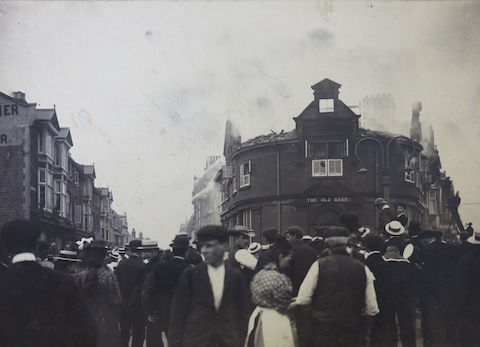
A large crowd gathered to watch the fire at Ashby’s Bank and Woking’s council offices pictured by Claude de Neuville. Courtesy of Trevor Howard.
Downstairs in the bank, the clerks were initially unaware of the danger overhead. The bank had already closed for the day, and with the manager gone, the staff were puzzled by the commotion above – until someone banged on the door and raised the alarm. Wasting no time, the clerks sprang into action. Within minutes, they had secured all important items in the strong room, a vault built to withstand both burglars and the ravages of fire and water.
Fortunately, the fire never reached the lower floors. Though the furniture suffered significant water damage, the flames were stopped by the ceiling above, sparing the bank’s interior from further destruction.
Meanwhile, the fire intensified in the upper levels, spreading rapidly across the roof. As soon as the alarm was sounded, Porter Bide, better known locally as “Long John”, was first on the scene. He connected the station hose to the hydrant and began dousing the flames with remarkable determination. Though soaked to the skin, Long John fought like a Trojan, and his efforts proved invaluable.
Fireman Harding arrived shortly after and carried the hose up the escape ladder, allowing for a more direct attack on the fire. Soon, reinforcements from the Central Station arrived with additional hoses, and the firefighting effort expanded to two, then three jets.
Although Captain Sherlock was absent, the brigade operated with impressive co-ordination. Firefighters from both central and surrounding districts joined the effort, including Wright and Harding from Woking Station; Dodges, Eskine, from the surrounding areas; Howard from St Johns; and Rice and Foreman Hamilton from Knaphill, who arrived despite being off duty.
By the time the full brigade was in place, smoke had begun seeping into the lower levels. Outside, passersby watched as men near the flames tossed books and maps out of windows and into the stream running along Chertsey Road. Many items were saved, though most suffered some degree of damage.
Eventually, the workers were forced to retreat – their lives now at risk. At the far end of the building, the caretaker of the bank and council offices remained, his fate uncertain as the fire continued its assault.
Though one section of the premises remained untouched by the fire, all of the caretaker’s belongings were swiftly removed and safely preserved.

Still smouldering, Ashby’s Bank and Woking’s council offices pictured by Claude de Neuville. Courtesy of Trevor Howard.
As the blaze intensified, the flames gained a firm grip on the structure. The roof, built with heavy timber beneath the tiles, proved highly vulnerable. Once ignited, the fire consumed the wood rapidly. Unable to withstand the intense heat, the tiles cracked and fell in their hundreds, shattering on the ground below.
The “cruel red tongues” of fire leapt across the rooftop, and gradually, the structure began to collapse. Firefighters attempted to smash windows to allow water jets to reach the interior, but their efforts met with limited success.
By 5.30 pm, much of the roof had collapsed, and the relentless stream of water was finally overpowering the flames. At 5.40, the Guildford steamer arrived on the scene, accompanied by Superintendent Hook and Deputy Superintendent Hall. Summoned by both telephone and telegraph, their arrival was met with loud cheers from the gathered crowd.
However, the fire had already been brought largely under control, and the steamer was not needed. The Guildford manual engine and the Byfleet engine also arrived but found no active role to play. By 6 pm, the danger had passed, and the fire was fully subdued.
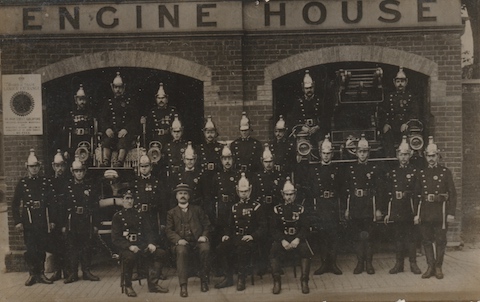
Men of Guildford Fire Brigade pictured in about 1910.
Throughout the ordeal, there had been considerable pressure and urgency. It became painfully clear how effective a steamer could have been in containing the blaze earlier – and how swiftly the fire might have been extinguished. The Woking Council, unfortunately, learned the cost of delay firsthand. That the fire occurred in their own chambers underscored the urgent need for the town to possess its own fire engine.
We understand that one has already been ordered and is expected to arrive on the 28th of this month. Still, many believe Woking should have acquired one long ago.
A new fire station opens
In 1928 Woking Fire Brigade moved into a new purpose-built fire station in Church Street.

Woking’s 1928 fire station published as a picture postcard.
Here is how the Woking News & Mail in its edition of July 20, 1928, reported the news.
A significant new chapter in the history of the Woking Fire Brigade will begin tomorrow (Saturday) afternoon – 21st July 1928, with the official opening of the town’s new fire station on Church Street.
The ceremony will be led by M. A. Foord, Chairman of the Woking Urban District Council, which oversees the local volunteer fire brigade.
A large gathering is anticipated for the occasion, which will feature a special display by the brigade. In the evening, a celebratory dinner will be held at the new station, hosted by the fire brigade.
The fire station stands on land behind the council offices, acquired by the local authority in December 1925. Designed by Mr G. J. Wooldridge, the council’s surveyor, and constructed under his supervision, the building was completed to a high standard by Messrs. E. P. Winn & Co. of London.
This impressive structure is a proud addition to Woking’s public buildings. Purpose-built to accommodate four motor fire engines, it reflects the town’s commitment to modern fire protection and civic progress.
The new fire station boasts a wide frontage along Church Street, with four large teak doorways designed in a handsome architectural style.
The façade is constructed from purple stone bricks with Portland stone accents, giving the building a distinguished appearance. Each of the four front doors is equipped with an automatic mechanism that opens swiftly at the pull of a cord — an impressive innovation for its time.
Inside, the engine house features a durable concrete floor and spans 53 by 36 feet, offering ample space to accommodate four motor fire engines. Should future needs arise, the station is well-prepared. The engine house connects directly to the adjoining St Dunstan’s House, which has been seamlessly integrated into the new facility.
The basement of St Dunstan’s has been transformed into a fully equipped workshop, along with bathrooms, lavatories, a wash-house for resident firemen, and a boiler room that supplies heating and hot water throughout the complex.
From the engine house, there is access to the ground floor of St Dunstan’s, where fire call offices and various storage rooms are located – ensuring rapid response and efficient co-ordination.
A staircase from the engine house leads to the first floor of the new building, which includes a spacious recreation room (32 by 20 feet) for the firemen. The chief engineer’s quarters comprise a large sitting room, three bedrooms, a kitchen, bathroom, and other essential facilities.
The upper floors of St Dunstan’s have been fully redecorated and converted into a residence for the second engineer, allowing two firemen to live on-site and respond swiftly to nighttime emergencies. Two fire poles have been installed for rapid descent to the ground floor.
The roof space of the new building has been designed to allow for the future addition of more rooms, ensuring adaptability as needs evolve.
As part of the construction, the road at the junction of Church Street and Percy Street has been widened, allowing for quicker exits during emergencies. The station has been built not only to serve Woking’s urban district but also to support nearby parishes, Chobham, Pirbright, and Bisley, under existing mutual aid agreements.
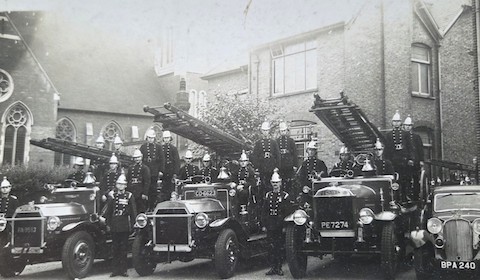
Woking firemen with their fire engines – all three made by the famous Dennis Brothers specialist vehicle firm of Guildford. Photo courtesy of Glenn Howard.
The following week’s edition of the Woking News & Mail reported in great details the opening ceremony, the great and the good who attended, the tributes and thanks, a celebration dinner, afternoon tea, entertainment and goodwill toasts.
The newspaper also reported… Speaking from the stairway that leads from the engine house to the recreation room and living quarters, Mr A. Foord, Chairman of the Woking Urban District Council, formally declared the new fire station open. He reflected on the remarkable journey of the Woking Fire Brigade, which began 33 years ago when the town, then with a population of around 10,000, had no fire brigade of its own and relied on Guildford in emergencies.
Mr Foord added that in 1925, the council entered into an agreement with the neighbouring parishes of Pirbright, Bisley, and Chobham to provide fire assistance. With the acquisition of a second motor engine, Woking was well-positioned to honour that commitment. Mr Foord hoped that representatives from those parishes, present at the ceremony, would see firsthand the brigade’s readiness and capability.
Mr Foord also presented medals and service bars to members of Woking Fire Brigade in recognition of their long-standing service.
The fire station served Woking and its surrounding villages well until May 1979, when the Woking News & Mail reported its closure under the heading…
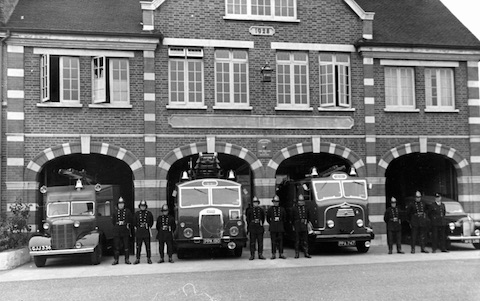
Woking Fire Station in about the 1960s.
Old Bones to stir under fire station
The fire station is on the move – literally. Last week, the 15-member firefighting team vacated the historic 1928 building and relocated to temporary prefabricated huts just across the road, behind the Centre Halls. The move was smooth, but the future remains uncertain.
No one knows how long they’ll stay in the huts while the old station is demolished and replaced with a new building, estimated to cost £60,000.
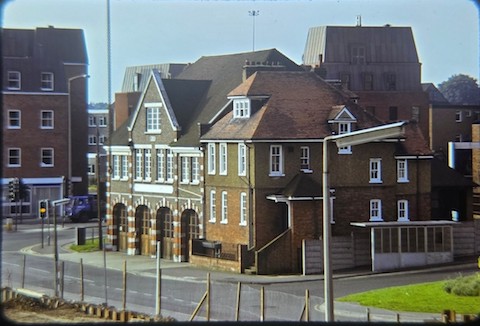
Woking’s 1928 fire station in its final years. Photo courtesy of Glenn Howard.
The fight for a new fire station has dragged on for at least seven years. Early proposals suggested building two new stations, but disagreements over suitable locations ultimately shelved that plan.
The oldest part of the current building once served as a rectory more than 50 years ago, and local lore claims a graveyard lies beneath the backyard.
“It might be interesting to see what turns up when they start digging,” said a farmer named Chuck.
With no consensus on how to proceed, each of the station’s five watches was asked to submit their own plans for improvements. However, renovating the interior to modern standards would have cost more than constructing a new station from scratch.
The new building will be set back about 10 feet further from the road. “All the front pillars have been damaged because the causeway isn’t wide enough for buses and fire engines to pass safely,” explained the station officer.
The old station holds a wealth of history. Beyond its days as a rectory [presumably the part of the station that was St Dunstan’s House], it once housed notable figures like Turpin the boxer. While working as a farmer in Woking, Turpin was training in the loft when he fell through the ceiling into the room below. His mouth still bears the scar from that incident.
Though the crew has a deep affection for their old station, conditions have deteriorated rapidly in recent years, and morale has reportedly declined.
“It’ll be a bit sad to leave,” said one long-serving firefighter, “but the old place is definitely showing its age.”

Woking Fire Station that was opened in 1981.
Woking’s replacement fire station opened on Thursday, October 15, 1981, and the Woking News & Mail reported…
Woking’s New £400,000 Fire Station Officially Opened
Woking’s new £400,000 fire station was officially opened last Thursday by Mr John Whitfield, JP, Chairman of Surrey County Council.
The ceremony was attended by a distinguished audience, including veteran firefighter Mr Burgess, who had also been present at the opening of the original Woking fire station in 1928.
The new station, the most modern in Surrey, is equipped with two of the latest fire engines manufactured by Dennis Brothers* of Guildford.
It has been constructed on the exact site of the original station. During the construction period, firefighters were temporarily housed in wooden huts beside the Victoria Way ring road.
Designed to combine operational efficiency with enhanced welfare provisions, the station features a ground floor dedicated to daily operations, a middle floor with sleeping quarters, and an upper floor offering recreational facilities, including a bar and rest area for off-duty personnel.
* The specialist vehicle maker Dennis Brothers was the former name of the company, by 1981 it traded as Hestair Dennis.

Woking’s current fire station in Goldsworth Road.
Finally, four decades later that fire station was demolished for the Hilton Hotel development and a new fire station was built at 42 Goldsworth Road.
The website of UK fire stations has a page on today’s Woking fire station with photos of the building and fire appliances.
Share This Post




I'm living well for nothing at all! (See: No Trifling Matter: Magpie Trapped in Godalming Sainsbury’s)




Next stop, Debt Chasm! (See: We Should All Be Outraged About the Failure to Deal with Legacy Debt)





Recent Comments