- Stay Connected

Socialize


 Abraham Lincoln
If given the truth, the people can be depended upon to meet any national crisis...
Abraham Lincoln
If given the truth, the people can be depended upon to meet any national crisis...

 Guildford news...
for Guildford people, brought to you by Guildford reporters - Guildford's own news service
Guildford news...
for Guildford people, brought to you by Guildford reporters - Guildford's own news service
Hop Growing Ends at Puttenham – And a History of its Cultivation in Farnham Area
Published on: 11 Sep, 2026
Updated on: 17 Sep, 2026
By David Reading with David Rose
After this year’s poor harvest, the Hampton Estate at Puttenham will stop growing hops – bringing to a close a chapter that has been part of the Hampton name for generations.
The reason is climate change – summers have been getting hotter making hops hard to grow well.
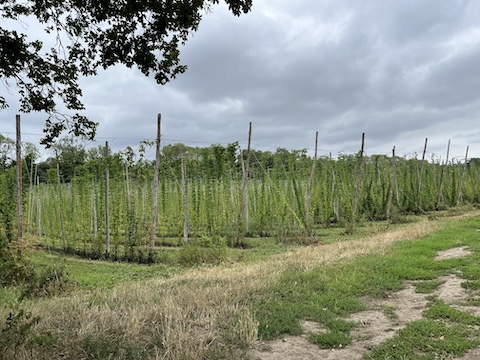
The Hampton Estate hop garden at Puttenham in July 2025. Picture by David Rose.
Estate manager Bill Biddell said: “The weather patterns are shifting. Our traditional Fuggles hops require an English maritime climate during the growing season of warmth, rain, a bit of sun, a bit of cloud then more rain, i.e. a traditional English summer.
“Last summer was extremely hot. The winter was extremely wet (which is good), but we haven’t had any significant rain on the farm since March and have had a summer of extreme unrelenting heat. The consequence is a very reduced yield at harvest, by approximately 70 per cent.”
Mr Biddell said that to irrigate hops in order to counter the effect of dry hot summers required significant investment and infrastructure and hop prices were not sufficient to be able to do this.
“We foresee a significant investment in hop machinery and hop plants over the next 10 years and with reduced yield and therefore a much-reduced income there is no scope for the hop enterprise to make this investment.”

Hops appeared to be growing well in Puttenham in 2025. Picture by David Rose.
Added to this is the fact that national beer consumption is falling year on year.
“Next year’s forecast for more extremely hot weather is not at all promising for hop growing,” Mr Biddell said.
“Personally, I am sad that hop growing around Puttenham cannot continue, but as a forward-looking agricultural business we can’t bury our heads in the sand. The closure of our hop gardens will bring great opportunities for the land and we are giving this much thought.”
A further statement from the estate says: “Over the coming years we’ll be thinking carefully and openly about what comes next for the land – with a view that’s something good for the soil, good for our community and able to stand on its own feet as a business.”
According to the British Hop Association there are just over 50 farmers growing hops in Great Britain today.
Half of the hop production is grown by West Midlands-based farmers and half in the South East – in the counties of Kent, Sussex and Suffolk.
A brief history of hop growing around Farnham, Puttenham and Badshot Lea
The chalky soil of the south-facing slopes of the the North Downs provides good conditions for growing hops and they had been cultivated in the Puttenham area for more than 170 years at least.

In the hop garden at Puttenham in the early 1900s. David Rose collection.
However, in Farnham and further west into Hampshire hops have been cultivated for much longer. It’s said hops were introduced into the Farnham area in 1587 by a Mr Bignall from Suffolk.
Authors Fran and Geoff Doel their book The Hop Bin – An Anthology of Hop Picking in Kent and East Sussex, (published in 2014) explain what the addition of hops add to ale and beer: “The addition of an extra ingredient into ale – the hop – not only changed the taste, making it bitter, it helped to preserve the concoction much longer and stabilised it.”
As well as ideal growing conditions for hops, also needed was plenty of wood (later charcoal) to heat the kilns to dry the hops.
Plus land to grow ash or alder trees, the wood then cut to make the poles onto which hop plants climb up.

In a Kent hop garden with pickers that includes Gypsies. Families from London also used to go “hoppin”. Picture postcard, David Rose collection.
And in their heyday from the 19th century into times of living memory, scores of people were needed to pick the hops each September.

A 1900s pocture postcard view of hop gardens at Farnham, with the town’s St Andrew’s Church in the distance. David Rose collection.
Author Jean Parratt, in her book Farnham Past, (published in 1999) wrote: “There are still thousands of [Farnham] residents who can remember hop-picking, two weeks out of school helping mother to pick the bracts which were put into baskets and then checked by the tallyman.

A Kent hop garden’s tallymen. These were farm officials responsible for measuring the volume of hops collected by pickers and recording their earnings.
“At the end of picking, in a good hop year, there might be enough money to buy a pair of boots for each child for the winter, and perhaps some clothes, too. A bad year was disastrous for the entire family.

Hop kilns, called oast houses, in Kent where the hops were dried. Many have survived and have been covered into homes. Picture postcard David Rose collection.

Inside a Kent oast house. Picture postcard David Rose collection.
“Hop picking also brought visitors to town. People from London would travel on the train, be met at the station by farmers with carts, taken to barns at local farms, and men, women and children would spend the next fortnight sleeping on straw-filled pockets (sacks) at night and working in the fields all day. This was looked upon as an annual holiday.

A view inside Guildford’s Friary, Holroyd & Healy’s Brewery (later Friary Meux) in about the 1930s with hop sacks from Marshall’s Weydon Farm, Farnham. David Rose collection.
“Hops grew everywhere and hop kilns were constructed where they could be dried. Evidence of many of these can still be found, for example in Downing Street, West Street and at the bottom on Crondall Lane. Maltings were built so that barley could be steeped until it sprouted, then dried and finally crushed.”
Farming had taken place at Runfold for several hundred years, and from 1851 to 1958, Runfold Farm was farmed for hops and vegetables by members of the Tice family.

Picture postcard view of the Tice’s hop kilns at Badshot Lea – now the village hall. David Rose collection.
Its hop drying kiln was built by Walter Tice in 1884 and is now Badshot Lea Village Hall.
In 1961 the Tice family sold off parts of the land for housing and a part to Pioneer Aggregates who extracted sand and gravel from the site until 2011.
In 2010 the site was purchased by Guildford Borough Council and transformed into a wetland nature reserve, passing into Surrey County Council’s ownership in 2021.
Share This Post


Responses to Hop Growing Ends at Puttenham – And a History of its Cultivation in Farnham Area
Leave a Comment Please see our comments policy. All comments are moderated and may take time to appear. Full names, or at least initial and surname, must be given.












M Hurley (Mr & Mrs)
September 15, 2026 at 12:26 pm
Let’s all hope that the land will not be concreted over by building ugly housing estates on it. We need the land to grow other crops and fruit for our existing population. It is not beyond the intelligence of human beings that we cannot put this land to future good use rather than losing it to a concrete mess.
Also, re-wilding the land is not the answer. We need food security in the area and in the country as a whole.
Jan Messinger
September 17, 2026 at 8:12 am
Mr and Mrs M Hurley make very sensible comments. Let’s hope area is used for growing food for the population. Something we really do need.