- Stay Connected

Socialize

 Abraham Lincoln
If given the truth, the people can be depended upon to meet any national crisis...
Abraham Lincoln
If given the truth, the people can be depended upon to meet any national crisis...

 Guildford news...
for Guildford people, brought to you by Guildford reporters - Guildford's own news service
Guildford news...
for Guildford people, brought to you by Guildford reporters - Guildford's own news service
Opinion: A Mayor Is Not Just Old Hat
Published on: 26 Apr, 2026
Updated on: 1 May, 2026
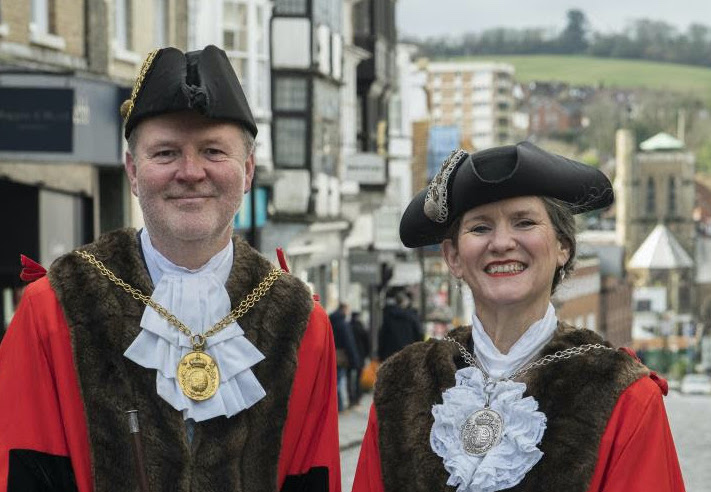
The current Mayor of Guildford, Howard Smith and his Deputy (soon-to-be Mayor) Jane Tyson.
By Gavin Morgan
Founder of the Guildford history Forum
This week a new Mayor is appointed in Guildford. Councillor Jane Tyson takes over from Cllr Howard Smith. Unless plans change, she could be the last Mayor of Guildford—the last in a long line stretching back to the Middle Ages .
Mayors, processions and chains of office are not to everyone’s taste, but they are much more than dressing up. They reflect something more serious: a town’s identity and its historic right to run its own affairs. As we go to vote for a new form of local government it is worth pausing to reflect. The new arrangements may be more efficient but local government may become a lot less local.
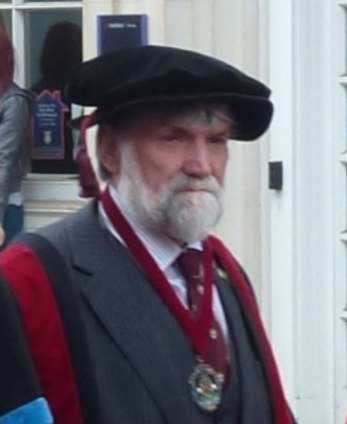
Matthew Alexander
Last year Matthew Alexander, the Honorary Remembrancer, wrote an interesting article on the history of the Borough. The office of Mayor grew out of the Middle Ages, when towns like Guildford were granted privileges that allowed them to organise some of their own affairs.
In 1257 Henry III granted Guildford a royal charter and started it on the road to self administration. The first Mayor was appointed about a century later. A principle was established. Guildford had its own civic identity and its own institutions. It has been that way, in different forms, for more than 800 years.
With the creation of a new unitary authority, however, Guildford Borough Council will be abolished, and Guildford will become part of a much larger structure. Its councillors will represent the town, but within a wider area and alongside many competing priorities.
So are Guildfordians losing control of their town after 800 years of autonomy? In many ways Guildford has only ever had limited autonomy, in recent years increasingly so, but what authority remained has been important.
Medieval local government was obviously a far cry from modern democracy. For centuries, power rested with a small group of local elites, and it was not until the nineteenth and early twentieth centuries that councils became properly representative.
Even then, local government remained constrained. As services became larger and more complicated after the Second World War, governments started favouring larger authorities.
 The current move to large unitary authorities dates back to the Redcliffe-Maud Commission of 1969, which proposed sweeping changes to local government in England and Wales.
The well known reorganisation that followed in 1974 created larger county and district councils, the system Surrey is now moving away from. Many of the functions of local government were tightly constrained by government legislation and most of our money is already spent at a county level.
Today, approximately 90 per cent of our council tax goes to Surrey County Council, and about 60 per cent of what comes to Guildford goes on statutory responsibilities such as housing, planning and waste collection.
But what remains gets spent on high profile services, like the maintenance of parks, the planting of flowers, support for cultural and sports venues. These may be small civic decisions but they shape how a town looks and feels and they are the things people notice. They are turn a place from somewhere that functions into somewhere that feels cared for.
We often hear the term “placemaking” and this is what we might notice goes missing in the new strategic, cash strapped authority. A larger authority may well deliver many services more efficiently. It may be better placed to manage strategic challenges and financial pressures. But it will also have to balance the needs of multiple towns, not just one.
Guildford will continue to be governed but will it continue to be governed with the same degree of local focus? How do we keep the best things about a historic town; its character and identity, in a system that is larger and more strategic?
This is the challenge that faces everyone who cares about Guildford’s unique character; councillors and the wider community alike. When Guildford says goodbye to its Mayor next year, it may be saying farewell to much more than a person in a bicorn or tricorn hat.
Share This Post



I'm living well for nothing at all! (See: No Trifling Matter: Magpie Trapped in Godalming Sainsbury’s)



Next stop, Debt Chasm! (See: We Should All Be Outraged About the Failure to Deal with Legacy Debt)



Recent Comments