- Stay Connected

Socialize

 Abraham Lincoln
If given the truth, the people can be depended upon to meet any national crisis...
Abraham Lincoln
If given the truth, the people can be depended upon to meet any national crisis...

 Guildford news...
for Guildford people, brought to you by Guildford reporters - Guildford's own news service
Guildford news...
for Guildford people, brought to you by Guildford reporters - Guildford's own news service
Opinion: Local Government Reorganisation – How Did It Happen Like This? Part 2
Published on: 5 May, 2026
Updated on: 6 May, 2026

Cllr Pat Oven
Patrick Oven
borough councillor for Send & Lovelace and Guildford Greenbelt Group leader
In Part 1 of his opinion piece Patrick Oven asked how we had arrived at the current solution for the Government’s reorganisation of local government. Today he explores the factors that should have been considered…
Eight of the 11 borough and district councils in Surrey, a large majority, were in favour of the county being divided into three unitaries when canvassed last year.
Surrey residents were given the opportunity to express their preference. Over 3,000 responded, not a huge proportion given there are 1.25 million residents, but not insignificant. 63 per cent of those responding expressed a preference for three unitaries.
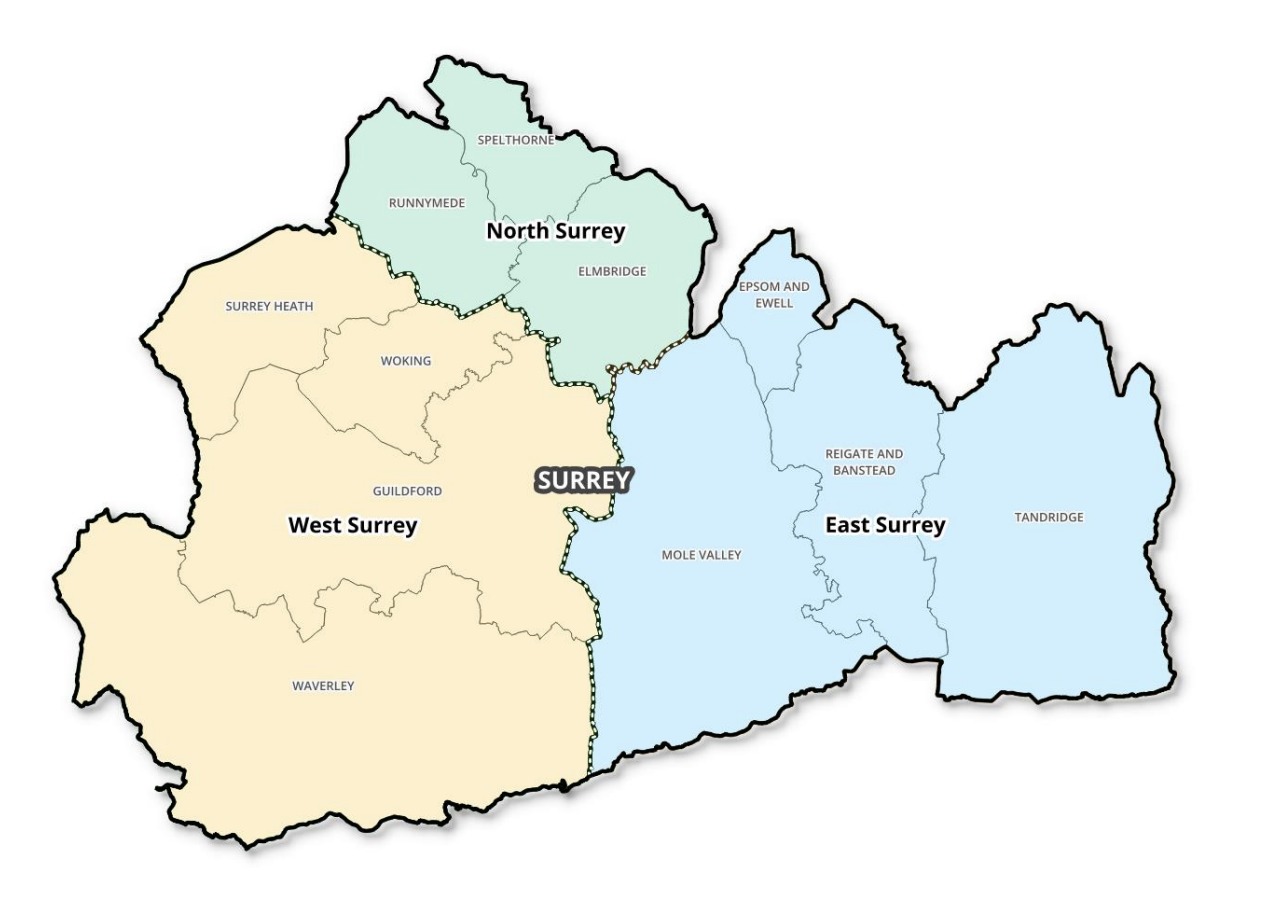
The proposed three unitary authorities for Surrey solution preferred by a majority of the borough and district councils.
So, the boroughs and districts were in favour of three, as were a clear majority of the participating residents. What did the county council do? It went for two.
Why?
If anyone takes a look at a map of Surrey, one thing becomes immediately apparent. There are three clear major areas of population, and thus economic activity, in the county. In the east, Epsom and Ewell, Reigate and Redhill, Horley and Caterham. In the centre west, the two by far largest towns, Guildford and Woking, and then Godalming. In the north and north west, Esher, Walton, Chertsey, Sunbury, Staines and Ashford. There are of course other outlier towns, but those are the major concentrations of population.
 The preferred Government model is for each unitary authority to be around 500,000 inhabitants. Whilst that may be their expressed preference, the reality is actually much lower in practice, as I will show below.
The proposed outcome for Surrey would produce a western unitary of 687, 800 residents. That for the Eastern would be 557,100. Both way above the target figure , the western one massively so. Remember Surrey is targeted for a huge amount of development. Neither of these figures provides any room for proposed population growth.
What’s happening elsewhere?
Figures have only last week been released for two broadly comparable counties with Surrey, Norfolk and Suffolk.
Norfolk has a population of 918,400, well below Surrey, yet is to have three unitaries. Ah, you might say, but it has significant area of population in three areas? Er, no. The only large, very large, town, is Norwich with a population of 200,000. After that, there is Kings Lynn at 43,000 then Great Yarmouth at 39,000. Nowhere else above 25,000. Average size of its unitaries is to be only 306,133.
As for Suffolk, it is even smaller, population of 765,000. Again, one large town, Ipswich obviously, 145,000, followed by Lowestoft at around 74,000 then Bury St Edmunds at c.41,000. Every other town below 20,000. Average size of its Unitaries a paltry 255,000, barely half the preferred model. So, size clearly not everything.
Surrey? Two towns, not including the area within their respective boroughs, of over 75,000 population. Guildford 77,000, Woking 75,500. Then Staines about 65,500, Walton about 40,000, Camberley similar.
There are then no less than 13 above 20,000. And yet we get two unitaries? On the basis of Norfolk and Suffolk, we could have argued for four! Two non-comparable counties, Essex and Hampshire, each have populations of around 1.9 million. They are each to have five unitaries, so populations of around 380,000 in each one. Someone seems to have sold Surrey very short.
Clearly, the 500,000 rule has not been applied equally. Nor need it be, if the existing authorities can provide good reason for it to be disregarded. Presumably other counties argued accordingly. Did Surrey, with a far more convincing case to show three clear areas of population? I have to assume not, as the county council, for whatever reason, was determined to go for two.
Tomorrow, Patrick Oven draws his conclusions about the reasons the local government reorganisation is taking place in the way it is. Click here.
Share This Post




I'm living well for nothing at all! (See: No Trifling Matter: Magpie Trapped in Godalming Sainsbury’s)




Next stop, Debt Chasm! (See: We Should All Be Outraged About the Failure to Deal with Legacy Debt)





Recent Comments