- Stay Connected

Socialize

 Abraham Lincoln
If given the truth, the people can be depended upon to meet any national crisis...
Abraham Lincoln
If given the truth, the people can be depended upon to meet any national crisis...

 Guildford news...
for Guildford people, brought to you by Guildford reporters - Guildford's own news service
Guildford news...
for Guildford people, brought to you by Guildford reporters - Guildford's own news service
Planners Reject Guildford Industrial Buildings That Would ‘Dominate The Landscape’
Published on: 12 Oct, 2025
Updated on: 13 Oct, 2025
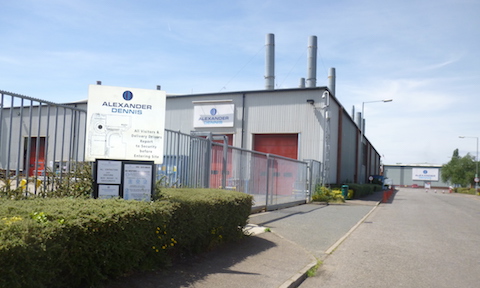
The old Dennis plant in Guildford. Closure was announced in 2020.
By Emily Dalton
local democracy reporting service
And David Reading
Guildford Dragon reporter
Plans to build eight new industrial and storage units on the Slyfield Industrial Estate have been rejected by Guildford Borough Council’s planning committee – following a 90-minute meeting in which one councillor was ejected from the proceedings and some members expressed deep frustration, saying they had received inadequate information about the project.
Had the application been granted, the new buildings would have replaced the old Alexander Dennis depot, which has remained vacant since 2022. The project was said by the applicants to be a boon for the local economy.
But local people protested that the scale of the buildings – up to 16.18 metres high – would have a serious detrimental visual impact on their lives. Objectors included Worplesdon Parish Council.

Cllr Vanessa King: chair of planning
Some committee members pushed strongly for a site visit so they could witness for themselves what impact the proposed industrial buildings would have on the local environment. But the chair, Cllr Vanessa King (Lib Dem, Stoke), had decided against a site visit before the meeting – arguing that there was already sufficient information for members in the officers’ documents and plans.
Clearly some councillors were frustrated by this.
It was the scale of the development – particularly the bulk and height of the buildings – that caused consternation among some committee members when they debated the application on Wednesday (October 8).
They feared that the development would dominate the landscape including nearby green belt land.
They argued that the buildings would tower over surrounding warehouses, most of which are around 8-10m high, and that the development would have an “unacceptable” visual impact when viewed from Jacobs Well Road and nearby open countryside.
Councillors who pushed for a site visit expressed annoyance that – in their view – they needed to witness what impact the scheme would have on the local environment and the nearby homes, rather than relying on official plans and documents. There were, they said, too many uncertainties.

Cllr Bilal Akhtar: ejected from the meeting
Cllr Bilal Akhtar (Conservative, Worplesdon) was one member who pressed hard for a site visit in an impassioned speech, worrying about the visual effect the buildings would have locally.
Cllr Akhtar was then ejected from the meeting after Cllr George Potter (Lib Dem, Burpham) told members that Cllr Akhtar had read from a pre-written speech, which was against the council’s procedural rules. The chair, Cllr King, said she was “genuinely sorry” but had to bar Cllr Akhtar from the rest of the meeting.
A vote was put to members on whether there should be a site visit. The result was 7-7. With Cllr Akhtar removed from the meeting, that left a decision to be made based on Cllr King’s casting vote. She voted against a site visit.
A major part of the argument by the applicants, Aviva Investors, was that the project could support up to 400 local jobs and deliver a “vital upgrade” to one of Guildford’s main employment zones.
Supporting the application, Charles Everest, a director at Aviva, said the scheme was not just replacement but a “modern, sustainable hub” designed to support local business growth. He said the height was important to allow more efficient storage in a limited space.
Worplesdon parish councillor Nigel Mitchell spoke against the application, citing the proximity to the green belt and the visual impact on local people.
This was echoed by local residents Ryan Batchelor and Richard Williams, whose homes are close to the development.
Mr Batchelor said: “Sixteen metres is twice the height of almost everything else on Slyfield. You cannot call this ‘in keeping’ with the rest of the estate.”
Mr Williams spoke of the “substantial loss of amenity” for local people – citing the height of the buildings and the possibility of light and noise pollution.

Cllr Sue Wyeth-Price: proposed that the application be refused
After almost 90 minutes of debate, as irritation began to show, the application was put to the vote. Members were reminded that refusal could lead to a costly appeal.
Cllr Sue Wyeth-Price (R4GV, Ash South) tabled a motion recommending refusal, citing visual impact on the nearby green belt and the overall height and bulk of the proposed buildings. Cllr Stephen Hives (Lib Dem, Stoke) seconded the motion.
The result was nine votes against the application, three in favour, with one abstention.
Share This Post


Responses to Planners Reject Guildford Industrial Buildings That Would ‘Dominate The Landscape’
Leave a Comment Please see our comments policy. All comments are moderated and may take time to appear. Full names, or at least initial and surname, must be given.


I'm living well for nothing at all! (See: No Trifling Matter: Magpie Trapped in Godalming Sainsbury’s)




Next stop, Debt Chasm! (See: We Should All Be Outraged About the Failure to Deal with Legacy Debt)





John Ferns
October 12, 2025 at 10:10 pm
I watched the Planning Committee meeting on 8 October with disbelief. Your report captured the tension and frustration in the chamber perfectly — councillors were clearly uncomfortable with how this application had been handled.
During the debate, Cllr David Bilbe commented that the Worplesdon Parish Council submission was “the most professional [he] had ever seen” and urged members to study it carefully. That remark prompted me to look for the document myself on the planning portal — and in doing so, I came across something even more extraordinary.
The parish submission had been uploaded on 23 September, but alongside it, I found a 21-page anonymous “Briefing to the Committee” that appeared only on 6 October, a mere 48 hours before the meeting. It was attractively formatted, laden with graphics and legal references — yet entirely unauthenticated and unsigned.
Its opening line stopped me cold:
“The ‘optics’ around this application should concern you, to say the least. GBC were set to determine this planning application while also receiving a large sum of money from the applicant as a ‘special’ purchaser of freehold land on the site.”
That is an astonishing statement to find on a public planning file. If Guildford Borough Council was simultaneously acting as both the determining authority and the land vendor, the perception of conflict is obvious. But it is equally remarkable that an anonymous and unattributed document of this nature was published at all. In normal circumstances, such material would be rejected or redacted.
One is left wondering whether someone blundered — either by accepting a document that had no provenance, or by inadvertently releasing something that was never intended for public view. Either scenario raises serious governance questions.
Given the Parish Council’s apparent lack of consultation, the late surfacing of this “briefing,” and the uncomfortable dual role of the Council as both seller and decision-maker, I believe there is now an overwhelming case for an independent investigation.