- Stay Connected

Socialize

 Abraham Lincoln
If given the truth, the people can be depended upon to meet any national crisis...
Abraham Lincoln
If given the truth, the people can be depended upon to meet any national crisis...

 Guildford news...
for Guildford people, brought to you by Guildford reporters - Guildford's own news service
Guildford news...
for Guildford people, brought to you by Guildford reporters - Guildford's own news service
Redhill Railway Station Proposal Would Allow ‘Croydonisation’
Published on: 3 Sep, 2025
Updated on: 4 Sep, 2025

CGI of the proposed Redhill Railway Station development with its 14 and 15-storey tower blocks Solum planning documents
By Emily Dalton
local democracy reporter
A public inquiry into plans for Redhill’s ‘tallest building’ has heard powerful new opposition from disability campaigners, who warn the station will be made unsafe and inaccessible for some passengers.
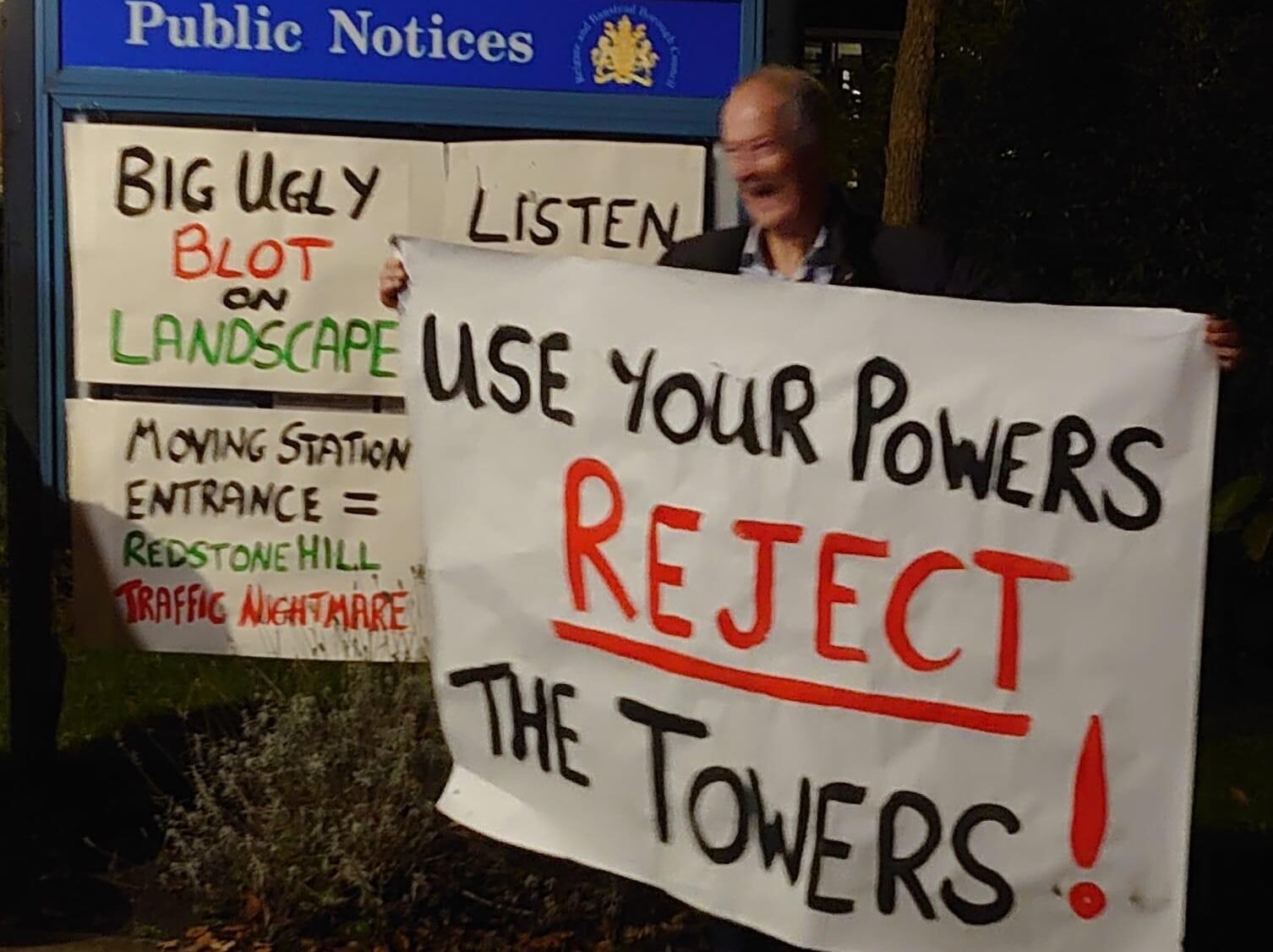
Redhill residents opposing plans to build in the town centre outside Reigate and Banstead Borough Council in October last year. Jan Sharman
Campaigners Redhill Residents Action Group have attacked the scheme, dubbing it as the “Croydonisation” of Redhill which they claim to be a “rural market town”. Croydon is a built up London Borough with many tower blocks.
The multi-million pound project put forward by rail developer Solum, would replace Redhill station’s forecourt and car park with two towers of up to 14 and 15 storeys tall alongside 255 new homes.

Redhill Station
The current taxi rank would be moved to the back of the station, while most drivers and cyclists would be directed to the steep Redstone Hill entrance. But campaigners with disabilities told the inquiry on September 2 the plans would ‘shut out’ those with mobility issues.
Nikki Roberts, CEO of the Surrey Coalition of Disabled People said: “Disabled people will no longer be able to use the railway station safely.” She explained that government guidance details disabled access should be as close as possible to the entrance of the station which is not the case in these proposals.
One man explained how it can be really difficult for those with mobility issues or for wheelchair users to move up and down Redstone Hill next to a busy road.
He said there could be “devastating consequences” if someone was to lose control of their wheelchair on the incline and fall into oncoming traffic.

Cllr Jonathan Essex
SCC Cllr Jonathan Essex (Green, Redhill East) said: “Surely disadvantaging access for those with a disability by reducing their options to the station is unacceptable.”
He also argued that the development needed a modal shift to sustainable transport of buses and cycling rather than just removing car parking spaces.
The speakers acknowledged the planning proposal does include some improvements for disabled access such as upgrading the existing ramp outside the station’s entrance.
The applicant also said they had consulted a diversity and accessibility stakeholder panel during the planning process around any concerns.
The controversial scheme was called in to the Planning Inspectorate in May after Reigate and Banstead Borough Council kicked out the proposals last year.
Councillors threw out the application due to its height, scale, design and layout which would harm the town’s character and conservation areas.
The council’s legal representative told the inquiry the twin towers would “puncture the character of the area” and sever connections across the station.
Campaigners, Redhill Residents Action Group (RRAG), who had fundraised its own lawyer at significant expense were also at the inquiry as they had been granted main party status by the planning inspectorate.
Presenting the summary of their argument to the inspector, the legal representative said: “Redhill is not a large city but a small rural market town with only a few tall buildings.”
He argued the impact of the buildings would be felt far and wide changing the character of the town and harm the view of the surrounding landscape including the Surrey Hills.
But developers argue the public benefits of new housing in a “phenomenally sustainable location” alongside train improvements would outweigh any alleged harm.
Solum’s lawyer Chris Katkowski CBE KC argued the council cannot prove it has enough land for housing to meet its five-year supply. He also questioned why the application was rejected for not having any affordable housing when the council accepted the scheme could not be viable with non-commercial units.
The inquiry is set to last for at least nine days with the first part ending on Friday, September 7 and then resuming in November. A decision will be made whether to overrule the council’s refusal or agree with the objections in due course.
Share This Post




I'm living well for nothing at all! (See: No Trifling Matter: Magpie Trapped in Godalming Sainsbury’s)




Next stop, Debt Chasm! (See: We Should All Be Outraged About the Failure to Deal with Legacy Debt)





Recent Comments