- Stay Connected

Socialize

 Abraham Lincoln
If given the truth, the people can be depended upon to meet any national crisis...
Abraham Lincoln
If given the truth, the people can be depended upon to meet any national crisis...

 Guildford news...
for Guildford people, brought to you by Guildford reporters - Guildford's own news service
Guildford news...
for Guildford people, brought to you by Guildford reporters - Guildford's own news service
Taking a Peek at Bisley Camp’s Historic Pavilions
Published on: 24 Sep, 2025
Updated on: 24 Sep, 2025
By Mark Coxhead with David Rose
Bisley Camp opened its rifle ranges in 1890 as the venue for the Imperial Meeting, culminating in The Queen’s Prize, organised by the National Rifle Association (NRA), which was previously held at its range on Wimbledon Common.
The camp is architecturally notable for the numerous prefabricated huts erected by the NRA and local rifle clubs, many of which remain, substantially unchanged.
Today, the overall impression of the camp “blends elements reminiscent of a colonial outpost, a museum of cricket pavilions, and a recreational holiday camp”.
It serves as a venue for competitive shooting events and other leisure activities.
The camp is a significant site for the NRA and its members, and maintains a “rich legacy in both history and architectural heritage”.
In 1986, a series of five articles by Paul Roberts on the Bisley buildings appeared in the National Rifle Association Journal.
The history of several of these buildings has also been noted by the renowned architectural author Sir Nikolaus Pevsner in his book Buildings of England – Surrey.
While Tim Price, an Honorary Life Member of the NRA and tour guide of the camp, has also supplied some details here, all of which give a brief history of eight of the buildings.
G. E. Fulton & Son Registered Gunsmiths

G. E. Fulton & Son Registered Gunsmiths today.
This building was originally erected on Wimbledon Common for the NRA as a temporary headquarters building.
Along with others there, it was dismantled at end of each season’s shooting, stored and re-erected the following year.
The NRA’s main headquarters at the time was in London. However, this building was brought from Wimbledon to Bisley Camp and re-erected in 1890.
According to the websites of the Queens Westminster Rifles and Fulton’s, George Fulton had started his shooting career with the Wimbledon Rifle Volunteers in 1881. He won The Queen’s Prize in 1888, the Grand Aggregate in 1890 and the St George’s in 1896 and 1900.
With the £250 he received for winning The Queen’s Prize he started his gunsmith’s business in about 1895. It was based for a short while in Wandsworth and later Staines, where there was a large range at the time.
In 1905 a move was made to Bisley Camp, and the business was established in its present premises.
The building had been designed by Captain William Salmond RE. It features bolted timber walls and a shallow corrugated-iron roof, extending around all four sides to form a verandah, resembling a long bungalow.
Bisley Shooting Ground, formerly the Council Club
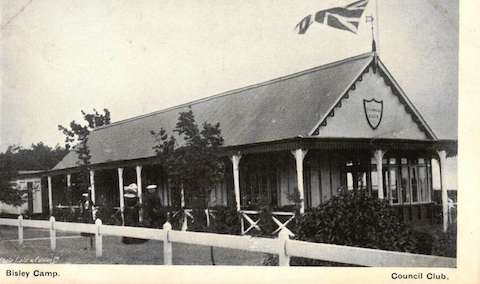
Vintage postcard view of the Council Club’s building, now the Bisley Shooting Ground’s building.
The building was originally erected at Wimbledon Common in 1885 and today is the home of what has been described as the “country’s top clay shooting ground for tuition, practice, corporate and charity events”.
It’s website states it caters “for all levels of experience for adults and juniors from 10 years old”.
The building was formerly the home of the Council Club.
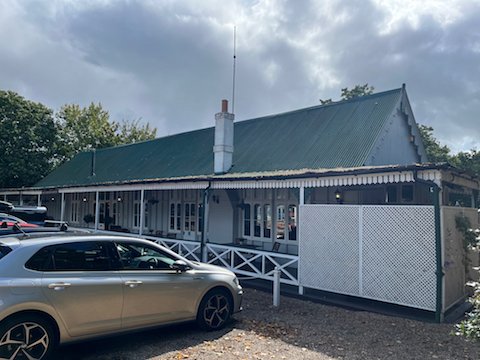
Today’s view of the building that is now the home of the Bisley Shooting Ground.
National Rifle Association headquarters
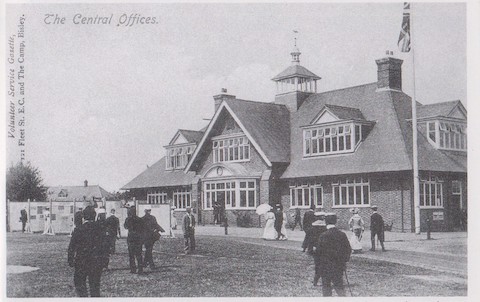
Edwardian picture postcard captioned “The Central Offices” the headquarters of the National Rifle Association.
Designed by Alfred Burr and constructed in 1902.
This building is notable for its red brick construction, red tiled roof, pediment, large dormers, and a lantern topped with a cupola.
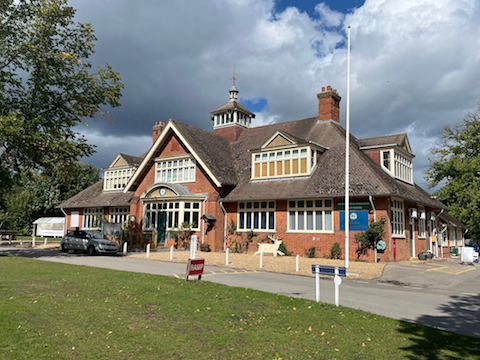
The National Rifle Association’s headquarters today.
The Pavilion
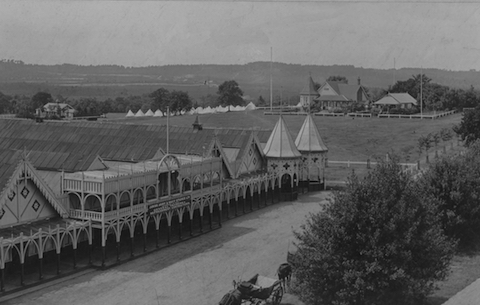
The original pavilion building re-erected at Bisley Camp.
The original Pavilion building was a prefabricated refreshment room dating to 1876. Originally at Wimbledon Common, it was later dismantled and brought to Bisley Camp.
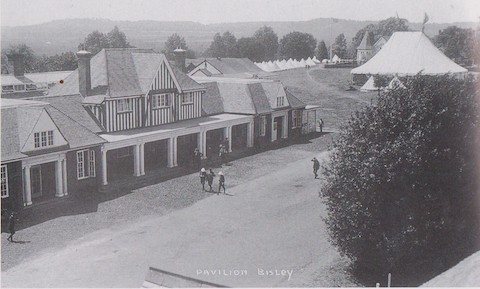
A vintage view of The Pavilion building of 1924.
It was replaced in 1924 by today’s Pavilion building, designed by Elgood & Hasstie.
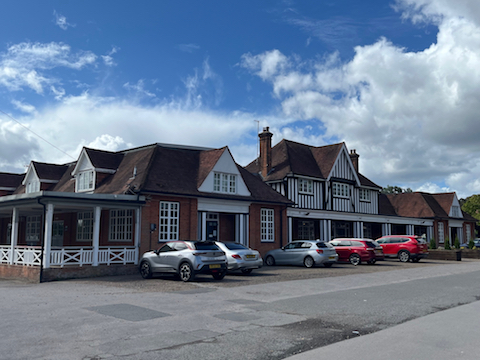
The Pavilion today.
The Macdonald Stewart Pavilion, formerly the Canadian Pavilion
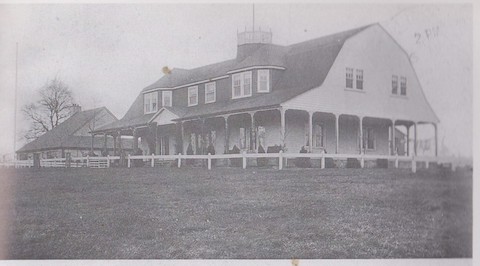
The Canadian Pavilion at Bisley Camp, circa 1900s.
Built in 1897 entirely with Canadian timber and designed by Saxe & Rodden of Montreal for the Dominion of Canada Rifle Association.
It has been said that it exemplifies Canadian architectural and cultural influences.
It stands as a two-storey structure featuring a gambrel roof that extends over a verandah on three sides, reflecting the British Columbian traditions of the era.
The pavilion is framed in Canadian maple hardwood and clad with cedar shingles, its interiors boasting a large brick fireplace and various examples of taxidermy.
Renamed the Macdonald Stewart Pavilion in 1975, it honours the memory of Walter M. Stewart (died 1967).
Stewart was a notable figure in the Dominion of Canada Rifle Association, serving as the president of the Macdonald Stewart Tobacco Company and a passionate marksman.
A significant benefactor, he sponsored events such as the Macdonald Stewart Grand Aggregate and initiated the tradition of the Macdonald Stewart Dinner at the Château Laurier Hotel in Ottawa.
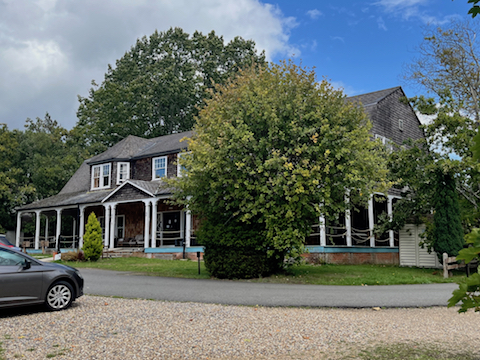
The Macdonald Stewart Pavilion today.
The London & Middlesex Rifle Association pavilion
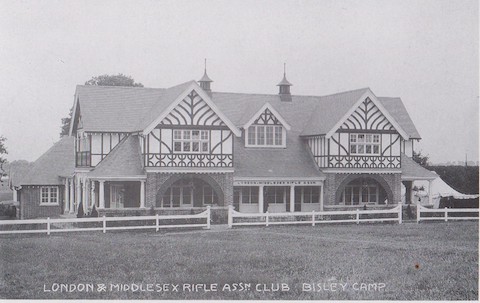
This view of the London & Middlesex Rifle Association pavilion may well have been taken soon after it was opened.
Opened in 1908, it was designed by the architect C. Lancaster Parkinson in a free “Olde English” style. It was extended in 1992.
Upon its opening, the Woking News & Mail reported: “This elegant pavilion, which Mr Haldene, Secretary of State for War, recently opened, is to be the Bisley home of the Middlesex & London Counties Rifle Association [sic]. It is one of the finest, as it is certainly one of the most pleasing in appearance, of the buildings in the camp.
“It is substantially built of red brick faced with white stone, the upper part being of rough cast and ornamental half-timbering, with tiled roof. Running round three sides is a broad verandah, on to which opens a spacious dining hall, which will seat 150 persons, and a cosy smoking room.
“Round the dining hall runs a gallery from which open about 20 sleeping cubicles, and the other accommodation includes a gun room, fitted with 50 lockers for the use of members, and quarters for the caretaker.”
The report added it had been erected by… “the well-known firm of Messrs Drowley & Co, of Woking, who are to be complimented upon the excellence of their work.”
Interestingly, the current website of the association notes the clubhouse was opened by the Duke of Bedford, then Lord Lieutenant of Middlesex and President of the London and Middlesex Rifle Association.
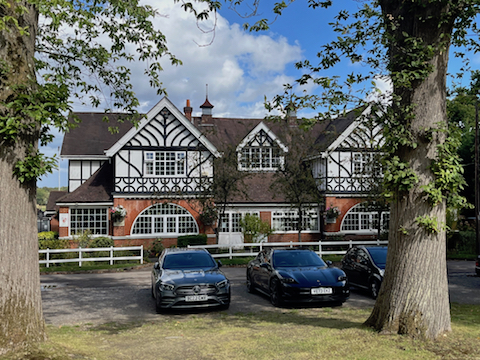
The London & Middlesex Rifle Association pavilion today.
Honorable Artillery Company’s clubhouse
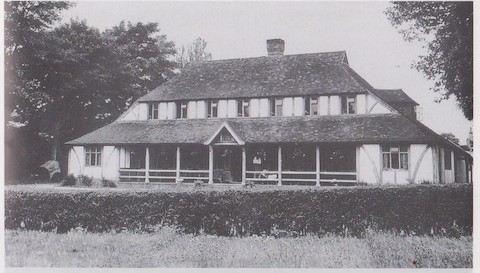
A vintage view of the clubhouse of the Honorable Artillery Company.
It was designed by architects B. de C. Jackson, was built in 1927 in a Tudor half-timbered style.
This elite regiment, founded in 1537, saw more than 4,000 members commissioned during the First World War.
They suffered 5,961 casualties and received 225 orders and decorations, including two Victoria Crosses.
The clubhouse was constructed as a memorial to those who lost their lives in the First World War.
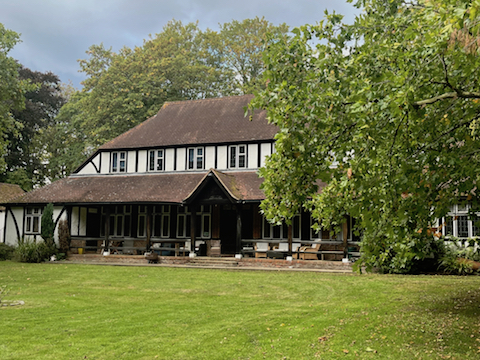
Honorable Artillery Company’s clubhouse today.
Exhibition Hut
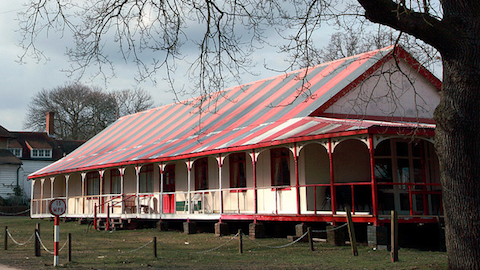
The recently refurbished Exhibition Hut today.
This is another demountable building originally from Wimbledon Common and re-erected at Bisley Camp.
It was formerly used to display trophies during the Imperial Meeting. It’s said to be “a rare complete example of the type of temporary or prefabricated hut used by the army in the colonies during the late 19th century”.
It was recently the clubhouse of the Muzzle Loaders’ Association of Great Britain, but has just been sympathetically refurbished and is currently vacant.
In his book, A Hundred Years Behind The Times – the history of Bisley in Surrey, Tim Price notes of the building: “It was described in 1960 as once having been the NRA Members’ Club ‘a spacious, well-lighted building with a lounge, writing room and a gun room’, to which was added the somewhat dismissive remark ‘whilst in the rear portion were the Ladies’ Club rooms’. Typical of so many clubhouses, this one has a capacious verandah that extends around three sides.”
Share This Post




I'm living well for nothing at all! (See: No Trifling Matter: Magpie Trapped in Godalming Sainsbury’s)




Next stop, Debt Chasm! (See: We Should All Be Outraged About the Failure to Deal with Legacy Debt)





Recent Comments