- Stay Connected

Socialize


 Abraham Lincoln
If given the truth, the people can be depended upon to meet any national crisis...
Abraham Lincoln
If given the truth, the people can be depended upon to meet any national crisis...

 Guildford news...
for Guildford people, brought to you by Guildford reporters - Guildford's own news service
Guildford news...
for Guildford people, brought to you by Guildford reporters - Guildford's own news service
The Spectacular Collapse of Worplesdon’s Owen Stone Company
Published on: 20 Aug, 2026
Updated on: 1 Sep, 2026
By Mark Coxhead with David Rose
The Owen Stone Company was established in 1897 close to Worplesdon railway station, producing artificial stone that was compared to the best Portland stone.
Promoted as looking good and easy for stonemasons to carve, it appears it may not have been what it was claimed to be.
It has been previously noted in some accounts of the firm’s history that the stone crumbled after a few years. Although this fact hasn’t come to light in this research, the company itself certainly did crumble, and very quickly too!
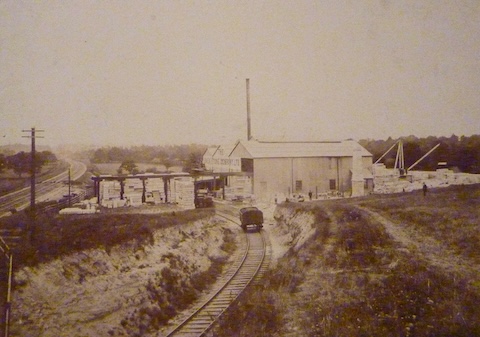
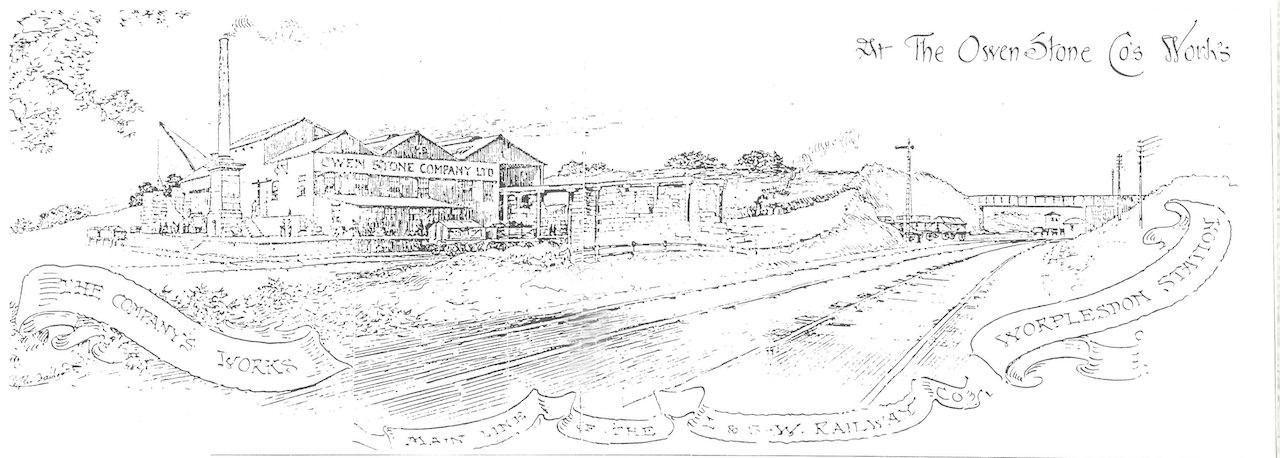
A view of the Owen Stone Company’s works showing the railway line into the site.
The works covered some size and a siding ran into it from the adjacent up railway line.
The product it made used the fine sand found in the area, mixed with lime.

Page from the 1901 reveals the address of William Owen and his family at Pontsarn, Guildford Road, Woking. However, William was not present on the night the census was taken. Click on image to enlarge in a new window.
The business was founded by a William Owen whose house was called Pontsarn, Guildford Road, Woking. As noted on the 1901 census, it was next to the police station.
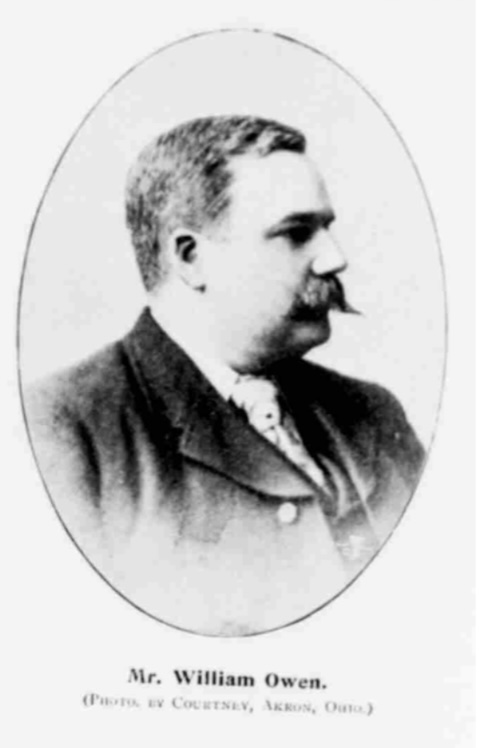
William Owen.
Using genealogy websites and other online sources, Mr Owen has been somewhat tricky to trace and seems to have been tricky by nature!
From searches made, his name does not seem to appear in the censuses from the late 19th and early 20th centuries.
No record of his birth or death has been found.
However, he was married and at least had one daughter, Elsa Heddan Owen.
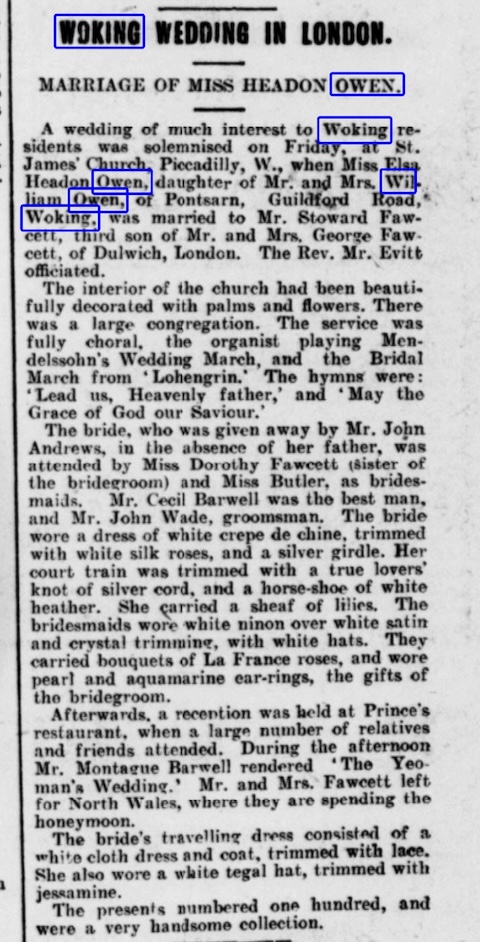
Report of the marriage of William Owen’s daughter Elsa Headon Owen published in the Woking News & Mail in its edition of June 22, 1911.
She married Mr Stoward Fawcett at St James’ Church Piccadilly, London, as reported by the Woking News & Mail in its edition of June 22, 1911. By that time the Owen Stone Company it seems had ceased to have traded in the UK for some time.
However, William Owen gave an interview to a reporter of a journal called the St James’s Budget, that it published in its edition of December 24, 1897, under the heading ARTIFICIAL STONE A Chat with the Inventor.
Part of the published interview reveals…
At the beginning of the month I joined a party of journalists, architects, builders, etc., to inspect the manufacture of Owen’s Stone at the Company’s works at Worplesdon, near Woking.
During our tour of the works I soon recognised Mr Owen, but he was too busy explaining the manufacture of his invention for me to trouble him.
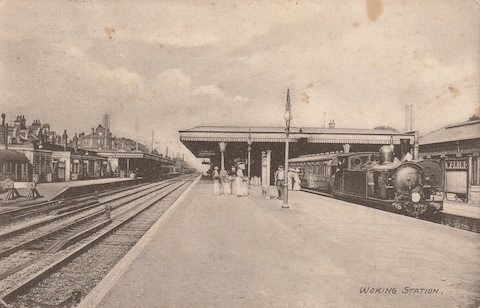
A picture postcard view of Woking railway station c.1910.
At Woking Station my chance came. We had some time to wait, and there on the platform was my host, who very politely asked me if he could offer me a cigar.
As the train was then starting, I explained that I hoped to have obtained an interview for publication purposes, and would it be possible for me to see him anywhere on the following day.
Replying, with characteristic geniality, “Tomorrow at the Royal Societies Club at four, if that will suit you I will be delighted.”.
I left this splendid specimen of humanity for he is an exceptionally fine built man – and found him the next afternoon at his club in St James’s Street.
“Can you give me some particulars of your early life?” I asked.
“I went to Belgium when I was sixteen to study for my profession of civil engineer. My brother at that time being inspecting engineer for several States and railways. I remained with him for three years as his assistant, after which I had full charge.
As a F.R.G.S., [Fellow of the Royal Graphical Society?] I suppose you have travelled somewhat?
“Yes – in my official capacity as chief engineer for railway materials I visited all the principal cities of the Continent – at any rate, those of Germany, France, Austria, Russia and Spain. I also visited the United States, and in 1892–93 I made an extended tour of America.”
Can you tell me briefly the component parts of Owen Stone and the principles of its manufacture?
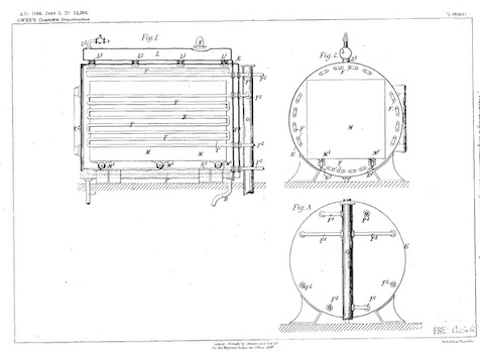
“It is simply composed of sand and lime, and the chief principles of its production are the boxes in cylinder by which we get undisturbed pressure without current of air.”
Illustration from one of William Owen’s patents that likely shows the boxes and cylinders used to produce his artificial stone.
You consider your stone equal to Portland Stone?
“Not only equal, but superior, for the simple reason that it is not influenced by extreme heat or cold.”
Then it should be of universal interest and importance?
“Unquestionably. And that is the reason why with some of our companies we have not had to go to the public for money; they were subscribed for privately. This was the case with our very first, the Scottish one.”
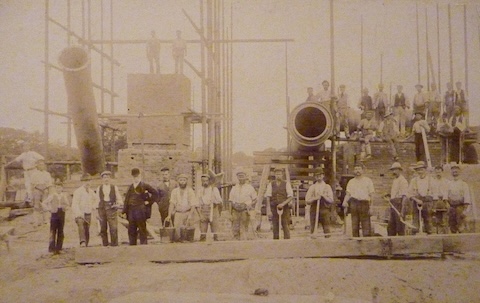
The Owen Stone Company’s works at Worplesdon. Could the two large cylinders be those used to manufacture the artificial stone, or are they simply water pipes?
More of William Owen’s other works in Scotland further on. Meanwhile, his new venture at Worplesdon was splashed over a page of the Woking News & Mail in its edition of December 3, 1897.
It reported….
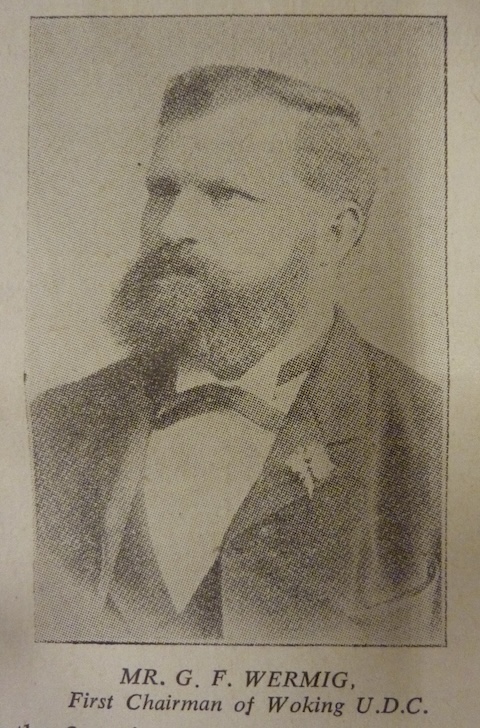
At the Railway Hotel [Woking] on Wednesday, the directors of the Owen Stone Company, Ltd., entertained a large gathering of professional and business gentlemen at a luncheon to mark the completion of their extensive works near Worplesdon Station. After an excellent meal served by host C. F. Waters, the company – which included Mr G. F. Wermig, J.P., and Mr.H. Dimmock – joined in several toasts.
The health of Mr W. Owen, inventor of the artificial stone that bears his name, was warmly honoured.
In his reply, Mr Owen explained the manufacturing process.
Gustav Friedrich Wermig.
Mr Wermig then responded on behalf of the visitors, extending, on behalf of Woking, a cordial welcome to Mr Owen. He expressed confidence that their good wishes for Mr Owen’s prosperity would be justified by results. He himself was convinced that the stone would attract the notice of all practical men, and that the company would prosper in their undertaking (applause).
The party then travelled by special train to Worplesdon, where they inspected the works and saw the process demonstrated. The land acquired for the project covers about 22 acres, the soil of which – down to at least 120 feet – consists of white, sharp sand ideally suited to manufacturing the stone. The stone is produced from this sand mixed with hydraulic lime in the proportion of 87 and a half parts of sand to 12 and a half parts of lime. There is therefore an effectively inexhaustible supply of the principal ingredient on site.
An illustration of the Owen Stone Company’s works at Worplesdon. Click to enlarge in a new window.
The works themselves are extensive, fitted with plant of a highly complete and elaborate character. Around 300 workmen will be employed, for whom a model village of substantial stone-built houses is to be provided. A railway siding has already been constructed at a cost of £1,500. All this clearly demonstrates the company’s confidence in the success of their venture, which promises to bring an important new industry to the district.
The process by which the stone is made is both simple and economical. The sand and lime are subjected, in the presence of highly heated water, to a pressure of 60 to 70 lbs per square inch, causing them to chemically combine. The result is a compact and homogeneous stone equal in appearance and quality to the finest Portland stone, but at half the cost. It is, in fact, superior to natural sedimentary stones by virtue of being free from vents, cracks, and flaws.
The stone is produced in steel moulds, which can be adjusted to any required size, shape, or design. Even the most delicate mouldings can be formed in blocks or pieces weighing up to ten tons. This brings considerable economy, eliminating the need for much subsequent carving and reducing unnecessary transport of waste material. The stone can be used immediately upon removal from the moulds and can be carved, turned, worked, and tooled as readily as the best Portland.
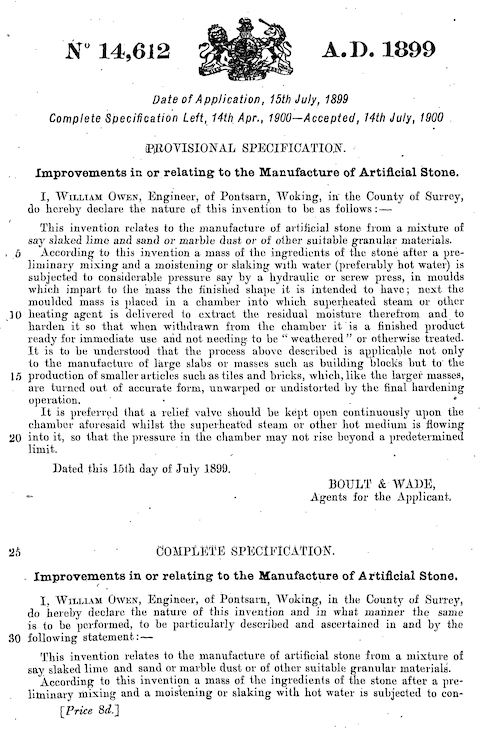
Page one of William Owen’s 1899 patent for his artificial stone.
On November 6, 1897, the Railway Times was already extolling the virtues of Owen’s stone…
The stonework used on railway platforms — and the stone-paved approaches leading to them — is subjected to enormous wear and therefore requires frequent replacement in the interest of public safety. This ongoing renewal is extremely costly. As a result, for many years inventors and scientific experts have sought to develop a material that possesses the durability of natural stone while being significantly less expensive.
Many substitutes have been tested, but for railway platforms most fail in one critical respect: after only a short period of use, they become smooth and greasy, providing insecure footing and creating a serious danger for the travelling public.
Mr William Owen has succeeded in producing a material that in many ways surpasses high-quality Portland stone, while costing less than half as much.
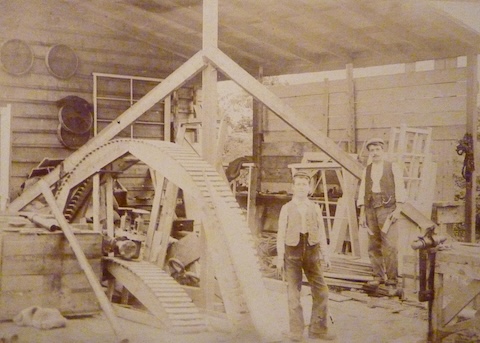
A view inside the works at Worplesdon.
The story continued with the manufacturing process in much the same words as the other publication quoted here. Perhaps William Owen issued them all with his own press release?
A classified advertisement for masons at the works was published in the Woking News & Mail in its edition of February 1, 1898.
It read…
MASONS Wanted (Six); constant employment, 9d per hour at the Owen Stone Company’s Works, Worplesdon, Surrey.

Advertisement for masons.
All appeared favourable for Mr Owen’s new product. It was none other than the trade journal The British Architect that also compared it to the best natural Portland stone, adding its fire-proof quality meant it could withstand the “fiercest flames” or cold water poured on it when the stone was extremely hot.
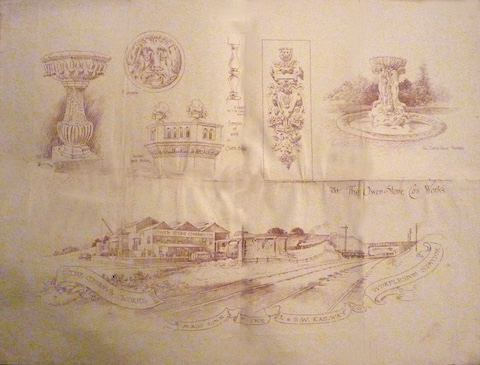
An illustration of the works at Worplesdon and examples of the products that could or had been made from Owen’s artificial stone.
It’s believed a catalogue issued by the company featured this artificial stone forming the balustraded porch of a hotel in Woking and a font at St Mary’s Church, Perry Hill, Worplesdon.
As he mentioned in his interview with the reporter of the St James’s Budget, William Owen had established another works, also in 1897, at Bathgate in Scotland.
The venture was called the Owen Stone Company of Scotland.
The Bo’ness Journal and Linlithgow Advertiser had reported in its edition of November 26, 1897…
A New Industry — The Owen Stone Company of Scotland Formal Opening of the Bathgate Works
The new works of the Owen Stone Company, situated on the Meikle Inch, Bathgate, were formally opened last Thursday under very favourable circumstances. At the invitation of the directors, around 150 gentlemen – mostly builders, architects, and others connected with the building trade – visited the works and inspected the manufacturing processes.
The manufacture of stone from sand is practically a new industry, and these works are the first of their kind in Scotland. The company began operations at Worplesdon, Surrey, where their first works were established. With a view to expanding and developing the trade further, the new works at Bathgate have been opened. Here, the company has access to an abundant supply of sand for many years to come, having already leased approximately sixty-three acres.
Around one hundred workers are currently employed, and as the trade develops, it is expected that two to three hundred people will eventually find employment. When fully operational, the output is estimated at two to three hundred tons per week. The works – remarkable for their compact layout – were constructed under the supervision of the manager, Mr Oliver. With a railway siding leading directly into the site, a plentiful supply of sand, and an energetic, practical manager at the helm, the undertaking appears promising.
As a special mark of esteem for his excellent services in constructing the new works, Mr Oliver was presented with a beautiful gold watch by Mr Owen, the patentee, on Thursday.
Unfortunately, just how much of the artificial stone was actually produced at each works has not be found in this research.
Besides, the Scottish venture was soon in trouble.
In its edition of May 2, 1899, The Edinburgh edition of The London Gazette reported that the Owen Stone Company of Scotland was in liquidation.
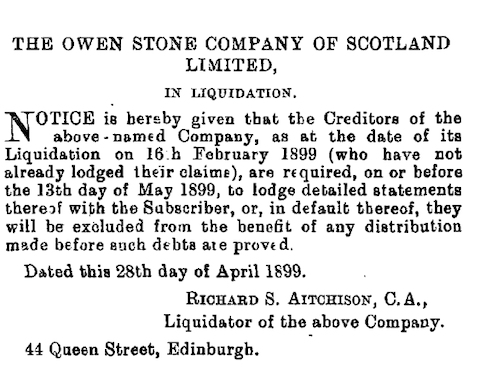
Notice in the Edinburgh edition of The London Gazette reporting the Owen Stone Company of Scotland was in liquidation.
And in its edition of May 9, 1899 a requested was published that any creditors of the business who had not already lodged their claims had to do so by May 13, 1899.
Meanwhile, Colchester Town Council had considered using William Owen’s artificial stone it for its new town hall. And as reported in the Essex Standard in its edition of May 20, 1899…
A sub-committee had visited the Owen Stone Company’s works at Worplesdon and were unanimous that they could not recommend the use of the company’s material for the tower of the new Town Hall.
The architect expressed a strong preference for Portland stone over Owen stone, the additional cost being £300.
However, the downfall of the Owen Stone Company in Worplesdon and its owner, as was his Scottish firm, began very soon.
A public notice published in the Midhurst and Steyning Express in its edition of April 17, 1900, and the Woking News & Mail of April 20, 1900 stated…
NOTICE IS HEREBY GIVEN that William Owen, of “PONTSARN,” WOKING, has ceased to be connected with the Owen Stone Company Limited, and has no authority to act on behalf of, or pledge the credits of, or represent the use of the name of the said Company, and that the said Company will not be responsible for any debts contracted by him.
The Edinburgh edition of The London Gazette, in its edition of March 8, 1901, reported that following an ordinary general meeting on February 12, on March 5, the company was “voluntarily wound up”.
A further public notice in the Edinburgh edition of The London Gazette of May 9, 1901, noted that at an extraordinary general meeting held on February 12, 1901, a resolution was confirmed: “That the Company be wound up voluntarily.”
In its edition of July 5, 1901, the Woking News & Mail published a story under the heading BANKRUPTCY OF MR. W. OWEN
The public examination of Mr William Owen, of Pontsarn, Woking, was to have been taken at the Guildford Bankruptcy Court on Tuesday, but Mr Acheson, the assistant official receiver, stated that the creditors’ meeting having been adjourned, he could not proceed with the public examination.
A few questions were put to the debtor [William Owen] by Messers. Herring and Son’s legal representative, and from his replies it appeared that he was appointed general manager of the Owen Stone Company in September 1897, and ceased to be a salaried manager in July 1899, although he continued to manage the company’s affairs after that date.
He took over part of the works and carried them on experimentally on his own account. The machinery he bought from Messers. Herring and Son was bought on his own account, and not on account of the company.
Shown a document signed by himself to the effect that he was not acting for himself in the matter, but for the company, the debtor said he signed it under a false impression. He was suffering from an infection of the eyes at the time, and could not read. It was his intention that Messers. Herring and Son should be paid in full.
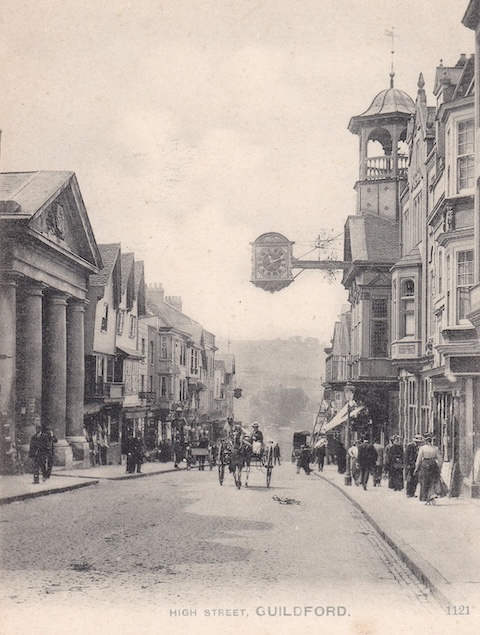
Early 1900s picture postcard view published by Lloyd of Albury showing Guildford High Street and its Guildhall, where it was likely that William Owen’s bankruptcy hearings were held.
The Woking News & Mail, in its edition of August 2, 1901 published under the heading AN ARTIFICIAL STONE MAKER’S FAILURE. Note: in legal terms within the hearing, William Owen is referred to “debtor” when he owes and as “witness”at times when he had received money.
At the Guildford Bankruptcy Court on Monday, the public examination took place of Mr William Owen, formerly manager of the Owen Stone Company, Woking.
In reply to Mr Britten, the assistant official receiver, the debtor stated that in 1896 he had been experimenting in London on stone making. He took out a patent in 1895 which was sold to the Owen Stone Company, as was another patent taken out in 1896.
The witness received about £5,000 gross for this, of which about £2,000 was paid to him as commission. He had also paid the assistant official receiver a list of net amounts he had received for patents, amounting to about £9,000. Of this, around £4,000 was in respect of the Western Australian patent, and £1,750 in respect of the Transvaal patent. The witness was appointed manager of the Owen Stone Company and was to receive £1,000 in salary the first year, but this was only on paper, and for the three years his salary only amounted to a total of about £600. He was also to have received 200 shares, but they were not allotted to him.
Witness received £250 deposit on the Canadian contract, which was not completed. The house in which he lived at Woking was bought by his wife, and he lent her £750 for the purchase of two plots of ground to make into a kitchen garden, and £350 of his money was spent on doing up the house. Mr Britten asked the debtor if his wife repaid the money.
“She has paid me a lot more than that, when I have been hard up.”
A little later in the examination the debtor was referring to some papers, when Mr Britten asked why he had not handed them over. He replied that he had not been asked for them. Mr Britten read out a clause in a document requiring him to furnish the official receiver with all books and documents relating to his affairs. He then asked the debtor to hand over what he had in his hands. Mr Owen passed some papers over.
Mr Britten: “And the others?”
Mr Owen (debtor): “What, the letters?”
Mr Britten: “Hand them over.”
Debtor: “It is not fair that you want those letters.”
Mr Britten: “Hand them over.”
Debtor: “There they are. I only brought them down for the sake of convenience.”
Mr Britten: “And what are those?”
Debtor: “They are simply private.”
Mr Britten: “I must see them.”
Witness: “If they are love letters?”
Mr Britten: “You won’t be examined upon those. Do you have love letters from men?”
Debtor: “You would have known it if they were love letters I shall hand.”In answer to further questions, the debtor said he was worth about £1,200 to £1,300 in September 1899, and 12 months later he had paid about £1,250 of that away.
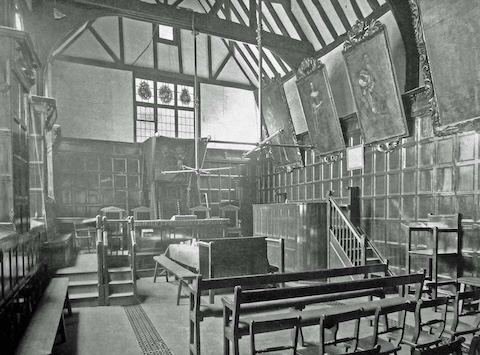
The courtroom inside Guildford’s Guildhall.
When questioned further William Owen admitted that he had become insolvent, but said he had not been aware of it, because when he took over the works himself, he intended handing them over to another syndicate.
William Owen said he lost the position of manager because the company ceased manufacturing. And he added that its failure was partly attributed to the seizure of the plant and stock – about 150,000 specimen bricks – by the trustee of the debenture holders.
While carrying on the works in Worplesdon himself, he did not consider that there was any deception of the public in that.
He denied a claim of £982 by a Mr Perryman (also at the hearing) on the grounds that he was to be paid for his services by shares when the company was formed. William Owen said had lent Perryman £250, but had not included that in his statement of affairs, because he considered it a bad debt.
William Owen also admitted that he had previously been bankrupted in 1890. He also admitted having paid money into the banking account of his wife at Guildford.
Mr Perryman put it to William Owen there was a receipt for £500 when the Owen Stone Company was formed as a bonus for his (Owen’s) services in respect of stone-making experiments. But William Owen denied this.
Mr Perryman then said William Owen had told him he had put the house at Woking into his wife’s name.
William Owen told the hearing that he did not recollect making such a statement.
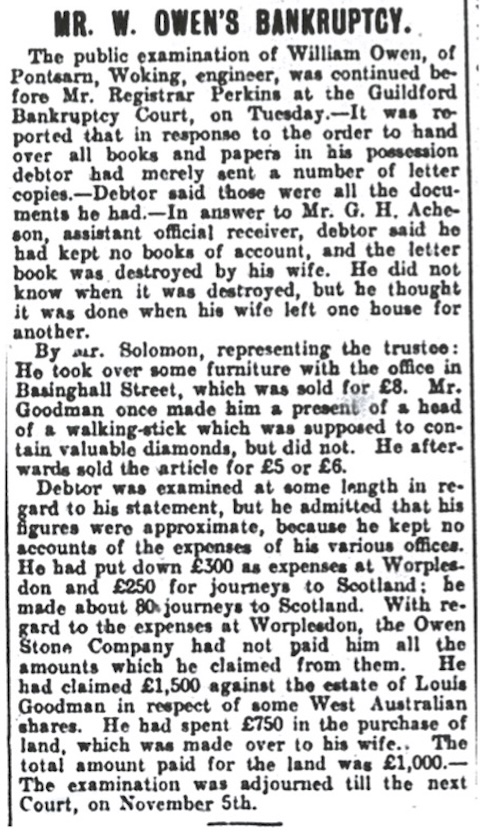
A further story in the Woking News & Mail in October October 1901 concerning William Owen’s bankruptcy.
The Woking News & Mail in October 1901 published a further story under the heading MR OWEN’S BANKRUPTCY, noting…
It was reported that in response to the order to handover all books and papers in his possession debtor had merely sent a number of letter copies. Debtor said these were all the documents he had. In answer to Mr. G. H. Acheson, assistant official receiver, debtor said he had kept no books of account, and the letter book was destroyed by his wife. He did not know when it was destroyed, but he thought it was done when his wife left one house for another.
William Owen admitted that his figures in the accounts were approximate, because he kept no account of the expenses of his various offices.
He added that had put down £300 as expenses at Worplesdon and £250 for journeys to Scotland: he made about 80 journeys to Scotland.
With regard to the expenses at Worplesdon, he said the Owen Stone Company had not paid him all the accounts which he claimed from them.
He had claimed £1,500 against the estate of Lewis Goodman in respect of some West Australian shares. He had spent £750 in the purchase of land, which was made over to his wife. The total amount paid for the land was £1,000.
The next hearing of William Owen’s bankruptcy was reported in the Woking News & Mail’s edition of November 8, 1901.
The report included…
Mr Solomon said between August 1896 and February 1898 debtor’s personal drawings from the bank mounted to £2,858.
Debtor pointed out that during the building of the works at Worplesdon the accounts were paid by him, some of the building materials, wages, and petty, cash, etc., were paid out of his own account, and this would be refunded to him from the company.
He could not say how much of the £2,858 represented his personal expenditure. There were outgoing before the erection of the works in April 1897. Not a single penny of it had gone into his own pocket.
William Owen told the hearing that it was impossible for him, without the company’s books, to extract from his pass-book, the items which referred to the works, and which were his own personal drawings.
He said if he could get the company’s books, he might probably be able to do it.
When questioned with regard to several cheques, William Owen gave some details. However, when he came to refer to the amounts which were drawn to himself, he said he could not explain what they were for, only adding that he paid wages and petty cash and other things by drawing checks in his own name.
William Owen was ordered to provide full details of the items shown in his bank, passbook, and his wife’s passbook, from August 14 1896. However, he said it was impossible to do that.
The registrar made an order that the details should be filled in a month.
William Owen also told the hearing that he had no interest in any of his patents. He said he sold all his patents to the Owen Stone Company and he had not dealt with any patents since the sale to the company.
One more newspaper report of William Owen’s bankruptcy has been found. This was in the Woking News & Mail in January 1902.
Here are the key parts of the report…
The Assistant Official Receiver, Mr Acheson, said the debtor had not complied with the order of the court to make a statement showing to whom and for what purpose the moneys shown in his pass-book had been expended.
Mr Solomon said there had been a very large sum of £15,000 passing through the debtor’s hands, and he stated there were no assets.
Debtor said he could not give the details unless he could have the books of the Owen Stone Company. Mr Solomon said he had tried, and could not get the books of the company.
The registrar ordered that the debtor file a statement as complete as he could make it within 21 days.
In its edition of August 27, 1904, the West Surrey Times published an advertisement for the sale of equipment at the Owen Stone Works in Worplesdon.
FOR Sale. Vertical Marshall ENGINE and Lancashire Boiler, 20ft by 6ft., for 120 lbs pressure; Corrugated Iron Building. 75ft long by 78ft wide: Drying Cylinders, Light Rails and Turn-tables; large quantity of Stone, and two Overhead Travellers: seen at Owen Stone Works, Worplesdon. – Apply, A. Underwood, 3, Queen Street, London, E.C.
The final blow to the Owen Stone Company at Worplesdon appears to have been the publication of a public notice in The London Gazette in its edition of September 4, 1904.
The Owen Stone Company Limited
At an Extraordinary General Meeting of the above Company, and held on the 5th day of September, 1904, the following resolution was carried unanimously: –
“That it has been proved to the satisfaction of the meeting that the Company Cannot by reason of liabilities, continue its business, and that it is advisable to wind up the same, and accordingly that the Company be wound up voluntarily.”
The last mention of him in England that has been found relates to the marriage of his daughter, Elsa Heddan Owen to Steward Fawcett in 1911, as noted here previously.
It says he did not attend his daughter’s wedding!
That wedding report in the Woking News & Mail included: “The bride, who was given away by Mr John Andrews in the absence of her father, was attended by Miss Dorothy Fawcett (the bridegroom’s sister) and Miss Butler as bridesmaids.”
What became of William Owen?
All the authors have found so far is a clue in a patent he applied on November 6, 1902 and was granted on June 23, 1903 by the United States Patent Office.
The application being by WILLIAM OWEN, WOKING, SURREY, and titled PROCESS OF MANUFACTURING ARTIFICIAL STONE.
Moreover, at the foot of the patent document he signs and dates himself William Owen, Toronto, November 6, 1902.
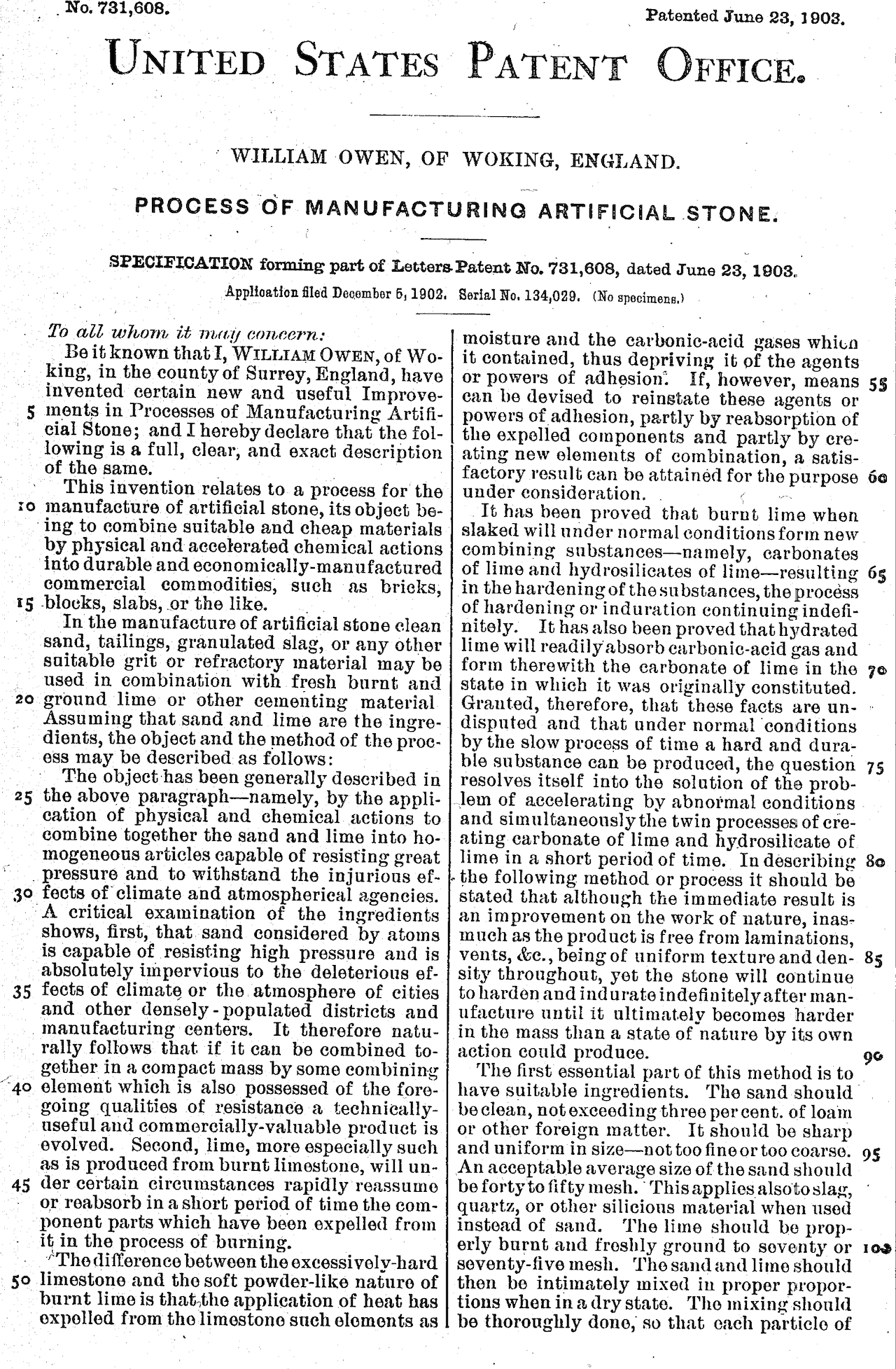
Above and below, William Owen’s United States of American patent details, applied for in 1902 and granted in 1903. Click on each one to enlarge in a new window.
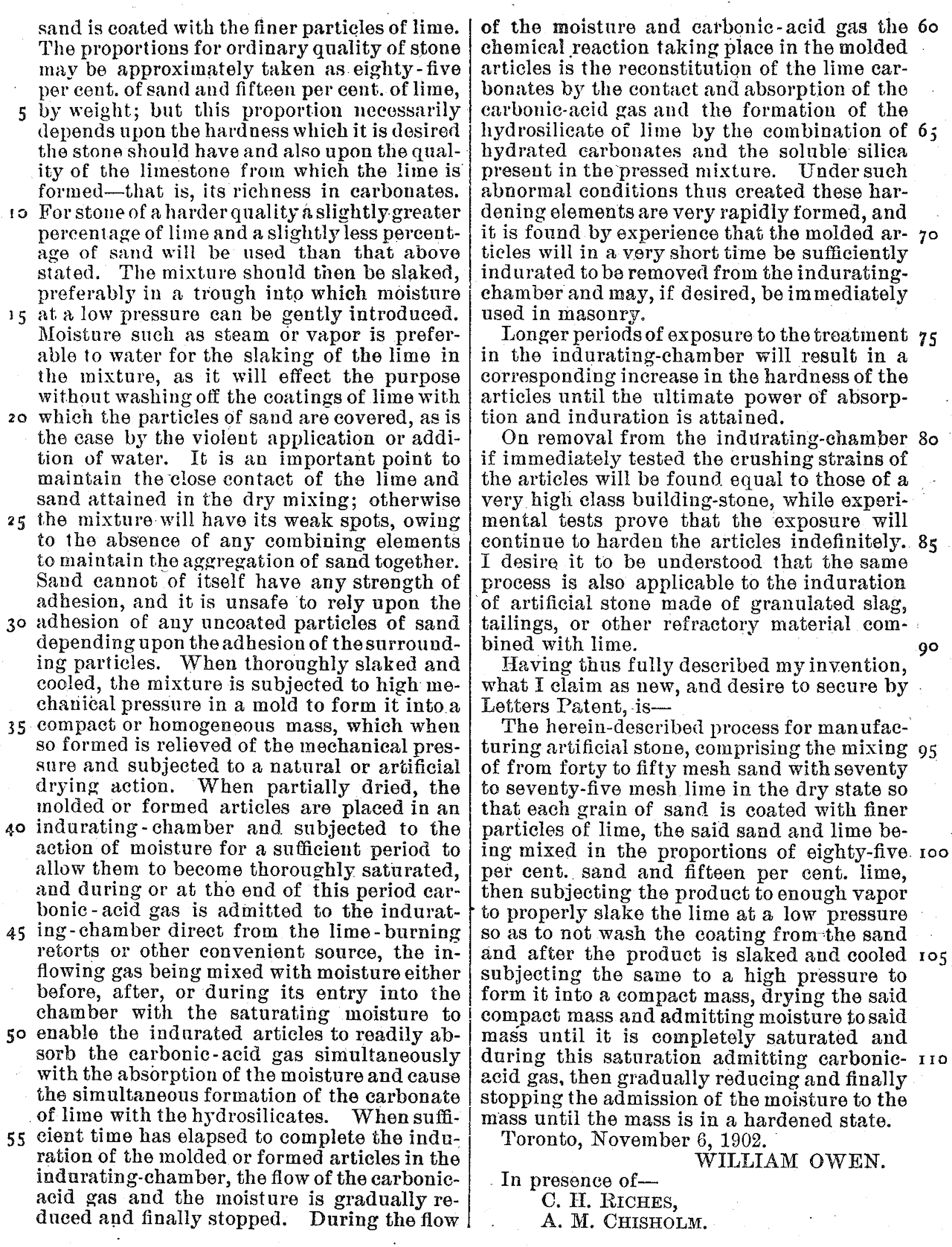
It seems he was attempting to start a new life in North America…
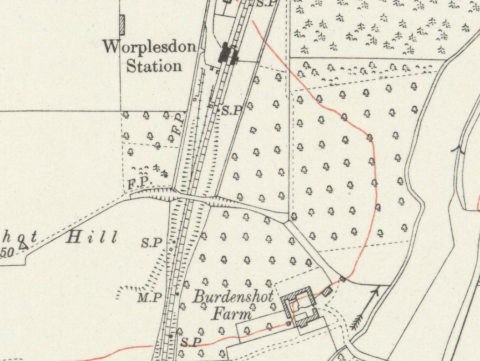
Finally, below is the OS map of 1913 shows no trace of the Owen Stone Company’s works, only some cross hatching marking the shallow cutting where the railway line siding into the site had been.
Share This Post


Responses to The Spectacular Collapse of Worplesdon’s Owen Stone Company
Leave a Comment Please see our comments policy. All comments are moderated and may take time to appear. Full names, or at least initial and surname, must be given.










Eric Brough
August 29, 2026 at 4:45 pm
Great research. I’ve often looked out of the train at the area SW of Worplesdon station and wondered what was there: earthworks, particularly the route of a siding, still quite visible.
Nigel Searle
August 31, 2026 at 11:01 pm
The site and the siding cutting can also be seen clearly on LiDAR (Light Detection and Ranging) aerial surveys of the area (a search for ‘LiDAR finder’ should find such.)
It would be interesting to know if the site was used for anything else post the demise of Owen’s works.
David Rose replies: I have now added to the story the site as is shown on the OS map of 1913, from the National Library of Scotland’s website. I am not sure, but I don’t think anything else was built on the site.