- Stay Connected

Socialize

 Abraham Lincoln
If given the truth, the people can be depended upon to meet any national crisis...
Abraham Lincoln
If given the truth, the people can be depended upon to meet any national crisis...

 Guildford news...
for Guildford people, brought to you by Guildford reporters - Guildford's own news service
Guildford news...
for Guildford people, brought to you by Guildford reporters - Guildford's own news service
A Clean Air Zone Would Not Be Appropriate For Guildford, Says Report
Published on: 17 Jun, 2026
Updated on: 18 Jun, 2026
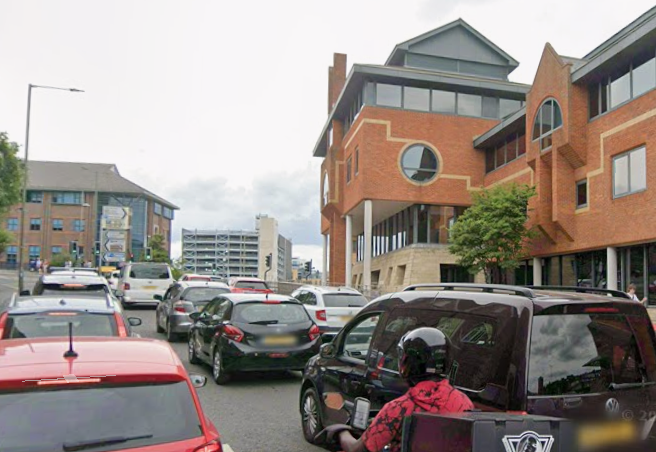
Park Street, Guildford’s pollution hot spot.
By James Moules
local democracy reporting service
A clean air zone for Guildford has been deemed “not proportionate to local need” given the town’s air quality issue is “primarily concentrated” on one particular street.
Guildford Borough Council’s Overview and Scrutiny Committee considered a report into measures to bring down harmful air pollution levels in the town.
Consultant Dr Margarethe Theseira, who spoke to councillors, had been commissioned to carry out a study into the feasibility of introducing a clean air zone (CAZ) in Guildford.
However, the report suggested alternative measures such as targeted measures in pollution hotspots and incentives for active travel instead of a blanket clean air zone, which it warned could incur significant costs. The matter will go before the council Executive for a final decision in due course.
Dr Theseira told councillors that the reason a clean air zone or low emission zone was inappropriate was that high pollution levels were very much concentrated on one site, at Park Street. So a broader scheme was disproportionate in scale and cost.
“There are alternative measures you can do to improve air quality at Park Street,” she said.
Dr Theseira added that implementing a CAZ would not be cheap, and that the cost of operating equivalent schemes could run into millions of pounds per year.
“If you compare yourselves to Bath, it was around £10 million for Bath to set up its clean air zone – and it cost £2 million in operational costs per year,” she said.
The report noted that Park Street in the town centre saw especially high pollution levels as the vehicles are forced to travel uphill before being held at traffic lights.
“That’s what’s causing the problem,” Dr Theseira said. “It isn’t just the traffic lights, it’s the slope that approaches that junction that causes more emissions than you may expect.”
Options for targeted interventions to improve air quality in this area could include traffic management, or engineering solutions such as assisted ventilation in relevant buildings, according to the report.
Clean air zones and low emissions zones have become more common in cities and towns across the country over the past half decade.
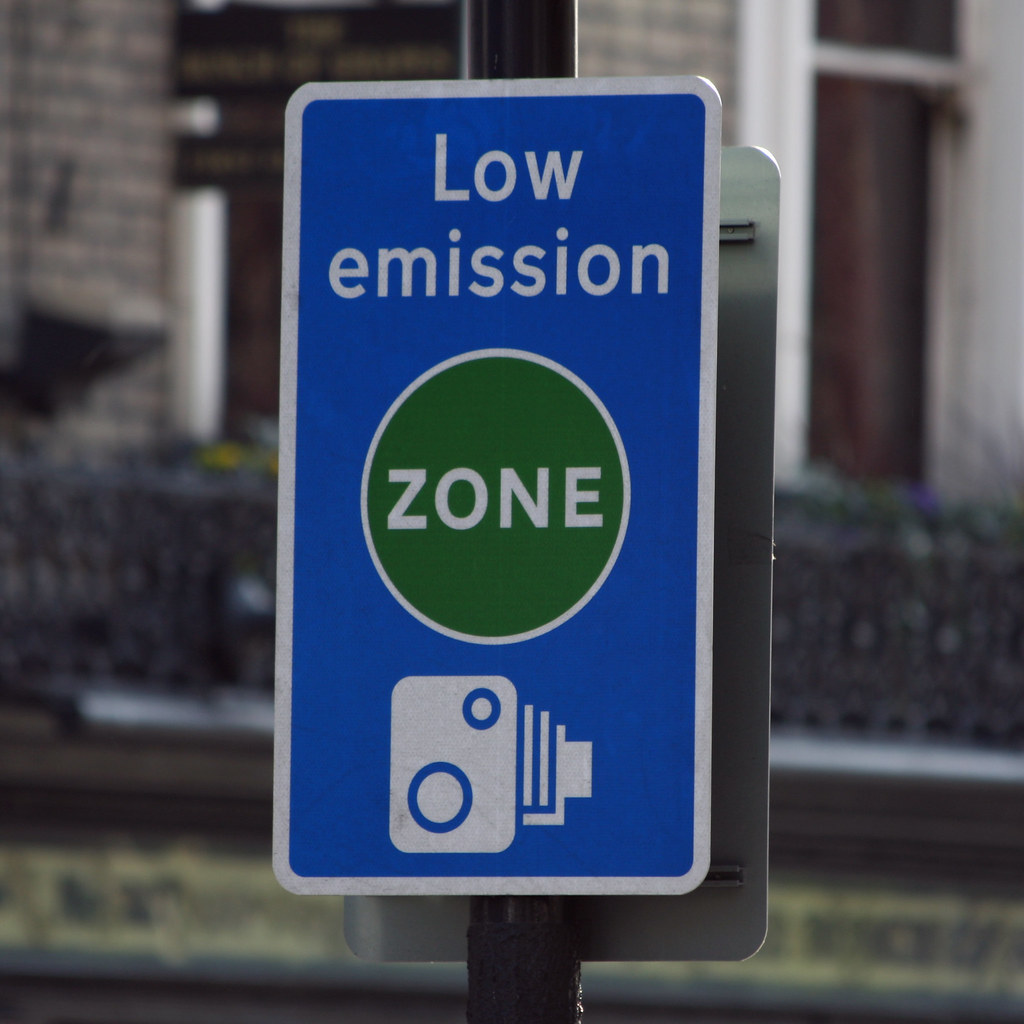 Some schemes, such as London’s Ultra Low Emission Zone, make high-polluting vehicles pay a fee to drive within their boundaries, while others such as that in Derby opt for traffic control measures instead of charges.
Research conducted for the study found that only 68 per cent of cars registered in Guildford meet London ULEZ standards – which drops to 57 per cent among vans.
But the report ultimately deemed that a clean air zone would not be an “appropriate response” given the likely high operating costs and uncertain revenue it would entail.
It adds: “This is further exacerbated by the level of uncertainty over future updates of vehicles given changes in direction from recent government policy, and global geo-political concerns potentially impacting on fuel price and car production.”
Instead, alternative measures such as incentives for active travel, a review of council fleet emission standards and further analysis of park and ride schemes were floated.
Committee members considered the recommendations, which are expected to be presented to the council executive for a final decision in due course.
Share This Post


Responses to A Clean Air Zone Would Not Be Appropriate For Guildford, Says Report
Leave a Comment Please see our comments policy. All comments are moderated and may take time to appear. Full names, or at least initial and surname, must be given.


I'm living well for nothing at all! (See: No Trifling Matter: Magpie Trapped in Godalming Sainsbury’s)



Next stop, Debt Chasm! (See: We Should All Be Outraged About the Failure to Deal with Legacy Debt)





Patrick Bray
June 21, 2026 at 9:41 pm
Sounds like some common sense is being applied.
Of more worry regarding air quality is the number of people using log burners and chimineas.
These are most certainly not environmentally friendly and the heavier deposits have direct health impacts – even in those designed to burn hotter and heat exhaust gases.
Of particular frustration is being choked by someone else’s fumes on a warm balmy evening because someone “likes looking at the flames”.
Let’s consider reducing these before we start making going to work even more expensive.
Tony Harrison
June 26, 2026 at 3:25 pm
Does Patrick Bray really think that the proposed measures will have even a tiny fraction of the impact on Guildford? The town is a stinking mass of pollution from gridlocked traffic every day. No wonder we’re in this mess.
Calum Shaw
June 24, 2026 at 8:38 pm
Bath’s Class C Clean Air Zone is considered a success for public health. It is also relatively cheap—or free—depending on what you drive, as private cars are completely exempt from charges.
Is it successful?
Emissions Drop: Nitrogen dioxide (NO₂) pollution inside the zone has dropped by about 22% to 26% compared to 2019 baseline levels, with average reductions reaching up to 40% in some areas. Legal limits met: monitored sites within the zone successfully fell to within legal annual mean limits (≤ 40μ g/m³). Cleaner fleets: compliance rates have improved as local businesses upgraded their vehicles, aided by a financial assistance grant scheme.
Is it cheap?
Private cars & motorbikes: completely free. You will pay nothing to drive a standard passenger car through the zone. Vans, taxis, & LGVs: £9 per day for non-compliant vehicles (Euro 5 or older diesel, Euro 3 or older petrol). HGVs, buses, & coaches: £100 per day for non-compliant heavy vehicles.
Council financials
While the zone initially brought in millions through penalty charge notices, the operational costs are high, and the council expects the zone to run an £800k deficit. However, the council planned for this, ring-fencing previous profits specifically to absorb these future running costs. Payments for non-compliant vehicles must be made via the UK Government Clean Air Zone portal within a 13-day payment window (6 days before, the day of, or up to 6 days after your journey).