- Stay Connected

Socialize


 Abraham Lincoln
If given the truth, the people can be depended upon to meet any national crisis...
Abraham Lincoln
If given the truth, the people can be depended upon to meet any national crisis...

 Guildford news...
for Guildford people, brought to you by Guildford reporters - Guildford's own news service
Guildford news...
for Guildford people, brought to you by Guildford reporters - Guildford's own news service
Birdwatcher’s Diary No.344
Published on: 22 Feb, 2026
Updated on: 22 Feb, 2026
By Malcolm Fincham
Although temperatures remained mostly in higher single figures in southern counties of the UK during the latter weeks of January and the first weeks of February, weather conditions remained bleak for the most part.
Constant south and westerly Atlantic low pressure systems dominated, bringing an unvarying theme of ‘rinse and repeat’ to a now already saturated countryside about southern regions of the UK, allowing little opportunities for me to get out and about with my camera.

Lower viewing hide at Tice’s Meadow.
Surprisingly to me however, a visit to Tice’s Meadow near Farnham on an overcast but rare dry day on January 25, saw water levels still reasonably low out on the ‘workings’, continuing to allow access to the lower viewing hide often flooded at this time of year.

Wintering wildfowl at Tice’s Meadow.
Although remaining dry during my time there, overcast conditions didn’t favour my photos.

Shoveler ducks, Tice’s Meadow.
A few rafts of shoveler ducks graced the water.

Pochard, Tice’s Meadow.
While a few wintering, mostly drake pochards came close to view.

Green sandpiper on far bank at Tice’s Meadow.
Much further to view across on the far bank a green sandpiper could be seen.

Peregrine falcon, Tice’s Meadow.
A regular visiting peregrine falcon could be viewed perched up and preening on a small island across the water.

Lapwings Tice’s Meadow.
Also adding a deceit of 50 or so lapwings that could be counted on some of the islands closer to view.
About my local retreat at Britten’s Pond, adjacent to Whitmoor Common, I could remain within sight of my car to withdraw to shelter and avoid the next rain event to pass through.
Regular visits did allowed me a few photos.

Tufted ducks, Britten’s Pond.
On the pond the pair of tufted ducks that had arrived in January continued to be viewed during the first weeks of February, often tucked in close to one of the islands.
But occasionally seen drifting to the centre of the pond to feed before returning in flight back to the islands to shelter and preen.
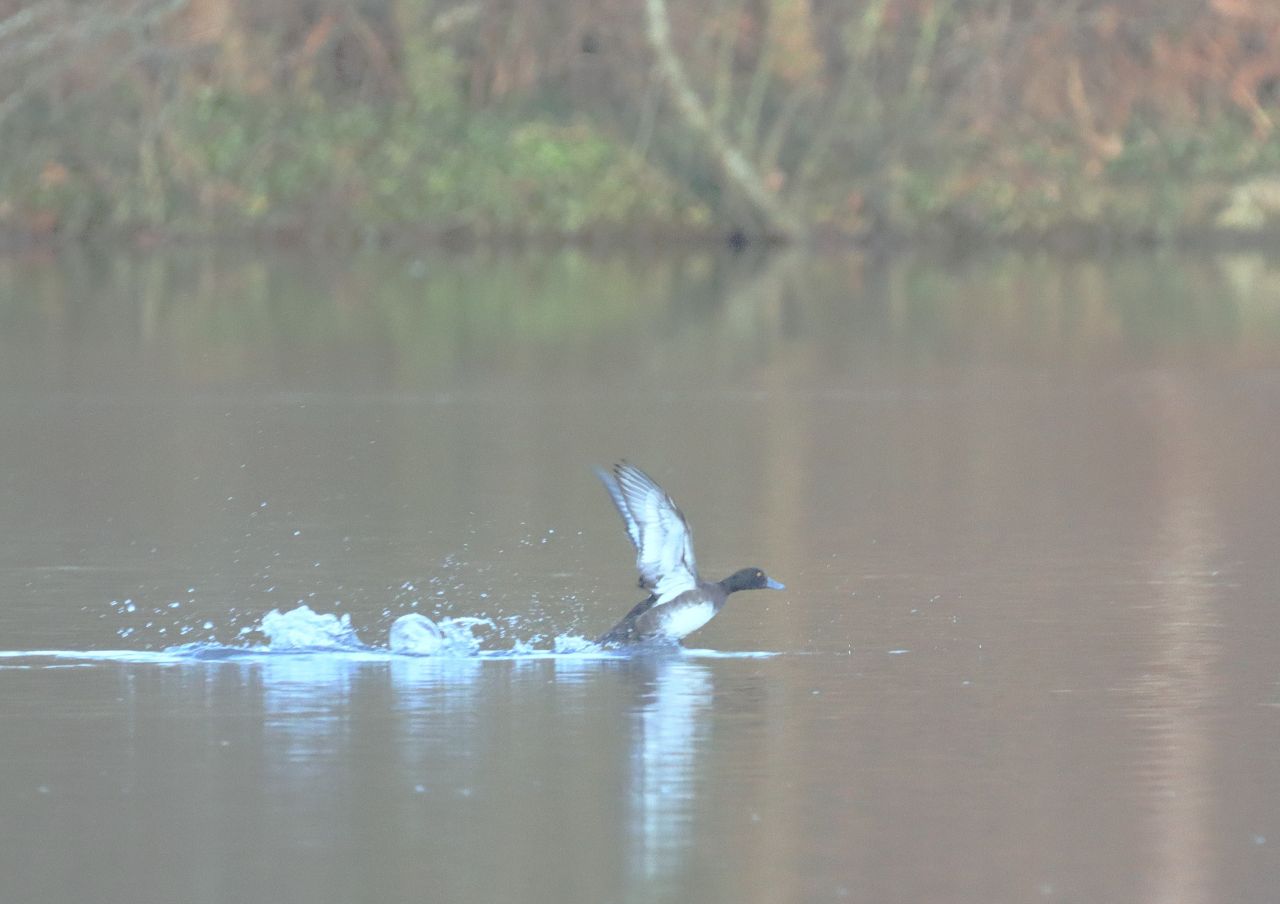
Female tufted duck in flight, Britten’s Pond.

Great crested grebe,with fish, Britten’s Pond.
A great crested grebe had also made an appearance and could occasionally be photographed catching fish.

Cormorant in flight, Britten’s Pond.
Other birds caught on camera fishing without a licence were, on occasions, as many as three cormorants.

Cormorant with fish, Britten’s Pond.
One of the cormorants seen to have caught what looked to be quite a sizeable perch.
Continuing to regularly visit the pond was the resident kingfisher, and on one visit even spotting two as they flashed past low across the water.

Kingfisher with fish, Britten’s Pond.
Although still struggling to capture an up-to-date decent photo, I did manage a record shot of one on a particularly overcast afternoon as it perched up a small distance away with a fish in its beak.

Mute swan, Britten’s Pond.
The long staying mute swans in recent years continued their presence.

Mute swans chasing one of the greylag geese about Britten’s Pond.
Although in previous years they have failed to reproduce, they have continued to form a close bond and were now showing a few early signs of aggression towards the resident greylag geese and also appeared to be starting to structure a nest site.

Egyptian geese, Britten’s Pond.
The resident pair of Egyptian geese had also started to show signs of courtship behaviour.

Treecreeper, Britten’s Pond.
Around the pond the best photo I could achieve was of a treecreeper as it probed the bark of a tree looking for insects.

Firecrest, Britten’s Pond.
And a firecrest had made a recent return and could be seen constantly on the move, flitting about the holly trees feeding on insects at the back of the pond.

Robin, Britten’s Pond.
Numerous robins continued to remain resident, accepting any titbits donated.

Common buzzard.
Over the pond a common buzzard attracted my attention on several of my visits.
 While a pair of red kites could already be seen displaying.

Woodcock in flight, Witley Common.
Elsewhere, on a visit to Witley Common on February 7 I was rather pleased to capture a photo of a woodcock in flight as it flew up from an area of bracken.
A few trips beyond the Surrey borders included a visit to Burpham, West Sussex. This in the company of Dougal.

Cattle egrets in flooded fields near Wepham.
At Wepham, from the roadside as many as 50 or more cattle egrets could be counted across the flooded fields.
Unfortunately, with so much water lying in the area, we were not able to see the three Bewick swans that had been observed from the viewpoint just a few days earlier.

Grey partridges in flight.
However, at Burgh we were fortunate to see a small covey of grey partridges as they took flight from a ditch by the fence-line along the main track.
With the addition of Bob, we also visited Farlington Marshes near Portsmouth, allowing me some additional photos including birds rarely seen within our local Surrey habitats.

Brent goose, Farlington Marshes.
As usual at this time of the year large flocks of brent geese gathered out on the marsh to feed.

Brent geese in flight, Farlington Marshes.
While other flocks could occasionally be seen flying in large skeins across the harbour as they continued to winter along our southern coastal regions.

Common seals in Langstone Harbour, viewed from Farlington Marshes.
With the tide reseeding on our arrival, a group of a dozen or so common seals could be viewed some distance out in Langstone Harbour.

Common redshank.
Also viewed on the mudflats were common redshanks.

Dunlin feeding on mudflats with brent geese at Farlington Marshes.
Groups of dunlin could be seen from the seawall probing the mud for food.

Dunlin in flight.
While large ‘flings’ of dunlin could be observed in flight.

Barnacle goose, Farlington Marshes.
On the inland reserve the resident barnacle goose, usually seen associating with a domestic white goose, (presently absent), now appeared to be associating with a mute swan.

Drake pintail duck, Farlington Marshes.
Wintering wildfowl included pintail ducks.
 Groups of shoveler ducks.

Teal ducks, Farlington Marshes.
Teal.

Gadwall duck, Farlington Marshes.
And gadwall ducks.

Spoonbill. A previous sighting at Farlington Marshes.
Too distant for my camera, but viewable through a ‘scope’, a spoonbill was added to our, sightings for this year.

Marsh harrier, Farlington Marshes.
Adding a marsh harrier to our day’s sightings.
With a few hours to spare we also visited the Oysterbeds at Hayling Island.

Oystercatchers.
This allowing me more photos of oystercatchers.

Grey plover.
Grey plovers.

Curlew, Oysterbeds, Hayling Island.
And curlews.
Once again, too distant for my camera, but viewable through Dougal’s telescope a distant red necked grebe and a drake greater scaup could be viewed.

Mediterranean gulls showing signs of coming into summer plumage, Oysterbeds, Hayling Island.
Adding to this year’s photos, and closer to view. were a group of 50 or more Mediterranean gulls, some already gaining signs of summer plumage.

Red-breasted mergansers, Oysterbeds, Hayling Island.
A pair of red-breasted mergansers.

Turnstones, Oysterbeds, Hayling Island.
And several turnstones.
Share This Post















Recent Comments