- Stay Connected

Socialize

 Abraham Lincoln
If given the truth, the people can be depended upon to meet any national crisis...
Abraham Lincoln
If given the truth, the people can be depended upon to meet any national crisis...

 Guildford news...
for Guildford people, brought to you by Guildford reporters - Guildford's own news service
Guildford news...
for Guildford people, brought to you by Guildford reporters - Guildford's own news service
Dragon Review: The Last Picture at the Yvonne Arnaud Theatre
Published on: 10 Mar, 2026
Updated on: 10 Mar, 2026
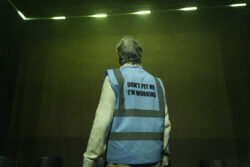
Robin Simpson in The Last Picture – Yvonne Arnaud
By Isabelle Trubshaw
A picture is only as complete as the imagination that sees it.
That is the message that I took from Robin Simpson’s 90-minute performance of Catherine Dyson’s “The Last Picture” – a one-man show directed by Joe Wilkinson. In it, an emotional support dog named Sam guides a group of Year 9 school children through a Holocaust photography exhibition.
First performed in a rehearsed reading at The York Theatre Royal, the play was later selected by the Royal Shakespeare Company for its 2023, “37 Plays” national playwriting initiative. It subsequently embarked on a UK tour, most recently stopping in Guildford.
Inspired by several unexplained photographs depicting Dyson’s relatives – found in her grandfather’s suitcase as he fled from occupied Poland in 1939 – the play asks us to confront the collective responsibility behind mankind’s capacity for hatred and suffering.
Performed in the intimate Mill Studio at the Yvonne Arnaud, which seats only 80 spectators, the production breaks many of the traditional limits of theatre. Simpson – known for his roles in Coronation Street, Holby City and Home Fires – commences by shattering the fourth wall, informally chatting to the audience.
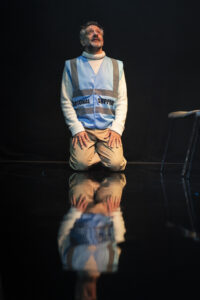
The Last Picture – Yvonne Arnaud
Soon, this unperturbed atmosphere is turned on its head, as the audience are asked to take on as much theatrical responsibility as Simpson himself.
Moving from photograph to photograph, we are guided from passive spectators to Year 9 students — and finally to anonymous figures within the black-and-white images themselves.
It is in this spotlight of raw emotion that we are challenged to move beyond simply looking at images, and instead actively engage with the harrowing realities they represent. The photographs swiftly shift from light-hearted observations to gruelling scenes of realism, making our role increasingly demanding and requiring deeper reflection.
Armed with little more than four chairs, Benny Goodman’s subtle lighting changes and Max Pappenheim’s sparse background music, Simpson commands the stage with honesty and rhythm. He plays intentionally with space, volume, and tempo, holding the audience’s imagination throughout.
By striking a remarkable balance between humour and solemnity, the production exposes humanity’s distorted empathy — how easily it is shaped by self-interest, and how often we avoid confronting the complexity of thought and emotion.
At times, the audience participation becomes heavy and overwhelming, likely leaving some spectators uncomfortable. Nonetheless, Simpson’s composure ensures that even the most intense moments — those of grief, discomfort, even suffocation — are met with clarity.
At key points, Simpson draws us back to the present through a headcount, reminding us who we are, where we are, and why we are here.
Ultimately, the play closes on a message of hope. Against a glowing yellow and red backdrop, The Last Picture reminds us that while mankind is capable of brutality and atrocity, we are equally capable of love and kindness. Only by confronting the past together can we begin to build a better future.
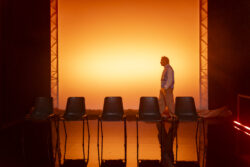
Ending message of hope- The Last Picture
Share This Post




I'm living well for nothing at all! (See: No Trifling Matter: Magpie Trapped in Godalming Sainsbury’s)



Next stop, Debt Chasm! (See: We Should All Be Outraged About the Failure to Deal with Legacy Debt)





Recent Comments