- Stay Connected

Socialize


 Abraham Lincoln
If given the truth, the people can be depended upon to meet any national crisis...
Abraham Lincoln
If given the truth, the people can be depended upon to meet any national crisis...

 Guildford news...
for Guildford people, brought to you by Guildford reporters - Guildford's own news service
Guildford news...
for Guildford people, brought to you by Guildford reporters - Guildford's own news service
Opinion: What Now for Local Government Reorganisation? Part 1 The Devil Is in the Detail…..
Published on: 26 Nov, 2025
Updated on: 27 Nov, 2025
 By Bernard Quoroll
former local authority CEO
In earlier opinion pieces, I pointed out why this Government was making such a poor fist of local government reorganisation in Surrey and why it is so bad for local democracy.
Click here for previous Insights articles.
Previous wholesale reorganisations have sought to balance ability to deliver services economically and efficiently (not just provide financial sustainability), against a need for local ownership and democratic responsiveness.
The decision letter from the Secretary of State now makes it very clear that financial considerations trump everything else. It feels like a preordained conclusion.
But there has been no meaningful attempt to assess informed public opinion and the financial case is incomplete and has not been proved to stack up. Nor does it answer the funding or the debt crises. It only kicks them both down the road.
Worst of all, any idea of community has been abandoned. The baby has been thrown out with the bath water. And we are still waiting to hear about a “super mayor”. I suspect that Surrey, big as it is, is not a large enough geographical area to justify its own regional mayor, (whose substantial on-costs do not yet seem to have been taken into account but they could easily outweigh any short term savings elsewhere).
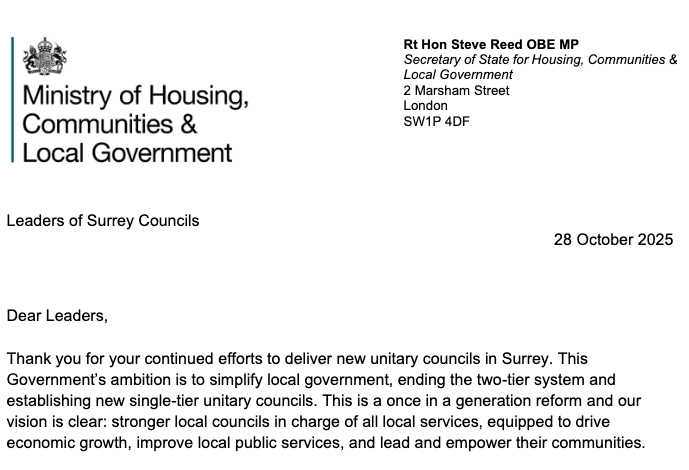
The letter from the Secretary of State announcing decision on two unitary authorities for Surrey.
To see letter in full follow link to: Two Unitaries for Surrey – Letter to Council Leaders
The Government may also be concerned that a mayor will see his or her job as immediately trying to prise more money out of central government. And of course, their manifesto talked about devolution not reorganisation. On what we have heard so far, devolution it ain’t.
But that is old news. The good news is that citizens will get unitary or ‘most purpose’ councils, which should have some effect in removing confusion about who is responsible for what.
Almost every service in districts and counties has a doppelgänger in the other. Combining them under one roof provides a chance to rationalise service delivery across the board. For managers it provides an exciting opportunity to combine related services within a more coherent delivery structure.
Remember too that a local council is often the largest employer in the area with a budget in the billions. Adequately funded and managed, an outward looking, innovative council can have an enormous impact in its own community and in turn contribute to the national economy. But it should also be the living heart of the community it serves and be much more than just a service delivery agent.
 Sadly, I fear that aspect has been lost and is unlikely easily to be rebuilt. Neighbourhood based democracy and parish or town councils are not magic bullets which will give local voice and influence. If the County Council truly believed that and wanted to promote it, they would have done so decades ago.
The neighbourhood-based claim is trotted out routinely by county councils at every reorganisation but it is misdirection. The elected representatives of Camberley and Spelthorne will in future have far more say about what happens in Guildford than any neighbourhood committee, parish or town council.
The big decisions (which means almost all decisions that citizens most care about, or which affect their pockets), will in future be taken by remote bodies lacking feel for a vast number of different communities.
Restructuring Surrey is a herculean task. Most mergers, even in the private sector tend to be takeovers and most fail. It is easy enough to provide the appearance of business-as-usual on the first day but real change will take years – perhaps even a decade.
Counties and districts have different cultures. Counties often see themselves as “knowing best” and can appear detached and aloof, even patronising. Districts typically tend to be more street-wise but less strategic in outlook.
Neither are in my view sufficiently focused on putting citizens, customers and voters at the heart of what they do. Much will be made about the fact that unitary councils are legally new bodies and can start afresh. But in practice, larger bodies and their leaders tend to want to “absorb” smaller entities culturally as their legacy. Their senior staff are paid more and they tend to prevail at interviews.
Creating a responsive, customer-facing culture is one of the hardest things to achieve in a politically-led organisation. Those tasked with creating new unitary councils need to mitigate against recreating counties in their joint planning. The transition arrangements will in that sense be critical.
But there is no alternative to trying to make it work in the absence of an extremely unlikely Government U-turn.
Tomorrow, I will list what I think are some of the things existing councils should be thinking about…
Click here for: Part 2 The Challenges
Share This Post



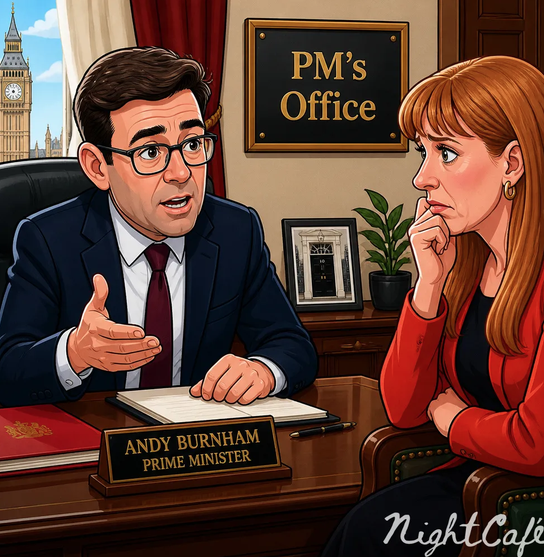
PM You say you're worried about the reaction in Surrey to council reorganisation. How many Labour MPs does Surrey elect? Angela Rayner: None, ever. PM Next item!










Recent Comments