- Stay Connected

Socialize

 Abraham Lincoln
If given the truth, the people can be depended upon to meet any national crisis...
Abraham Lincoln
If given the truth, the people can be depended upon to meet any national crisis...

 Guildford news...
for Guildford people, brought to you by Guildford reporters - Guildford's own news service
Guildford news...
for Guildford people, brought to you by Guildford reporters - Guildford's own news service
Dragon Interview: Greenham Common – “It’s Like Nothing That’s Ever Happened Before”
Published on: 20 Apr, 2026
Updated on: 20 Apr, 2026
By Esme Campbell
Ten miles south of Guildford, on the slopes of Hascombe Hill, there is a standing stone circle. It was built by hand using 19 stones from Dorset, each weighing about nine tonnes and secured seven feet in the ground.
Deep markings decorate some of them, although the patterns aren’t anything symbolic, but rather a result of forklift truck handling at the quarry they came from – because this monument is less than 30 years old. And the person who built it is sitting in front of me.
“It’s the biggest stone circle by hand since Stonehenge,” Surrey-born novelist, activist and anarchist Eleanor Anstruther tells me. “It’s amazing, it’s become a landmark now.”
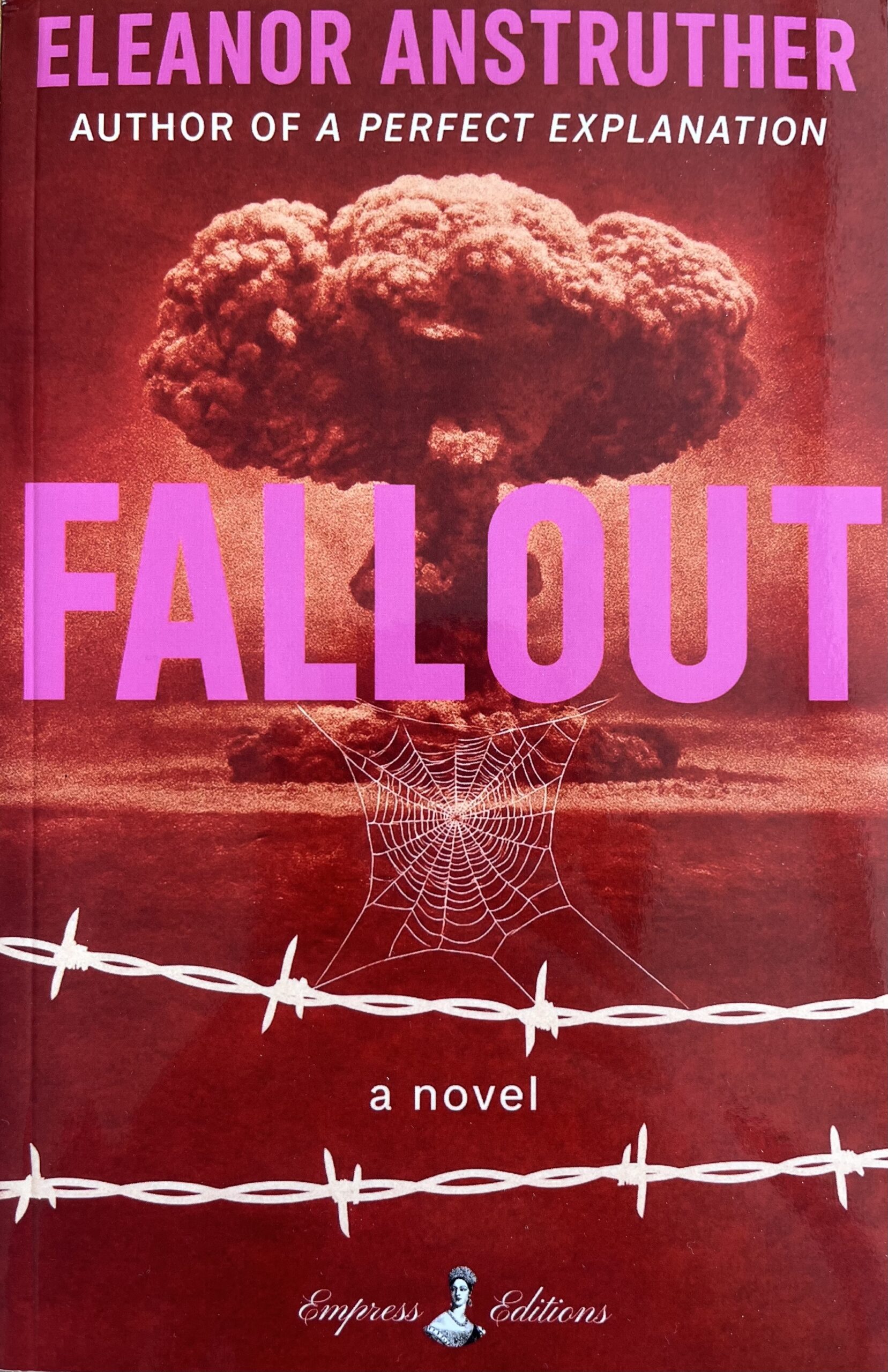
 Eleanor sits opposite me in Frida’s Coffee House while we talk about her newest book, ‘Fallout’. It’s the first fictionalisation of Greenham Common Women’s Peace Camp, one of the largest-scale examples of communal living, which, as it turns out, Eleanor has some experience in too.
“When we first started building the stone circle, we had 500 people living on that hill for a month,” she says. It was made by the commune that lived there in the mid-1990s, set up by Eleanor on the farmland she inherited.
“We lived there for four years,” she says, wistfully. “I knew a load of Pagans and Wickans and Hippies and we were all just living out on the edges. We were coalescing around the idea of ‘Let’s find out if communes work.’”
I ask Eleanor what the conclusion was. “They’re really intense,” she laughs, head in her hands. “We had some really crazy people and some really brilliant people. But the majority were just amazing people who wanted to live off-grid. Kids were born there and people got married there and people died there.”
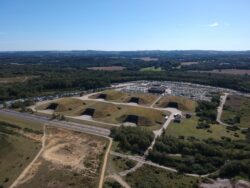
Greenham Common missile shelters 2019. Matthew Prior via Wikimedia.
The commune received push-back from the council when they began building the stone circle, but refused to play by the rules of a system they weren’t living in, Eleanor tells me.
Now, the Dragonstones circle is listed as a landmark on the council’s website. “If you ask for permission, you’re already in the system. Because we didn’t ask if we could, they didn’t know how to stop us,” Eleanor explains.
“That’s what Greenham women did. Had they accepted the premise of the system they were fighting, they would have been in that system. And the system, just like every Dickens novel will show you, will crush you. You will never get through it.”
Nuclear politics and Nando’s
Eleanor’s novel ‘Fallout’ follows the story of 15-year-old Bridget, naive, indifferent and exasperated by her dad’s attempts to convert the downstairs loo into a nuclear shelter, until her art teacher takes her to the women’s peace camp at Greenham Common. Stunned by what she finds there and the women she meets, Bridget’s view of the world unravels.
It’s a sentiment that’s born of Eleanor’s own experience. Although she never went to Greenham, her participation in various protests and marches throughout her life helped shape this narrative – as well as years at the dinner table with a socialist mother and Tory father.
“My outrage and passion underscore all of it,” Eleanor says. “Bridget turns up completely ignorant. Then, what always happens when you’re 15, you suddenly feel as if you’re the first person to discover politics. Then you become incredibly idealistic, and you can’t understand how people can carry on going to Nando’s when there’s a war on.
“I remember being that person,” she continues. “That feeling of becoming politicised, and being part of something, and believing in something.”
But the monumental protest has a crumbling legacy, as Eleanor discovered when she visited the peace camp in 2022 – or what’s left of it. The once-vibrant camp now consists of the gatepost of Blue Gate, standing in the woods like a painted Ozymandius, and a small memorial garden for a woman who died at Greenham. “It was heartening, and sad and touching,” Eleanor said. “It was this epic battle, and it’s buried under brambles.”
Nothing beside remains
Those brambles are the reason Eleanor wrote ‘Fallout’. It’s the first thing she tells me when we sit down with our coffee, and a point we keep returning to. The limited literature, media and overall attention given to Greenham was something Eleanor discovered in her research of the 19-year protest, and while her admiration grew with the more she learnt, so did her indignation.
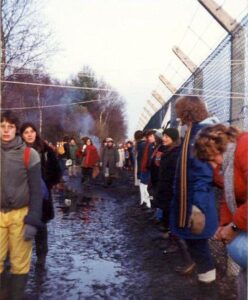
Embrace the Base protest, Greenham Common, 1982. Creativecommons
“Nobody who wasn’t at Greenham has written about Greenham. It’s a glaring omission. What’s going on there? … I feel so angry that the incredible achievement of these women has been brushed aside. It’s an outrage. So, I wrote this to put that right – my effort, my radical act was to put that right.”
Researching the peace camp also shifted Eleanor’s political outlook, she explains, and left her with a more favourable view of human nature. “I’d never have called myself an anarchist before, but I do now. In the true sense of the word, which is a complete belief in the goodness of human beings.
“You see it in every single global disaster that happens, we don’t become ransacking nightmares, we ask ‘Can I help?’ That’s what we do, and that’s what Greenham was. They coalesced and created this place where everybody was welcome, not everybody agreed – you didn’t have to – and everyone looked after each other.”
Could Greenham happen again?
On the subject of tolerating disagreement, I’m keen to find out whether Eleanor believes something like Greenham Common could happen in today’s quarrelling climate.
“I don’t think it could,” Eleanor responds simply. “One of the most incredible things about Greenham is that, for 19 years, ideologies crept in, but Greenham was just an idea. There was an enormous amount of dispute among the women, but no amount of argument meant you weren’t allowed to belong there…
“Now, with our thinking which is so fixed and polarised, it would quickly become an ideology rather than an idea.”
The prospect of comfortably cohabiting in disagreement may seem unlikely to Eleanor, but she remains hopeful about humanity’s potential to unite. “The ability to really come together and to come up with brilliant ideas, that is alive and kicking,” she says.
After all, Eleanor knows what it means for a group of people to come together and achieve something. The evidence is standing on a hill in Surrey.
Share This Post




I'm living well for nothing at all! (See: No Trifling Matter: Magpie Trapped in Godalming Sainsbury’s)




Next stop, Debt Chasm! (See: We Should All Be Outraged About the Failure to Deal with Legacy Debt)





Recent Comments